
1. Introduction
This manual provides detailed instructions for the installation, operation, and maintenance of your Sanpyl Bluetooth MP3 Decoder Board. Please read this manual thoroughly before using the product to ensure proper function and to prevent damage.
2. Safety Information
- Ensure the power supply voltage matches the product's specifications (DC 7V-12V or Micro USB 5V). Incorrect voltage can cause damage.
- Do not expose the device to moisture, rain, or extreme temperatures.
- Avoid disassembling or modifying the device, as this may void the warranty and pose safety risks.
- Keep out of reach of children.
- Disconnect power before making any connections or disconnections.
3. Package Contents
Verify that all items are present in the package:
- 1 x Sanpyl Bluetooth MP3 Decoder Board
- 1 x Remote Control
- 1 x 2-pin Power Cable
- 2 x 3-pin Audio Cables
4. Product Overview
The Sanpyl Bluetooth MP3 Decoder Board is a versatile audio module designed for integrating music playback and FM radio capabilities into various projects. It supports multiple audio sources including USB drives, SD/MMC cards, Bluetooth, and external line-in. It also features hands-free calling and comes with a remote control for convenient operation.
4.1 Front Panel Layout

Figure 4.1: Front panel of the decoder board. This view shows the digital display, USB port, SD/MMC card slot, and control buttons for playback, volume, and mode selection.
- Digital Display: Shows current mode, track number, frequency, etc.
- USB Port: For connecting USB flash drives.
- SD/MMC Card Slot: For inserting Secure Digital or MultiMediaCards.
- Control Buttons: Play/Pause, Volume Up/Next Track, Volume Down/Previous Track, Mode.
4.2 Rear Connections

Figure 4.2: Rear connections of the decoder board. This image highlights the various input and output terminals for power, audio, and the FM antenna.
- DC 12V+ / GND: Main power input (7V-12V DC).
- Micro USB 5V Input: Alternative 5V power input.
- L IN / R IN / GND: Stereo audio line input.
- L Output / R Output / GND: Stereo audio line output.
- FM Antenna: Connection point for an external FM antenna.
4.3 Dimensions
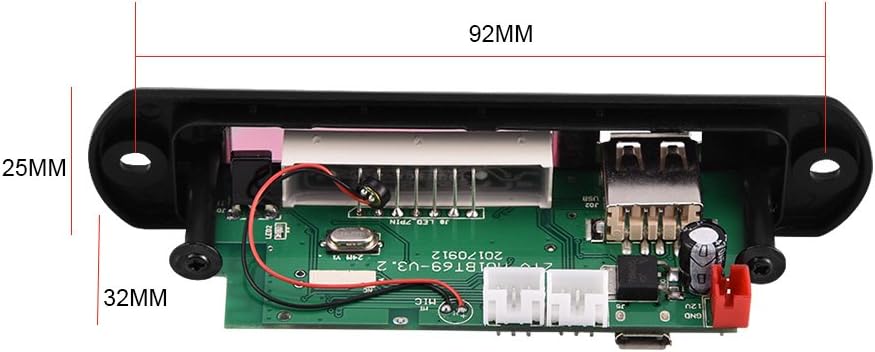
Figure 4.3: Physical dimensions of the decoder board. The panel length is 107mm, height is 25mm, and depth is 32mm. The mounting hole spacing is 92mm.
5. Specifications
| Model Number | Sanpylcw78yrodhs |
| Operating Voltage | DC 7V to 12V (main), Micro USB 5V (alternative) |
| Operating Current | 800mA to 1A |
| Panel Dimensions (L x H x D) | 107mm x 25mm x 32mm |
| Mounting Hole Spacing | 92mm |
| Screen Size | 45mm x 8mm |
| Supported Media | USB Disk, SD Card, MMC Card |
| Connectivity | Bluetooth, FM Radio, Line-in (AUX) |
| Features | Hands-free calls, Multiple EQ modes, Mute function, Digital display |
| Item Weight | 2.08 ounces (approx. 59g) |
6. Setup
6.1 Power Connection
The decoder board can be powered in two ways:
- DC 7V-12V: Connect the provided 2-pin power cable to the "DC 12V+" and "GND" terminals on the rear of the board (refer to Figure 4.2). Ensure correct polarity.
- Micro USB 5V: Alternatively, connect a standard Micro USB cable to the "Micro USB 5V Input" port. This is suitable for 5V power sources.
Caution: Do not connect both 12V DC and Micro USB 5V power simultaneously. Choose one power source.
6.2 Audio Connections
- Audio Output: Use the provided 3-pin audio cables to connect the "L Output", "R Output", and "GND" terminals to your amplifier or active speakers.
- Audio Input (AUX): If you wish to use an external audio source (e.g., phone, computer), connect it to the "L IN", "R IN", and "GND" terminals. You will need to switch the mode to "LIN" for this input.
6.3 FM Antenna Connection
Connect a suitable FM antenna to the "FM Antenna" terminal for optimal radio reception (refer to Figure 4.2).
7. Operating Instructions
7.1 Power On / Automatic Playback
Once powered on, the decoder board will automatically start playing music if a USB disk, SD card, or MMC card is inserted. If no media is present, it will default to the last used mode.
7.2 Mode Selection
Press the MODE button on the front panel or remote control to cycle through available modes: USB, SD, Bluetooth, FM, and LIN (Line Input).
7.3 Bluetooth Pairing
- Switch the decoder board to Bluetooth mode. The display will show "BT".
- On your mobile device, search for Bluetooth devices.
- Select the device named M01BT.
- If prompted for a password, enter 0000.
- Once paired, you can play audio from your device through the decoder board.
7.4 USB / SD / MMC Card Playback
- Insert a USB flash drive into the USB port or an SD/MMC card into the card slot.
- The board will automatically switch to the corresponding mode (USB or SD) and begin playback.
- Use the Play/Pause, VOL- / Previous, and VOL+ / Next buttons to control playback.
7.5 FM Radio Operation
- Switch the decoder board to FM mode.
- Press and hold the Play/Pause button to initiate an automatic scan for FM stations. The board will save found stations.
- Use the VOL- / Previous and VOL+ / Next buttons to navigate between saved stations.
7.6 Hands-free Calling
When in Bluetooth mode and paired with a phone, the decoder board supports hands-free calling. Incoming calls can be answered or ended using the remote control or specific buttons on the board (refer to remote control diagram if available, or typically the Play/Pause button).
7.7 Remote Control Functions
The included remote control provides convenient access to various functions:
- Power: Turn the device on/off.
- Mode: Switch between USB, SD, Bluetooth, FM, LIN.
- Play/Pause: Start or pause playback. Answer/End calls.
- Previous/Next: Skip tracks or navigate FM stations.
- Volume Up/Down: Adjust audio volume.
- EQ: Cycle through various equalizer sound modes.
- Mute: Mute or unmute audio.
- Number Buttons: Direct track selection (in USB/SD mode) or FM frequency input.
8. Maintenance
- Clean the device with a soft, dry cloth. Do not use liquid cleaners or solvents.
- Keep the USB port and SD card slot free from dust and debris.
- Store the device in a cool, dry place when not in use for extended periods.
9. Troubleshooting
| Problem | Possible Cause | Solution |
|---|---|---|
| No power / Device not turning on. | Incorrect power connection; Insufficient voltage; Faulty power supply. | Check power cable connections and polarity. Ensure power supply is within 7V-12V DC or 5V Micro USB. Test with a different power source. |
| No sound output. | Volume too low; Mute function active; Incorrect audio output connection; Amplifier issue. | Increase volume. Press Mute button on remote. Verify audio output cables are correctly connected to amplifier/speakers. Test amplifier with another source. |
| Bluetooth not pairing. | Device not in Bluetooth mode; Incorrect pairing password; Distance too far; Interference. | Ensure decoder is in Bluetooth mode ("BT" on display). Re-enter password "0000". Move device closer. Reduce interference from other wireless devices. |
| USB/SD card not playing. | Card/drive not inserted correctly; Unsupported file format; Corrupted media. | Re-insert media. Ensure media contains supported audio files (e.g., MP3). Try a different USB drive or SD card. |
| Poor FM radio reception. | No antenna connected; Weak signal; Interference. | Connect an external FM antenna. Reposition the antenna for better signal. Perform an auto-scan again. |
10. Warranty and Support
Sanpyl products are designed for reliability and performance. For any issues or questions regarding your Bluetooth MP3 Decoder Board, please contact your retailer or Sanpyl customer support. Please retain your proof of purchase for warranty claims.
For further assistance, visit the Sanpyl Store on Amazon.