Bolton Technical Long Range Cellular Antenna User Manual
Model: BT974822-V2
Product Overview
The Bolton Technical Long Range Cellular Antenna is a high-gain outdoor antenna designed to enhance cellular signal for booster kits. It features a parabolic grid optimized for a wide frequency range, including LTE, 4G, 5G, GSM, WiFi, and other cellular bands. This antenna is particularly effective in rural areas with weak or no existing cell signal, extending reach to cell towers up to 20 miles away. It is compatible with various signal booster brands and hotspot devices.
Figure 1: Assembled Bolton Technical Long Range Cellular Antenna.
This image displays the fully assembled parabolic grid antenna, showcasing its large, curved reflector and the central feedhorn. The design is optimized for directional signal reception.
Setup and Installation
Proper setup is crucial for optimal performance. This antenna requires a signal booster amplifier for operation (not included). Tools required for assembly include a 10mm wrench, socket, or nut driver, or an adjustable wrench/pliers. Mount and cables are not included.
1. Unboxing and Component Identification
Upon opening the package, verify all components are present. The box contains the instruction guide, two grid reflectors, the feedhorn, and mounting hardware.
Figure 2: Unboxed components including the feedhorn, parabolic grid sections, and mounting kit.
This image illustrates the main components of the antenna as they appear when unboxed: the feedhorn with its attached N-Female connector, the two halves of the parabolic grid, and the mounting hardware (L-bracket, U-bolts, nuts, and washers).
3. Grid Assembly
Assemble the two grid reflector halves by aligning the tabs and securing them with the provided screws. Ensure a snug fit for structural integrity.
Figure 3: Close-up of hands assembling the two halves of the parabolic grid reflector.
This image illustrates the process of joining the two grid halves, showing how the small tabs interlock and are secured with screws, forming the complete parabolic shape.
3. Feedhorn and Mounting Bracket Attachment
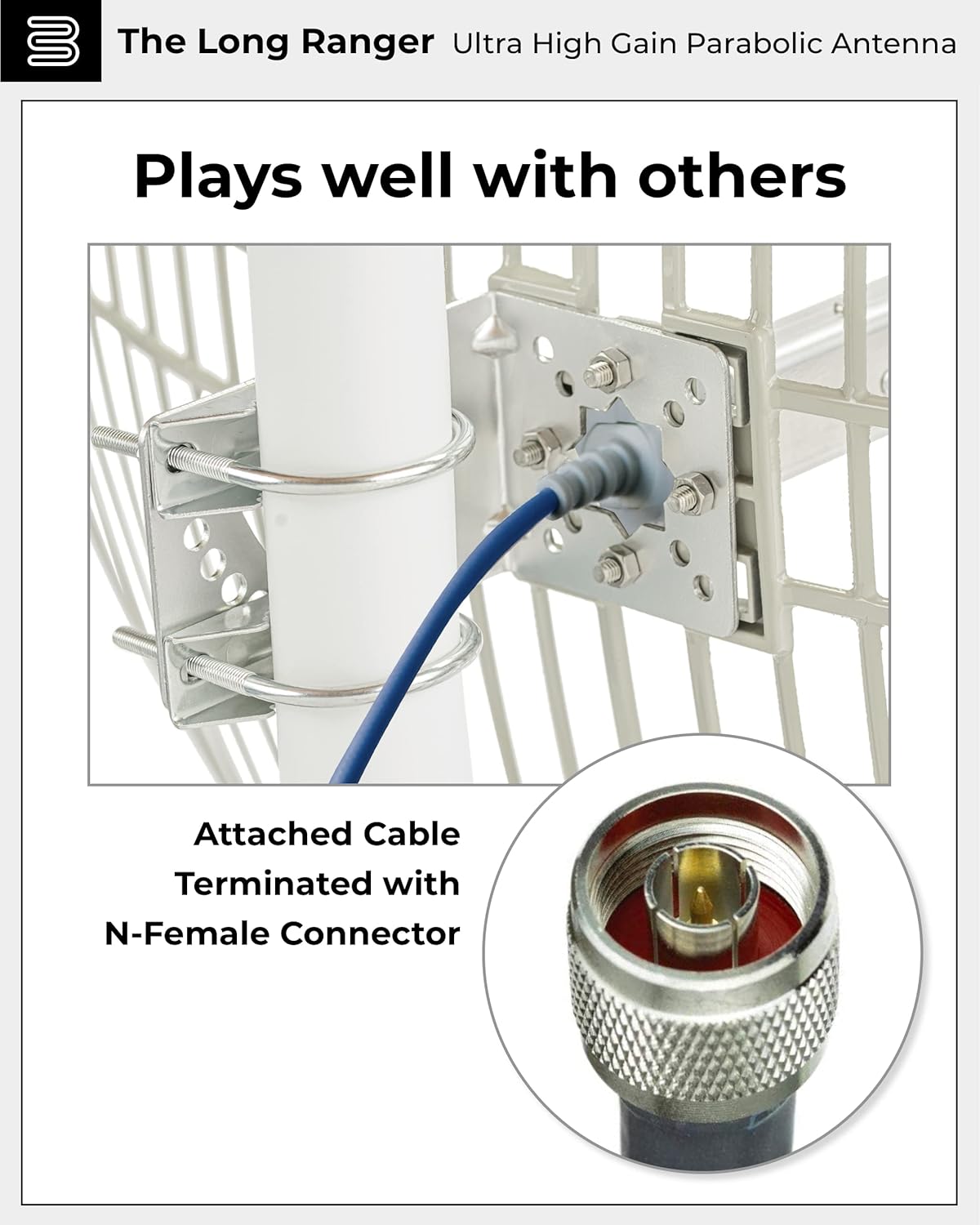
Attach the feedhorn to the assembled grid. The L-bracket and U-bolts are used to secure the antenna to a mast or pole (not included). The L-bracket is versatile and can be mounted on various surfaces.
Figure 4: Detail of the N-Female connector on the antenna's feedhorn.
This image provides a close-up view of the N-Female connector located at the end of the feedhorn's cable, highlighting its robust design for secure cable attachment.
Video 1: Unboxing and Testing the Bolton Technical Long Ranger Parabolic Antenna.
This video provides a comprehensive guide to unboxing, assembling, and testing the Bolton Technical Long Ranger Parabolic Antenna. It demonstrates the physical assembly steps and shows real-world signal testing scenarios, including connecting to a signal meter and a 4G LTE router to illustrate performance improvements in low-signal areas.
Operating Principles
The Long Range Cellular Antenna is a highly directional antenna. Its narrow radiation pattern (approximately 10 degrees) allows for precise aiming towards a distant cell tower, maximizing signal gain. This is unlike typical yagi antennas which have a wider 45-degree pattern. Due to its high directionality, careful aiming is essential for achieving optimal signal strength.
Figure 5: The antenna works effectively with cellular signal boosters and cellular Wi-Fi routers.
This diagram illustrates how the Long Range Cellular Antenna integrates into a system, connecting to either a cellular signal booster or a cellular Wi-Fi router to improve signal reception and distribution within a building or area.
Maintenance
The antenna is designed to be weatherproof. Regular visual inspections are recommended to ensure the mounting hardware remains secure and the antenna is free from physical damage or obstructions. Clean the parabolic grid periodically to prevent signal degradation from dirt or debris buildup.
Troubleshooting
No Signal Improvement: Ensure the antenna is precisely aimed at the nearest or strongest cell tower. Even small adjustments can significantly impact performance due to its narrow beamwidth. Use a signal meter or a cell phone's field test mode to find the optimal direction.
Intermittent Signal: Check all cable connections for tightness and proper seating. Ensure the LMR cable is not damaged. Verify that the signal booster is functioning correctly.
Physical Instability: Re-tighten all mounting hardware. Ensure the mast or pole is sturdy and properly secured to withstand environmental conditions.
Compatibility Issues: Confirm that your signal booster or hotspot device is compatible with external antennas and supports the frequency bands covered by this antenna (600 MHz to 6500 MHz).
Figure 6: Visual representation of antenna technical specifications.
This image provides a visual summary of the antenna's technical specifications, including its dimensions, weight, impedance, connector type, maximum input power, front-to-back ratio, VSWR, and lightning protection.
Warranty and Support
For warranty information, technical support, or any inquiries regarding your Bolton Technical Long Range Cellular Antenna, please visit the official Bolton Technical website or contact their customer service. Details can typically be found on the product packaging or the manufacturer's website.
Bolton Technical N-Type Whip Antenna BT151632 - 2.5mm DC Plug Specifications Comprehensive technical specifications for the Bolton Technical N-Type Whip Antenna, model BT151632. This antenna features a 2.5mm DC plug, N-Male connector, 50 Ohm impedance, +5dB gain, and supports wide band 2G, 3G, and 4G LTE frequencies from 698 to 2700 MHz.
Bolton Technical LPDA-92 Wideband Log-Periodic Antenna | 11dB Gain Discover the Bolton Technical LPDA-92, a futureproof wideband log-periodic dipole array antenna offering 11dB gain and 100W max power. Ideal for extreme weather and enhancing 3G/4G LTE signals indoors.
Bolton Technical BT684250 Sector High Gain Outdoor Panel Antenna Specifications Detailed specifications for the Bolton Technical BT684250 Sector High Gain Outdoor Panel Antenna, covering electrical and mechanical properties, frequency range, gain, polarization, and radiation patterns for robust outdoor signal connectivity.