
Introduction
This manual provides essential information for the safe installation, operation, and maintenance of your Lithonia Lighting Basics LED Emergency Light (Model EU2C M6). Please read these instructions thoroughly before installation and retain them for future reference. This emergency light is designed to provide reliable illumination during power outages in commercial and industrial settings.
Important Safety Instructions
When using electrical equipment, basic safety precautions should always be followed, including the following:
- Read and follow all safety instructions.
- Do not use outdoors.
- Do not mount near gas or electric heaters.
- Equipment should be mounted in locations and at heights where it will not be readily subjected to tampering by unauthorized personnel.
- The use of accessory equipment not recommended by the manufacturer may cause an unsafe condition.
- Do not use this equipment for other than its intended use.
- Servicing of this equipment should be performed by qualified service personnel only.
- Disconnect AC power before servicing.
Package Contents
Verify that all components are present before beginning installation:
- LED Emergency Light Fixture
- LED Lens
- Mounting Hardware
- Rechargeable Battery (pre-installed)
Setup and Installation
The Lithonia Lighting Basics LED Emergency Light is designed for wall-mount installation only, compatible with universal J-box setups. Ensure all local and national electrical codes are followed during installation.
Mounting Location and Spacing
For optimal performance and code compliance, mount the fixture no higher than 8 feet from the floor. For adequate illumination along a 3-foot path of egress, fixtures should be spaced no farther apart than 14 feet. For a 6-foot path of egress, spacing should not exceed 11 feet. Always consult NFPA 101 Life Safety Code and local building codes for specific requirements.

Image: The Lithonia Lighting Basics LED Emergency Light, showing its dual adjustable LED lamp heads and compact design. This unit is ideal for small spaces and provides reliable emergency lighting.
Wiring Instructions
The unit operates on either 120V or 277V AC input. Connect the appropriate power supply wires to the fixture's wiring. The internal rechargeable nickel-cadmium battery is typically pre-installed and connected. Ensure all connections are secure and insulated.
Video: This video provides an overview of the Lithonia Lighting EU2C Emergency Light, demonstrating its features and suitability for various applications. It highlights the compact design and adjustable lamp heads.
Video: This video offers a detailed product overview of emergency lighting, including discussions on code requirements, illumination standards, and proper fixture spacing to ensure life safety compliance. It compares different product families and their applications.
Initial Battery Charge
After installation and connecting to AC power, allow the unit to charge for a minimum of 24 hours to ensure the battery is fully charged and ready for emergency operation. The status indicator light will typically be green when charging and fully charged.
Operating Instructions
The Lithonia Lighting Basics LED Emergency Light operates automatically.
Normal Operation
When AC power is present, the unit's battery will be charging, and the status indicator light will be illuminated (typically green). The LED lamp heads will remain off.
Emergency Operation
Upon loss of AC power, the unit will automatically switch to battery backup mode, and the LED lamp heads will illuminate. The unit provides a minimum of 90 minutes of illumination during a power outage.
Test Switch and Status Indicator
A test switch is located on the front of the unit. Pressing this switch simulates a power outage, causing the LED lamp heads to illuminate, allowing for manual verification of battery and lamp functionality. The status indicator light provides visual confirmation of the unit's operational status (e.g., charging, fully charged, fault).
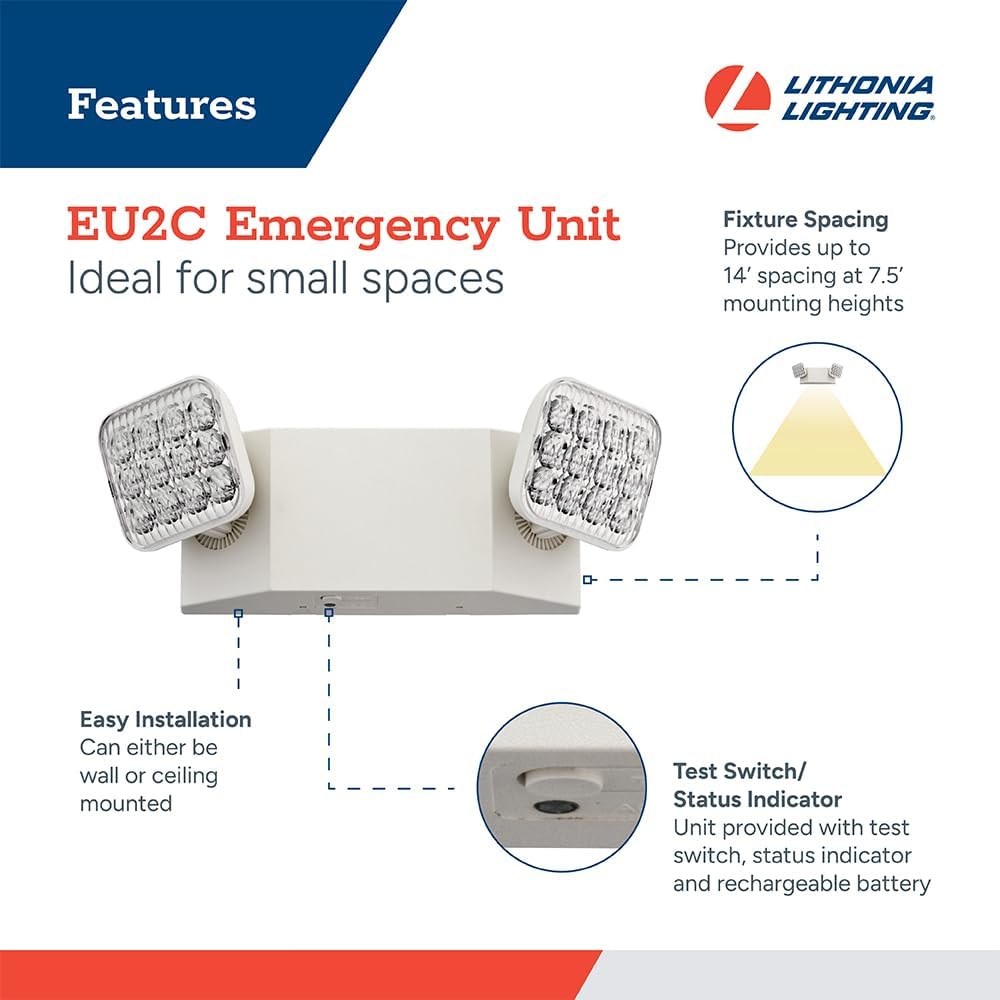
Image: A close-up view of the emergency light, highlighting the test switch and the status indicator light. These features allow for easy manual testing and provide visual feedback on the unit's operational state.
Maintenance
Regular maintenance ensures the continued reliability of your emergency light.
Routine Testing
Perform a monthly 30-second test by pressing the test switch. The LED lamp heads should illuminate. Conduct an annual 90-minute discharge test to ensure the battery provides the required backup duration. Self-diagnostic models perform these tests automatically and indicate any faults.
Battery Care
The unit uses a long-lasting, maintenance-free nickel-cadmium battery. While designed for durability, batteries have a finite lifespan. If the unit fails to provide 90 minutes of illumination during an annual test after a full 24-hour charge, the battery may need replacement. Contact qualified service personnel for battery replacement.
Cleaning
Clean the exterior of the unit and lamp heads periodically with a soft, damp cloth. Do not use abrasive cleaners or solvents.
Troubleshooting
| Problem | Possible Cause | Solution |
|---|---|---|
| LED lamp heads do not illuminate during power outage or test. | No AC power, discharged battery, faulty battery, faulty lamp heads. | Verify AC power. Allow 24-hour charge. Test battery. Replace battery or unit if necessary. |
| Status indicator light is off or red. | No AC power, battery fault, unit fault. | Verify AC power. Allow 24-hour charge. If fault persists, contact service personnel. |
| Short emergency run time. | Battery not fully charged, aging battery. | Ensure 24-hour charge. Replace battery if run time remains short. |
For issues not resolved by the above steps, contact qualified service personnel.
Specifications
- Model: EU2C M6
- Brand: Lithonia Lighting
- Dimensions: 10-1/8" W x 5-3/8" H x 3-3/4" D (25.7cm W x 13.7cm H x 9.5cm D)
- Power Source: 120V/277V AC, 50/60Hz input; Internal rechargeable Nickel-Cadmium battery
- Light Output: Dual adjustable 1W LED lamp heads, 5000K-9000K CCT, 90 Lumens
- Emergency Run Time: Minimum 90 minutes
- Construction: Injection-molded, flame-retardant thermoplastic housing
- Mounting: Wall-mount only, universal J-box compatibility
- Operating Temperature: 50°F–104°F (10°C–40°C)
- Certifications: UL Listed, NFPA 101, OSHA, FCC, NEC, CEC Title 20 compliant

Image: A diagram illustrating the dimensions of the Lithonia Lighting Basics LED Emergency Light, providing measurements for width, height, and depth for installation planning.
Warranty
This Lithonia Lighting product is covered by a 2-year limited warranty. For full warranty details, please refer to the documentation included with your product or visit the manufacturer's website.
Support
For technical assistance, troubleshooting, or warranty claims, please contact Lithonia Lighting customer support. Contact information can typically be found on the product packaging or the official Lithonia Lighting website.


