
1. Introduction
This manual provides detailed instructions for the installation, operation, and maintenance of your EBTOOLS 12V/24V 50A Solar Charge Controller. This intelligent regulator is designed to manage power flow from your solar panel to your battery and load, ensuring efficient and safe charging. It features dual USB ports, PWM/MPPT auto-parameter adjustment, and an LCD display for monitoring system status.
2. Safety Information
Please read all instructions carefully before installation and operation. Failure to follow these instructions may result in damage to the controller, battery, or other components, and may cause personal injury.
- Ensure all connections are correct and secure before applying power.
- Connect the battery first, then the solar panel, and finally the load. Disconnect in the reverse order.
- Do not connect the solar panel to the AC power supply.
- The controller is designed for indoor use. Avoid exposure to direct sunlight, high temperatures, and moisture.
- Ensure adequate ventilation around the controller.
- Use appropriate wire gauges for all connections to prevent overheating.
- This device is not a toy. Keep out of reach of children.
3. Product Overview
The EBTOOLS Solar Charge Controller integrates advanced charging technology to optimize battery life and system performance. Key components include the LCD display, control buttons, connection terminals, and USB output ports.
3.1 Front Panel
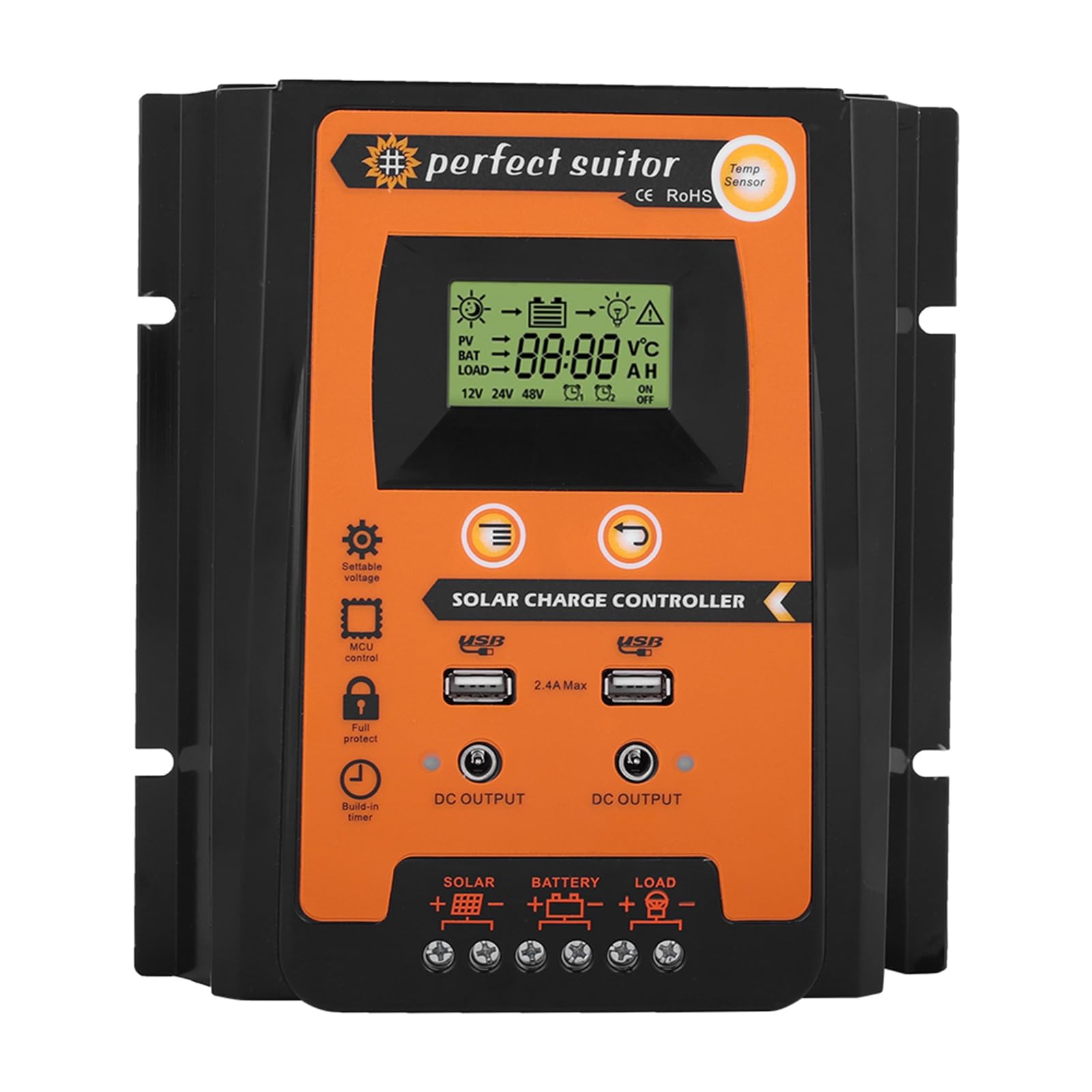
Figure 3.1: Front view of the EBTOOLS Solar Charge Controller. This image displays the LCD screen, control buttons, dual USB output ports, and indicators for solar, battery, and load connections.
3.2 Rear Panel

Figure 3.2: Rear view of the EBTOOLS Solar Charge Controller. The rear panel features heat sink fins for efficient heat dissipation.
3.3 Dimensions

Figure 3.3: Dimensions of the EBTOOLS Solar Charge Controller. The unit measures approximately 21cm (8.3 inches) in length, 19.2cm (7.6 inches) in width, and 5.5cm (2.2 inches) in height.
4. Setup and Installation
Follow these steps for proper installation of the solar charge controller. Ensure all power sources are disconnected before making any connections.
4.1 Connection Sequence
- Connect the Battery: Connect the battery to the controller's battery terminals (+ and -). The LCD display will light up.
- Connect the Solar Panel: Connect the solar panel to the controller's solar panel terminals (+ and -).
- Connect the Load: Connect the load to the controller's load terminals (+ and -).
Important: Always connect the battery first, then the solar panel, and finally the load. Disconnect in the reverse order: load, then solar panel, then battery.

Figure 4.1: Controller Connection Method. This diagram illustrates the correct wiring sequence from the solar panel to the controller, then to the battery, and finally to the load.
4.2 Mounting
Mount the controller on a vertical surface in a well-ventilated area, away from direct sunlight, high temperatures, and moisture. Ensure there is sufficient space around the controller for air circulation.
5. Operating Instructions
The controller automatically detects 12V or 24V system voltage. The LCD display provides real-time information about your solar system.
5.1 LCD Display
The LCD displays various parameters including battery voltage, solar panel voltage, load current, battery charge status, and error codes.
5.2 Control Buttons
- Menu Button: Press to cycle through display modes and enter setting menus.
- Up/Down Buttons: Used to adjust parameters within the setting menus.
- Enter Button: Confirms selections and saves settings.
5.3 USB Output
The dual USB ports provide a 5V/2.4A output for charging mobile devices. These ports are active when the controller is powered.
6. Maintenance
Regular maintenance ensures optimal performance and longevity of your solar charge controller.
- Check Connections: Periodically inspect all wiring connections for tightness and corrosion.
- Clean Controller: Keep the controller clean and free from dust and debris. Use a dry cloth for cleaning.
- Ventilation: Ensure that the ventilation openings are not blocked.
- Battery Inspection: Regularly check the battery terminals for corrosion and ensure the battery is in good condition.
7. Troubleshooting
This section addresses common issues you might encounter with your solar charge controller.
| Problem | Possible Cause | Solution |
|---|---|---|
| LCD display is off | Battery not connected or low voltage | Check battery connections; charge battery if voltage is too low. |
| Battery not charging | Solar panel not connected, insufficient sunlight, or faulty panel/wiring | Check solar panel connections; ensure adequate sunlight; test solar panel output. |
| Load not working | Load not connected, overload, or battery low voltage protection | Check load connections; reduce load; charge battery. |
| Over-voltage protection | Battery voltage too high | Controller will automatically stop charging. Check battery health. |
8. Specifications
Technical specifications for the EBTOOLS 12V/24V 50A Solar Charge Controller.
| Feature | Detail |
|---|---|
| Model | PVSC50A |
| System Voltage | 12V/24V Auto-sensing |
| Rated Charge Current | 50A |
| Rated Discharge Current | 50A |
| Max Solar Input | Less than 50V |
| USB Output | Dual USB 5V/2.4A (Max) |
| Material | Plastic |
| Product Dimensions | 6.89 x 5.51 x 1.57 inches (17.5 x 14 x 4 cm) |
| Item Weight | 1.06 pounds (0.48 kg) |
9. Warranty and Support
EBTOOLS products are designed for reliability and performance. For warranty information or technical support, please refer to the documentation provided with your purchase or contact your retailer. Keep your purchase receipt for warranty claims.