
1. Introduction
The AMTAST AMR317 Digital 5-in-1 Refractometer is a precision instrument designed for accurately measuring the concentration and freezing points of various automotive fluids. This device is essential for maintaining vehicle performance and preventing damage due to extreme temperatures. It offers precise measurements, quick operation, and a compact, durable design.

This image shows the AMR317 refractometer in an automotive context, highlighting its application for testing diesel exhaust fluid (DEF) and other automotive liquids. The device features a waterproof design, one-button measurement, and automatic temperature compensation.
It can measure:
- Automotive Urea (AdBlue/DEF) concentration
- Ethylene Glycol (Coolant) freezing point
- Propylene Glycol (Coolant) freezing point
- Windshield Washer Fluid freezing point
- Urea Refractive Index
This manual provides detailed instructions for the proper setup, operation, and maintenance of your AMR317 refractometer to ensure accurate and reliable measurements.
2. Product Overview
Familiarize yourself with the components of your AMTAST AMR317 refractometer:
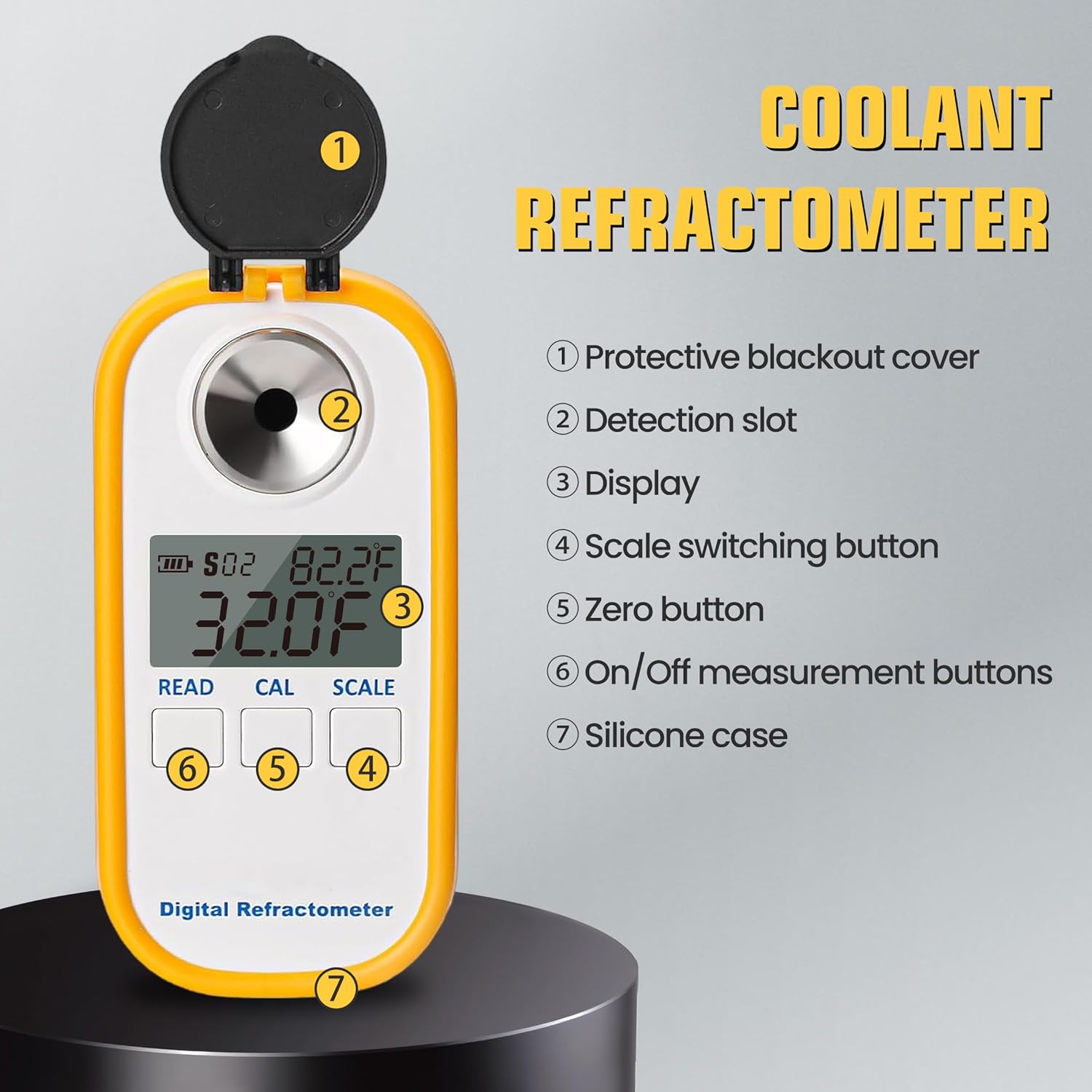
This image displays the AMTAST AMR317 Digital Refractometer with its key parts labeled for easy identification.
- Protective blackout cover
- Detection slot (prism)
- Display screen
- Scale switching button
- Zero button (Calibration)
- On/Off and Measurement buttons
- Silicone case
The device features a clear digital display for easy reading of measurements and an intuitive button layout for operation.
3. Setup
3.1 Battery Installation
The AMR317 refractometer requires one AAA alkaline battery (not included due to shipping regulations).
- Locate the battery compartment on the back of the device.
- Open the battery cover.
- Insert one AAA alkaline battery, ensuring correct polarity (+/-).
- Close the battery cover securely.

This image shows the rear of the AMR317 refractometer with the battery compartment open, illustrating where to insert the AAA battery.
3.2 Initial Calibration
Before first use and periodically thereafter, calibrate the device using distilled water to ensure accuracy.
- Ensure the prism (detection slot) is clean and dry.
- Apply a few drops of distilled water onto the prism.
- Close the protective blackout cover.
- Long press the "CAL" button until "CAL" blinks on the screen.
- Press the "CAL" button again. The screen will display "0.0%" after "END", indicating successful calibration.
- Clean the prism thoroughly with a soft cloth after calibration.
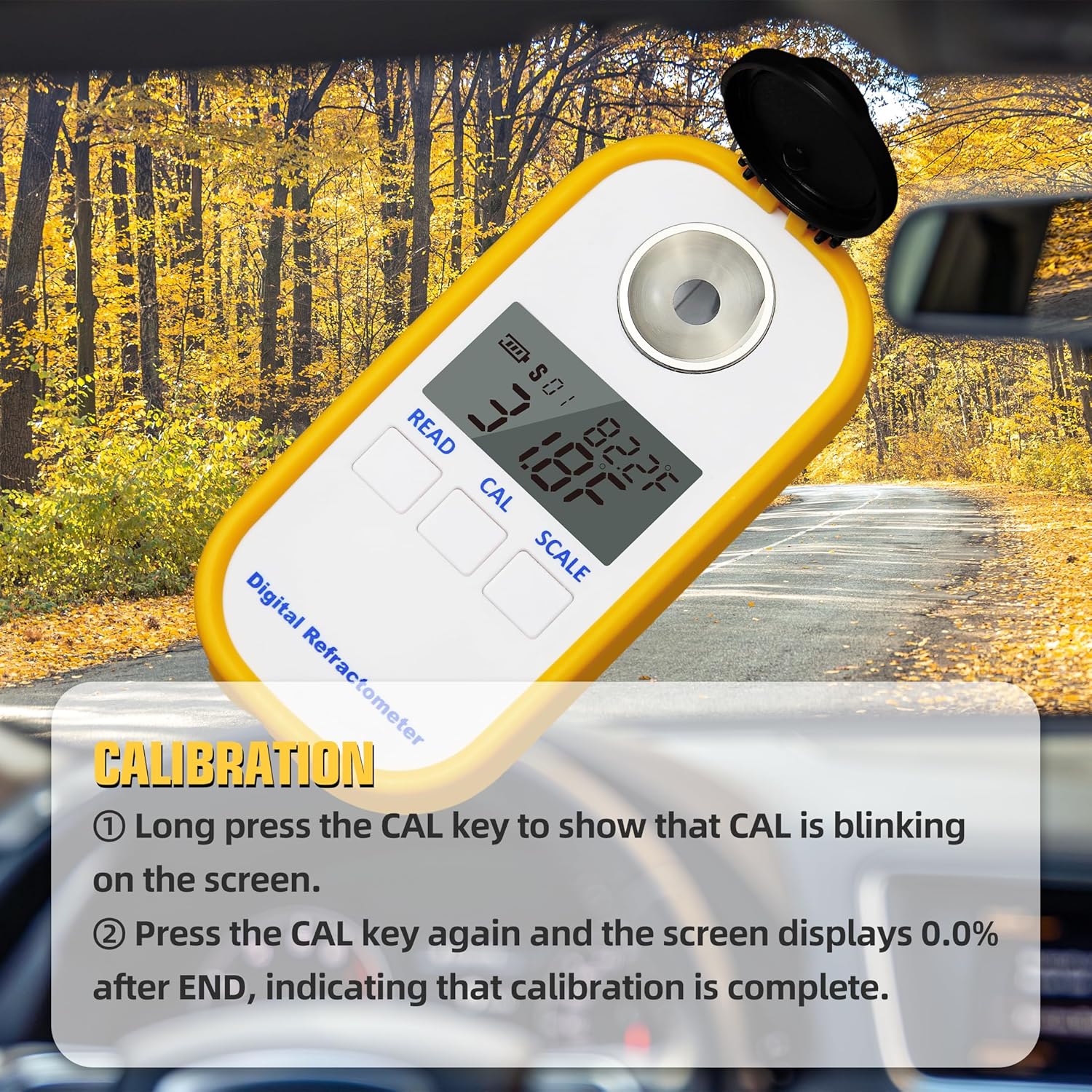
This image visually guides the user through the calibration process, showing the refractometer with distilled water on the prism and the "CAL" button being pressed.
4. Operating Instructions
Follow these steps for accurate measurement of various fluids:
- Ensure the prism and protective cover are clean and dry.
- Turn on the device by pressing the "READ" button.
- Press the "SCALE" button repeatedly to cycle through the available measurement scales (S01 to S05) until the desired scale is displayed.
- Apply 2-3 drops of the sample liquid onto the prism.
- Close the protective blackout cover to prevent light interference.
- Press the "READ" button. The measurement will be displayed on the screen within 2 seconds.
- Record the reading.
- Clean the prism thoroughly with a soft, damp cloth immediately after each measurement to prevent residue buildup.
4.1 Measurement Scales
The AMR317 offers five distinct measurement scales:
| Scale ID | Fluid Type | Range | Resolution | Accuracy |
|---|---|---|---|---|
| S01 | Window Cleaner | -60 ~ 0°C (-76 ~ 32°F) | 0.1°C | ±0.5°C |
| S02 | Ethylene Glycol | -50 ~ 0°C (-58 ~ 32°F) | 0.1°C | ±0.5°C |
| S03 | Propylene Glycol | -50 ~ 0°C (-58 ~ 32°F) | 0.1°C | ±0.5°C |
| S04 | Urea (NH2)2CO (AdBlue/DEF) | 0 - 51.0% | 0.001 | ±0.005 |
| S05 | Urea Refractive Index | 1.3330 - 1.4200 nD | 0.0001 nD | N/A |

This image illustrates the various fluid types and their respective measurement ranges that the AMR317 refractometer can analyze, including Window Cleaner, Ethylene Glycol, Propylene Glycol, Urea (AdBlue/DEF), and Urea Refractive Index.
5. Maintenance
- Cleaning: Always clean the prism and protective cover immediately after each use with a soft, damp cloth. Do not use abrasive cleaners or solvents.
- Storage: Store the refractometer in its protective case in a cool, dry place, away from direct sunlight and extreme temperatures. The compact and durable design ensures it can withstand tough conditions.
- Battery Replacement: Replace the AAA battery when the low battery indicator appears on the display.
- Avoid Immersion: The device is designed to be splash-proof but should not be immersed in water or other liquids.

The refractometer should be stored in its provided protective case when not in use to ensure its longevity and accuracy.
6. Troubleshooting
- Inaccurate Readings:
- Ensure the prism is clean and dry before applying the sample.
- Recalibrate the device using distilled water.
- Ensure the sample liquid completely covers the prism surface.
- Verify that the correct measurement scale (S01-S05) is selected for the fluid being tested.
- Display Not Turning On:
- Check if the battery is correctly installed with proper polarity.
- Replace the AAA battery with a new one.
- "CAL" Error Message:
- Ensure distilled water is used for calibration.
- Verify the prism is clean and dry before applying distilled water for calibration.
- Repeat the calibration process carefully.
7. Specifications
| Feature | Detail |
|---|---|
| Model Number | AMR317 |
| Power Source | 1 x AAA Alkaline Battery |
| Automatic Shutdown | Yes (after 1 minute of inactivity) |
| Temperature Compensation | Automatic |
| Dimensions | 6.85 x 4.41 x 1.81 inches |
| Weight | 11.39 ounces |
| Date First Available | September 14, 2018 |
Note: Refer to Section 4.1 for detailed measurement scale specifications.
8. Warranty and Support
For warranty information or technical support, please contact AMTAST customer service. Keep your purchase receipt as proof of purchase.
Manufacturer: AMTAST
For further assistance, visit the official AMTAST website or contact their support channels.