
1. Introduction
This manual provides comprehensive instructions for the installation, operation, and maintenance of your StarTech.com 4-Port Dual DisplayPort KVM Switch (SV431DPDDUA2). This device allows you to control up to four computers, each with dual DisplayPort outputs, from a single console consisting of two DisplayPort monitors, a USB keyboard, a USB mouse, and audio peripherals. It supports resolutions up to 4K at 60Hz, making it suitable for demanding multimedia and professional applications.
2. What's in the Box
- 1x SV431DPDDUA2 KVM Switch
- 1x Universal Power Adapter (NA/JP, EU, UK, ANZ)
- 1x Quick Start Guide
- 4x Rubber Feet

3. Product Features
- Dual Monitor Support: Connects two DisplayPort monitors to a single console.
- High Resolutions: Supports dual 4K (3840x2160) resolution at 60Hz.
- 4-Port KVM: Control up to four computers from one workstation.
- Peripheral Sharing: Features separate 3.5 mm microphone and speaker ports, and two USB ports for sharing peripherals independently of the keyboard and mouse.
- Versatile Functionality: Ideal for graphic design, video editing, CAD drawing, and other high-bandwidth applications.
- TAA Compliant: Meets Trade Agreements Act requirements.
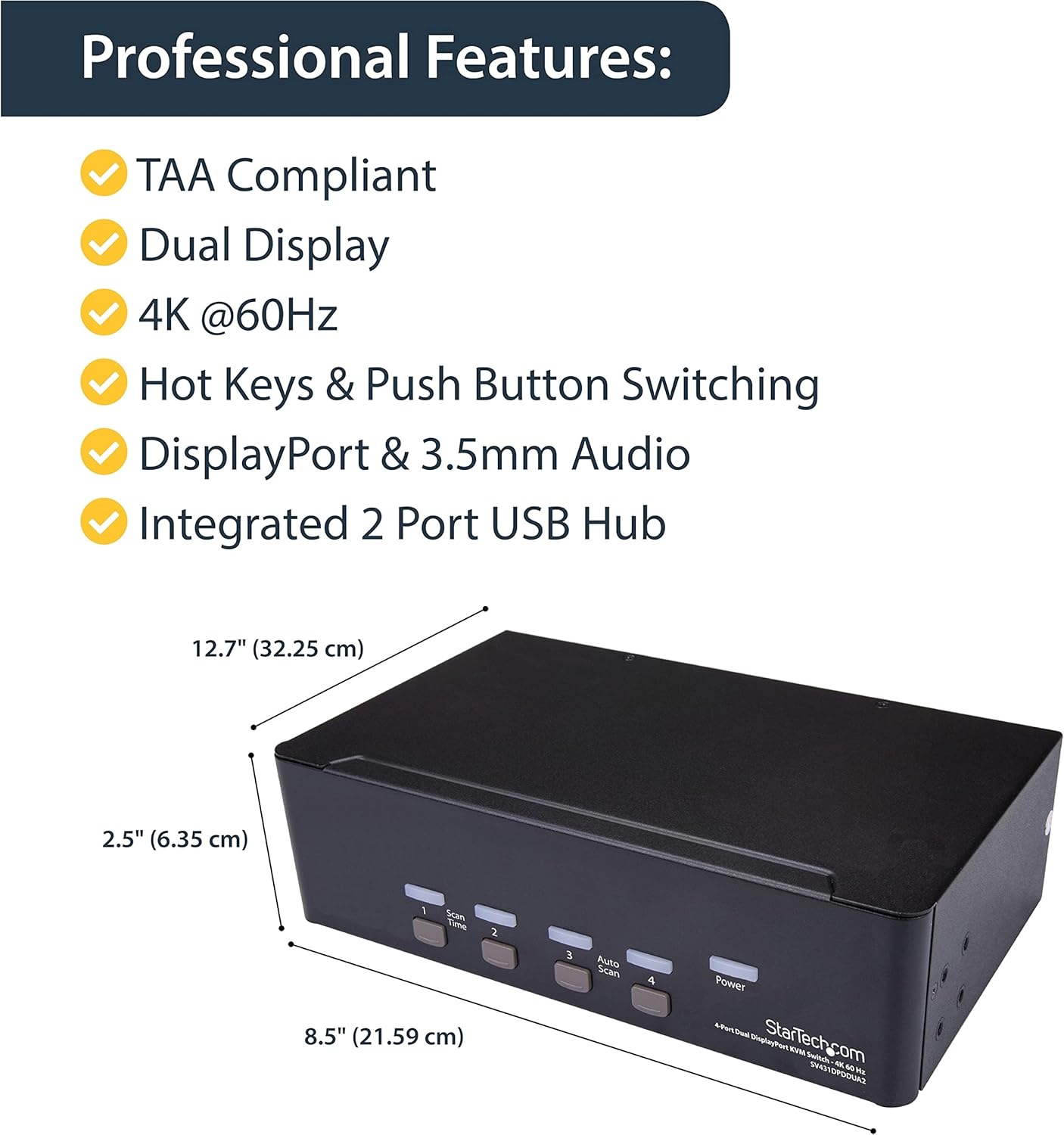
4. Product Overview
4.1 Front Panel

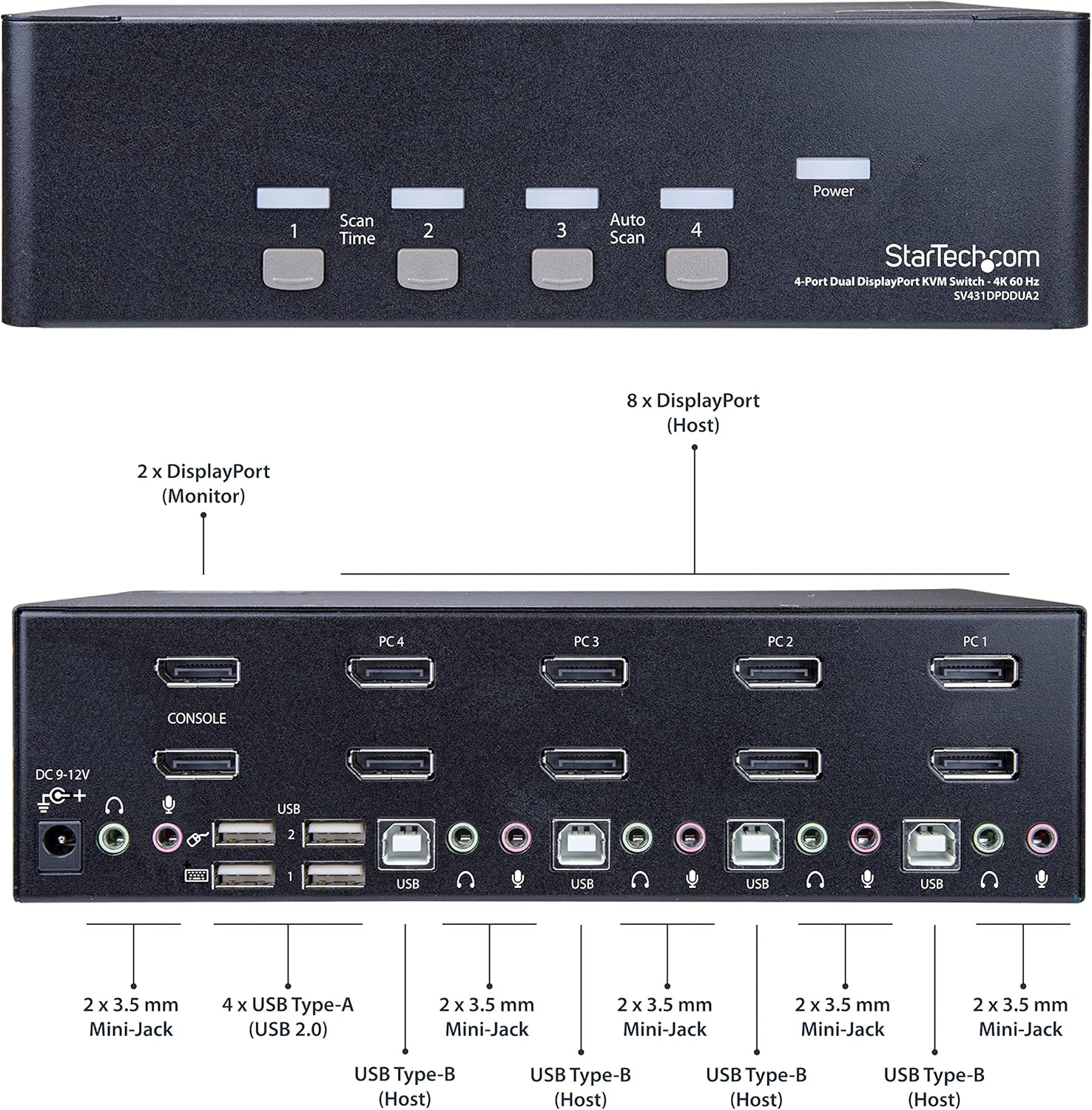
The front panel features four push buttons (1, 2, 3, 4) for direct port selection. Each button has an associated LED indicator. Additional buttons for 'Scan Time' and 'Auto Scan' are present, along with a 'Power' indicator LED.
4.2 Rear Panel

The rear panel provides all necessary connection ports:
- DC 9-12V Power Input: For connecting the universal power adapter.
- Console Ports: Two DisplayPort outputs for connecting your primary and secondary monitors.
- USB Ports (Console): Two dedicated USB-A ports for keyboard and mouse, and two additional USB-A ports for other peripherals.
- Audio Jacks (Console): 3.5mm jacks for microphone and speakers.
- PC Input Ports (1-4): Each PC input includes two DisplayPort inputs, one USB-B input, and 3.5mm audio jacks for microphone and speakers.
5. Setup
Follow these steps to set up your KVM switch:
- Power Off All Devices: Ensure all computers, monitors, and the KVM switch are powered off before making any connections.
- Connect Monitors: Connect your two DisplayPort monitors to the 'CONSOLE' DisplayPort output ports on the rear of the KVM switch.
- Connect Console Peripherals: Connect your USB keyboard and mouse to the dedicated USB-A ports on the rear panel. Connect your microphone and speakers to the respective 3.5mm audio jacks in the 'CONSOLE' section.
- Connect Computers: For each computer (up to four), connect:
- Two DisplayPort cables from the computer's video outputs to the corresponding 'PC' DisplayPort inputs on the KVM switch.
- One USB-B cable from a USB-A port on the computer to the corresponding USB-B input for that PC on the KVM switch.
- 3.5mm audio cables from the computer's audio output/input to the corresponding audio jacks for that PC on the KVM switch (optional).
- Connect Power: Connect the universal power adapter to the 'DC 9-12V' input on the KVM switch, then plug it into a power outlet.
- Power On: Power on the KVM switch, then power on your monitors, and finally power on your connected computers.


6. Operating Instructions
6.1 Switching Between Computers
You can switch between connected computers using two methods:
- Front Panel Buttons: Press the corresponding numbered button (1, 2, 3, or 4) on the front panel of the KVM switch to select the desired computer.
- Hotkeys: Use keyboard hotkey commands. The default hotkey sequence is to press the Scroll Lock key twice, followed by the port number (1, 2, 3, or 4). For example, to switch to PC 2, press Scroll Lock, Scroll Lock, 2.
6.2 Auto Scan Function
The 'Auto Scan' feature allows the KVM switch to automatically cycle through all connected computers, displaying each for a set duration. To activate or adjust this feature, refer to the detailed instructions in the included Quick Start Guide or the full product manual available on the StarTech.com website.
7. Maintenance
To ensure optimal performance and longevity of your KVM switch:
- Cleaning: Use a soft, dry cloth to clean the exterior of the device. Avoid liquid cleaners or solvents.
- Ventilation: Ensure the KVM switch is placed in a well-ventilated area to prevent overheating. Do not block any ventilation openings.
- Environmental Conditions: Operate the device within the specified temperature range (0°C to 45°C) and humidity levels.
- Cable Management: Keep cables organized and avoid excessive bending or tension to prevent damage to connectors and ports.
8. Troubleshooting
If you encounter issues with your KVM switch, refer to the following common solutions:
- No Display on Monitor(s):
- Verify all DisplayPort cables are securely connected between the computers, KVM, and monitors.
- Ensure the KVM switch is powered on and the correct input port is selected.
- Test monitors by connecting them directly to a computer to rule out monitor or cable issues.
- If a monitor does not wake from sleep, try switching to another port and then back, or power cycling the monitor.
- Keyboard/Mouse Not Responding:
- Ensure the USB keyboard and mouse are connected to the dedicated console USB ports.
- Verify the USB-B cables are securely connected from each computer to the KVM switch.
- Try connecting the keyboard/mouse directly to the computer to confirm functionality.
- Some specialized keyboards/mice with integrated hubs or unique drivers may require connection to the shared USB ports or direct connection to the computer.
- No Audio or Poor Audio Quality:
- Check all 3.5mm audio cables for secure connections.
- Ensure audio settings on the connected computers are correctly configured for the KVM's audio output/input.
- Test audio devices by connecting them directly to a computer.
- Switching Delays or Inconsistencies:
- Ensure high-quality DisplayPort and USB cables are used. Cable quality can impact performance, especially with 4K resolutions.
- If experiencing occasional failures to switch, try pressing input buttons 1 and 3 simultaneously to reset the KVM, then select the desired port.
9. Specifications
| Feature | Specification |
|---|---|
| Model | SV431DPDDUA2 |
| Number of Ports | 4 |
| Video Interface | DisplayPort 1.2 |
| Maximum Resolution | 4K (3840x2160) @ 60Hz |
| USB Interface | USB 2.0 (Dedicated for HID), USB 2.0 (Shared) |
| Audio Interface | 3.5mm Mini-Jack (Microphone, Speaker) |
| Control Method | Push Button, Hotkeys |
| Material | Steel |
| Item Dimensions (L x W x H) | 8.5 x 5 x 2.5 inches (21.59 x 12.7 x 6.35 cm) |
| Item Weight | 2.64 Pounds (1.2 kg) |
| Power Consumption | 18 Watts |
| Operating Temperature | 0°C to 45°C (32°F to 113°F) |
| Certifications | RoHS, WEEE |
10. Warranty and Support
This StarTech.com product is backed by a 2-Year Warranty. For the most current warranty information and technical support, please visit the official StarTech.com website or contact their customer service department. Support resources typically include online FAQs, driver downloads, and direct contact options via phone or live chat.


