Introduction
This manual provides detailed instructions for the installation, operation, and maintenance of your Hifonics BXX1600.1D Brutus Class D 1600W RMS 1 Ohm Mono Car Subwoofer Amplifier. Please read this manual thoroughly before attempting installation or operation to ensure proper function and safety.
Setup and Installation
Proper installation is crucial for optimal performance and safety. It is recommended that installation be performed by a qualified professional.
Wiring Connections
Ensure all power, ground, and remote wires are securely connected. Use appropriate gauge wiring for your installation to prevent overheating and ensure stable power delivery.

Image: Rear view of the Hifonics BXX1600.1D amplifier. This image highlights the power input terminals (+12V, REM, GND) on the right, and the mono speaker output terminals on the left. Two 70A fuses are visible between the power and speaker terminals, indicating the amplifier's power handling capabilities.
The amplifier features zero-gauge power and ground terminals for robust power delivery, and eight-gauge speaker terminals for secure speaker connections. Always disconnect the vehicle's battery before making any electrical connections.
Fuse Installation
The amplifier is equipped with internal fuses to protect against electrical overloads. Ensure these are correctly installed and of the specified rating (70A x 2) before operation.
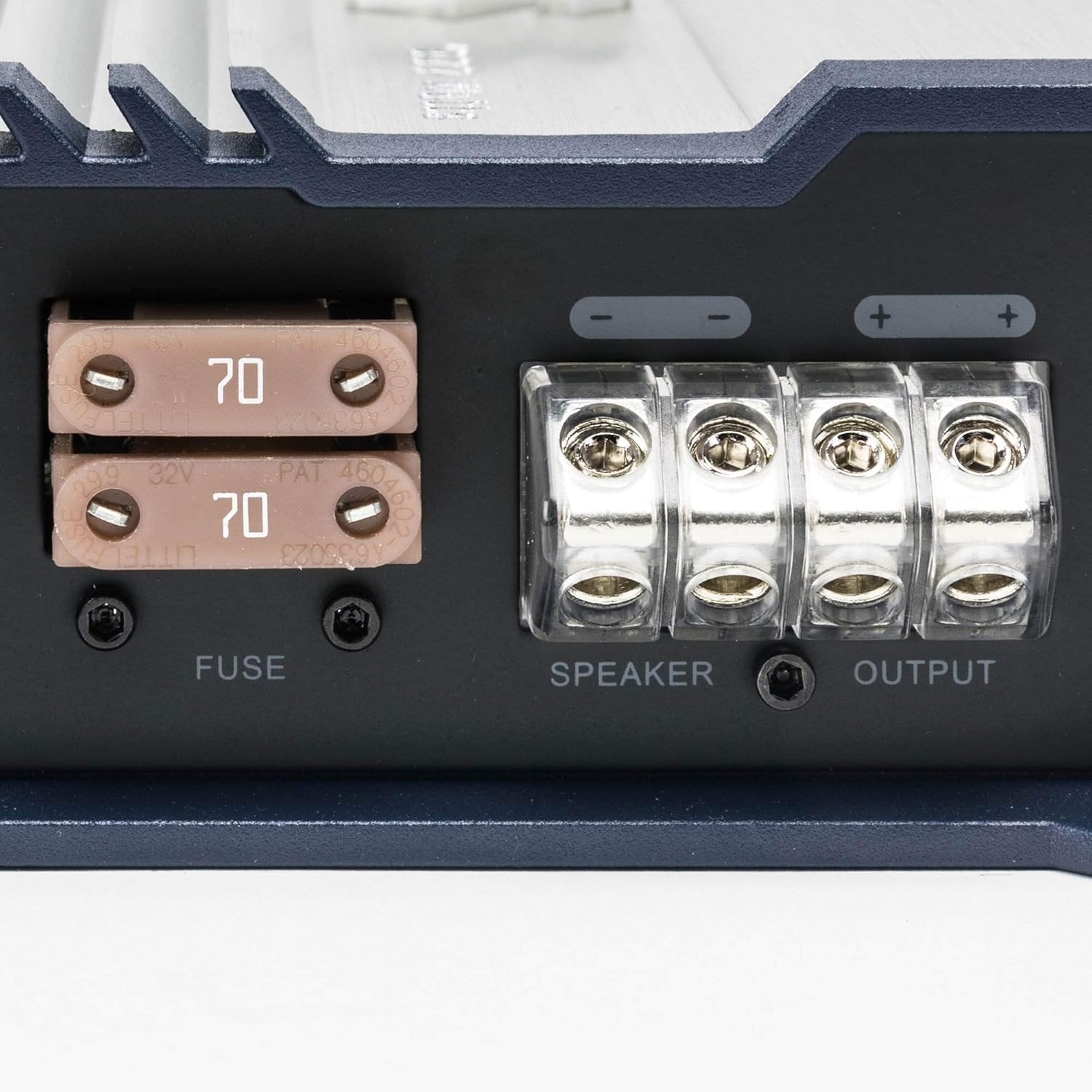
Image: A close-up view of the Hifonics BXX1600.1D amplifier's fuse compartment and speaker output terminals. Two 70A fuses are clearly visible, along with the robust speaker wire connections labeled "SPEAKER OUTPUT".
Operating Instructions
Familiarize yourself with the amplifier's controls to optimize your audio experience.

Image: Front view of the Hifonics BXX1600.1D amplifier's control panel. This image displays the RCA input and output jacks, remote bass knob port, and various adjustment controls including Level, Phase, Bass EQ, Subsonic Filter, and Low-Pass Filter (LPF).
Control Panel Overview
- Power/Protect Indicators: LEDs indicating operational status (green for power, red for protection mode).
- Remote: Port for connecting an optional remote bass level control.
- Input/Output RCAs: For connecting to your head unit and bridging multiple amplifiers.
- Gain Control: Adjusts the input sensitivity to match the output of your head unit.
- LPF (Low-Pass Filter): Filters out high frequencies, allowing only low frequencies to pass to the subwoofer.
- Subsonic Filter: Filters out extremely low frequencies that are inaudible and can damage subwoofers.
- Phase Control: Adjusts the phase of the subwoofer output (0° to 180°) to match other speakers.
- Bass EQ/Boost: Provides adjustable bass equalization for enhanced low-frequency response.
Initial Power-Up
After all connections are made, turn on your head unit. The amplifier's power indicator should illuminate green. If the protect indicator lights up, immediately turn off the system and check all connections and wiring for faults.
Adjusting Settings
Start with the gain control at its minimum setting. Gradually increase the gain until the desired volume is achieved without distortion. Adjust the LPF, Subsonic Filter, and Phase controls to blend the subwoofer output seamlessly with your main speakers.
Maintenance
Regular maintenance ensures the longevity and optimal performance of your amplifier.
- Cleaning: Keep the amplifier clean and free of dust and debris. Use a soft, dry cloth for cleaning. Do not use liquid cleaners.
- Ventilation: Ensure the amplifier has adequate ventilation. Do not block the cooling fins or mount the amplifier in an enclosed space without proper airflow.
- Wiring Inspection: Periodically check all wiring connections for tightness and signs of corrosion or damage. Loose connections can lead to poor performance or damage.
- Fuse Replacement: If a fuse blows, replace it only with a fuse of the exact same type and rating (70A). Using an incorrect fuse can cause severe damage to the amplifier or vehicle's electrical system.
Troubleshooting
If you experience issues with your amplifier, refer to the following common troubleshooting steps:
- No Power: Check the main power fuse, ground connection, and remote turn-on wire. Ensure the vehicle's battery has sufficient charge.
- Protection Mode (Red LED): This indicates a fault. Check for short circuits in speaker wiring, improper impedance loads, or overheating. Allow the amplifier to cool down if it's hot.
- No Sound: Verify all RCA input/output connections, speaker wire connections, and head unit settings. Check the gain control and ensure it's not set too low.
- Distorted Sound: Reduce the gain setting. Check for proper LPF and Subsonic filter settings. Ensure speaker impedance matches the amplifier's capabilities.
If problems persist after troubleshooting, consult a qualified car audio technician.
Specifications
| Feature | Detail |
|---|---|
| Model Number | BXX1600.1D |
| RMS Power (1 Ohm) | 1600W |
| Class | Class D |
| Type | Mono Amplifier |
| Product Dimensions | 19.5 x 10.2 x 3.6 inches |
| Item Weight | 11.48 pounds |
| Manufacturer | Hifonics |
| Date First Available | January 18, 2018 |
Product Overview Video
Watch this official video for an overview of the Hifonics Brutus Gamma BG Amplifiers, which share similar features and design principles with your BXX1600.1D model.
Video: An official Hifonics video showcasing the Brutus Gamma BG Amplifiers. This video provides visual details and highlights key features, offering insights relevant to the Hifonics BXX1600.1D amplifier.
Warranty Information
Your Hifonics BXX1600.1D amplifier is covered by a manufacturer's warranty against defects in materials and workmanship. Please refer to the warranty card included with your product for specific terms, conditions, and duration. Keep your proof of purchase for warranty claims.
Customer Support
For technical assistance, troubleshooting, or warranty inquiries, please contact Hifonics customer support through their official website or the contact information provided in your product packaging. You can also visit the Hifonics Store on Amazon for additional resources.


