
ARTURIA MiniBrute 2
Arturia MiniBrute 2 User Manual
Semi-Modular Analog Synthesizer and Step Sequencer
Product Overview
The Arturia MiniBrute 2 is a powerful and versatile semi-modular analog synthesizer designed for musicians and sound designers. It combines classic analog synthesis with modern connectivity, offering a rich sound palette and extensive patching capabilities. Its intuitive interface and robust build make it suitable for both studio and live performance environments.
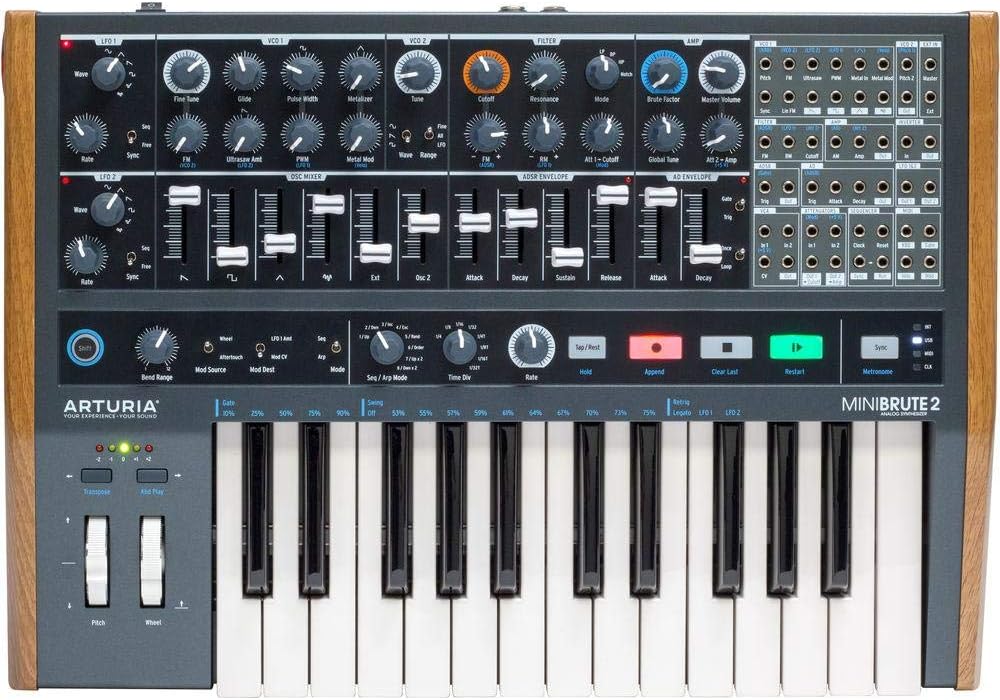
Image: Front view of the Arturia MiniBrute 2, showcasing its keyboard, knobs, sliders, and patchbay.
Key Features
- Analog Synthesizer: Features 2 Voltage Controlled Oscillators (VCOs) and 2 Low Frequency Oscillators (LFOs) for rich, authentic analog sound generation.
- Steiner Parker Filter: Equipped with a versatile filter offering 4 modes: Low Pass, High Pass, Band Pass, and Notch, allowing for diverse sound sculpting.
- Dual Envelopes: Includes 1 ADSR (Attack, Decay, Sustain, Release) envelope for amplitude shaping and 1 AD (Attack, Decay) envelope for flexible modulation assignments.
- Extensive Patchbay: A 48-point CV and Gate patchbay provides semi-modular capabilities, enabling deep sound design and integration with other modular systems.
- Keyboard and Sequencer: Features a 25-key keyboard with aftertouch for expressive playability, alongside a powerful built-in step sequencer for pattern creation.
Initial Setup
Unpacking
Carefully remove the MiniBrute 2 from its packaging. Ensure all components listed in the 'What's in the Box' section (MiniBrute 2 unit, power adapter, patch cables) are present and undamaged.
Power Connection
Connect the provided power adapter to the DC input on the rear panel of the MiniBrute 2. Plug the adapter into a suitable power outlet. Use only the original power supply to prevent damage.
Audio Output
Connect the Master Output (1/4" jack) to your audio interface, mixer, or amplifier using a standard audio cable. A dedicated headphone output is also available for private monitoring.
USB/MIDI Connection
For computer integration or MIDI control, connect a USB cable from the MiniBrute 2's USB port to your computer. Alternatively, use standard 5-pin DIN MIDI cables for MIDI In/Out connections with other hardware.

Image: Rear view of the MiniBrute 2, showing the power input, audio outputs, USB port, and MIDI In/Out connections.
Operating the MiniBrute 2
Powering On
Locate the power switch on the rear panel and flip it to the 'ON' position. The unit will initialize and be ready for sound creation.
Oscillators (VCOs)
The MiniBrute 2 features two Voltage Controlled Oscillators (VCOs). Use the 'Wave' selectors to choose waveforms (Saw, Square, Triangle, etc.) and the 'Tune' knobs to adjust their pitch. VCO2 can be synced to VCO1 for harmonic complexity.

Image: Close-up of the MiniBrute 2's control panel, highlighting the knobs and sliders for sound shaping.
Filter Section
The Steiner Parker filter is a key component for shaping your sound. Adjust the 'Cutoff' knob to control the filter's frequency and 'Resonance' to emphasize the cutoff point. Experiment with the four filter modes (LP, HP, BP, Notch) to achieve different tonal characteristics.
Envelopes (ADSR & AD)
The ADSR envelope primarily controls the amplitude contour of your sound. The AD envelope is a flexible modulation source that can be routed to various parameters via the patchbay, allowing for dynamic changes in pitch, filter, or other destinations.
Modulation Matrix (Patchbay)
The 48-point CV and Gate patchbay is the heart of the MiniBrute 2's semi-modular design. Use 3.5mm patch cables to connect different modules (e.g., LFOs to filter cutoff, envelopes to pitch) to create complex and evolving sounds. Refer to the included 'cookbook' for patch examples.

Image: Close-up of the MiniBrute 2's 48-point patchbay, showing various input and output jacks for modular connections.
Keyboard and Sequencer
The 25-key keyboard provides a responsive playing experience, enhanced by aftertouch for additional expressive control. The integrated step sequencer allows you to program melodic and rhythmic patterns, which can be synchronized with external gear via MIDI or CV/Gate.

Image: A user's hands on the keyboard and controls of the Arturia MiniBrute 2 during a performance or sound design session.
Care and Maintenance
Cleaning
To clean the exterior of your MiniBrute 2, use a soft, dry, lint-free cloth. For stubborn marks, a slightly damp cloth can be used, followed immediately by a dry one. Avoid using abrasive cleaners, solvents, or strong chemicals, as these can damage the finish and components.
Storage
When not in use, store the MiniBrute 2 in a cool, dry place away from direct sunlight, excessive heat, humidity, and dust. If transporting the unit, use a padded case to protect it from physical shock.
Firmware Updates
Arturia periodically releases firmware updates that may include new features, performance enhancements, or bug fixes. It is recommended to regularly check the official Arturia website for the latest firmware and follow the provided instructions for updating your device.
Troubleshooting
This section addresses common issues you might encounter with your MiniBrute 2. If the problem persists after trying these solutions, please contact customer support.
| Problem | Possible Cause | Solution |
|---|---|---|
| No Sound Output | Master Volume too low; incorrect audio cable connections; filter cutoff set too low; VCA envelope not triggering. | Increase Master Volume knob. Verify audio cables are securely connected to the correct outputs and inputs. Adjust filter cutoff. Check ADSR envelope settings and ensure a gate signal is reaching the VCA. |
| Keys Not Responding | MIDI/USB connection issue; local control disabled; sequencer/arpeggiator active. | Check USB/MIDI cables and connections. Ensure local control is enabled in the utility settings (refer to the full manual). Deactivate sequencer or arpeggiator if they are overriding keyboard input. |
| Unexpected Sound Behavior | Incorrect patchbay connections; extreme parameter settings; firmware glitch. | Review all patchbay connections and remove any unnecessary cables. Reset parameters to default positions. Consider performing a factory reset (consult the full manual for instructions) or checking for firmware updates. |
For further assistance, please refer to the comprehensive online manual or contact Arturia customer support.
Technical Specifications
| Feature | Detail |
|---|---|
| Model Name | MiniBrute 2 |
| Manufacturer | Arturia |
| Item Weight | 4.8 Kilograms (10.56 pounds) |
| Product Dimensions | 19.06 x 13.23 x 0.23 inches |
| Body Material | Metal |
| Finish Type | Painted |
| Color | Brown |
| Number of Keyboard Keys | 25 |
| Connector Types | 1/8" inch jack (patchbay), 1/4" inch jack (Master Output), USB, MIDI In/Out |
| Included Components | MiniBrute 2 unit |
Warranty and Support
Warranty Information
The Arturia MiniBrute 2 comes with a standard manufacturer's warranty. For detailed terms, conditions, and registration, please refer to the warranty card included in your product packaging or visit the official Arturia website.
Customer Support
For technical support, product registration, or any further inquiries regarding your MiniBrute 2, please visit the official Arturia support page:
You can also find a wealth of resources, FAQs, and community forums on the Arturia website to help you get the most out of your synthesizer.
Related documentsMiniBrute 2


Ask a question about this manual
Ask about setup, troubleshooting, compatibility, parts, safety, or missing instructions. Manuals+ will review the question and use this page’s manual context to help answer it.