
Seagate ST2000DM008
Seagate Barracuda ST2000DM008 2 TB 3.5" Internal Hard Drive - User Manual
Model: ST2000DM008
Product Overview
The Seagate Barracuda ST2000DM008 is a 2 TB 3.5-inch internal hard drive designed for desktop computers. It features a SATA 6.0Gb/s interface and a rotational speed of 7200 RPM, providing reliable storage and performance for various computing needs. This drive is suitable for general-purpose storage, gaming, and other applications requiring significant data capacity.

Image: Top-down view of the Seagate Barracuda ST2000DM008 2TB internal hard drive. The drive features a metallic silver casing with a prominent green and black label. The label displays the Seagate logo, "Barracuda Compute" branding, "2TB Barracuda ST2000DM008", and various certification marks. This view highlights the overall form factor and the primary identification label of the hard drive.
Setup and Installation
This section provides instructions for physically installing the Seagate Barracuda ST2000DM008 internal hard drive into a compatible desktop computer system. Ensure your computer is powered off and unplugged before beginning installation.
1. Preparation
- Gather necessary tools: Phillips head screwdriver, SATA data cable, SATA power cable (usually from PSU).
- Ensure your computer case has an available 3.5-inch drive bay.
- Ground yourself to prevent electrostatic discharge (ESD) by touching a metal part of the computer chassis.
2. Physical Installation
- Open your computer case. Refer to your computer's manual for specific instructions on opening the case and accessing drive bays.
- Slide the Seagate Barracuda hard drive into an available 3.5-inch drive bay. Secure it with screws on both sides of the drive bay, if applicable, to prevent vibration.
- Connect one end of the SATA data cable to the data port on the hard drive. Connect the other end to an available SATA data port on your motherboard.
- Connect a SATA power cable from your power supply unit (PSU) to the power port on the hard drive.
- Close your computer case and reconnect all external cables.
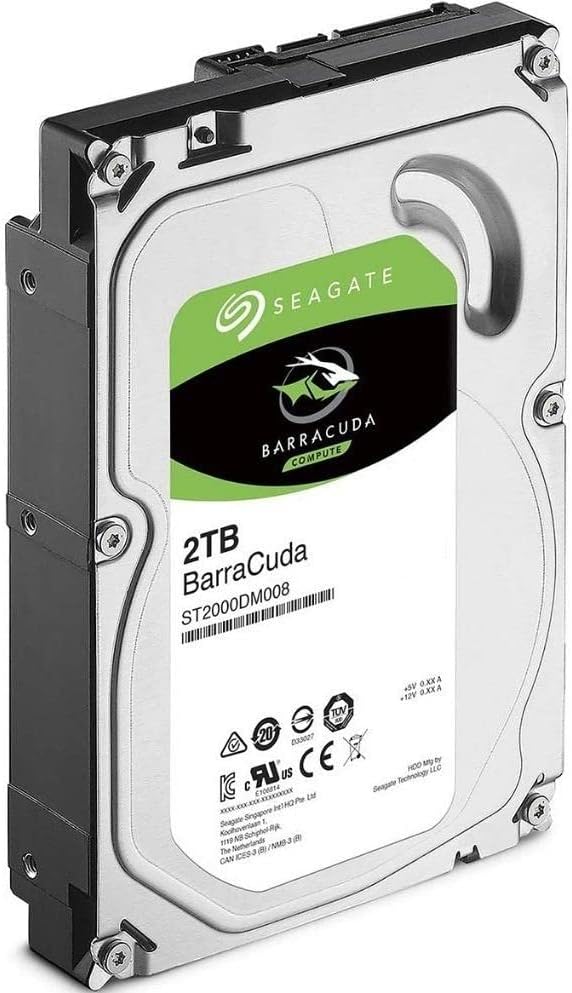
Image: Angled view of the Seagate Barracuda ST2000DM008 2TB internal hard drive. This perspective highlights the side profile and the rear connectors, including the SATA data and power ports. The drive's metallic casing and the green and black label are visible. This image is useful for identifying the connection points during installation.
3. Initializing and Formatting (Operating System Specific)
After physical installation, the drive must be initialized and formatted by your operating system before it can be used for storage. The process varies slightly depending on your OS (Windows, macOS, Linux).
For Windows:
- Boot your computer.
- Right-click on the Start button and select "Disk Management".
- You will likely be prompted to initialize the new disk. Choose MBR (Master Boot Record) for drives up to 2TB or GPT (GUID Partition Table) for drives larger than 2TB. For this 2TB drive, MBR is suitable, but GPT is also compatible and recommended for modern systems.
- Once initialized, right-click on the unallocated space of the new disk and select "New Simple Volume".
- Follow the wizard to assign a drive letter and format the drive (NTFS is recommended for Windows).
For macOS:
- Boot your computer.
- Open "Disk Utility" (Applications > Utilities > Disk Utility).
- Select the new Seagate drive from the sidebar.
- Click "Erase". Choose a name, format (e.g., APFS or Mac OS Extended (Journaled)), and scheme (GUID Partition Map).
- Click "Erase" again to confirm.
For Linux:
- Boot your computer.
- Use a disk utility like GParted or the
fdisk/partedcommand-line tools to partition and format the drive. Common file systems include ext4. - Mount the formatted partition to a desired directory.
Operating the Hard Drive
Once installed, initialized, and formatted, the Seagate Barracuda ST2000DM008 operates as a standard storage device within your computer system. It will appear as a new drive letter (Windows) or mounted volume (macOS/Linux).
Data Storage and Access
- You can save files, install applications, and store media directly onto the drive.
- Access the drive through your operating system's file explorer (e.g., File Explorer in Windows, Finder in macOS).
- The drive's 7200 RPM rotational speed and 256MB cache contribute to faster data access and transfer speeds compared to slower drives.
Power Management
The drive's power management features allow it to enter various low-power states to conserve energy when not actively in use. These states are typically managed by your operating system's power settings.
- Idle Mode: The drive spins, but heads are parked, consuming less power.
- Standby Mode: The drive spins down, consuming minimal power.
- Sleep Mode: The lowest power state, where the drive is almost entirely powered off.
Transitioning out of standby or sleep mode may introduce a slight delay as the drive spins up to full operational speed.
Maintenance
Proper maintenance can extend the lifespan and ensure optimal performance of your hard drive.
- Regular Backups: Always back up important data to another drive or cloud storage. Hard drives are mechanical devices and can fail.
- Disk Defragmentation (for HDDs): For Windows users, regularly defragmenting the drive can improve performance. SSDs do not require defragmentation.
- Disk Error Checking: Periodically run disk error checking tools (e.g.,
chkdskon Windows) to identify and fix file system errors. - Temperature Management: Ensure adequate airflow within your computer case to prevent the drive from overheating. High temperatures can degrade performance and lifespan.
- Avoid Physical Shocks: Hard drives are sensitive to physical impact. Avoid moving or bumping your computer while it is operating.
Troubleshooting
This section addresses common issues you might encounter with your hard drive.
Drive Not Detected
- Check Cables: Ensure both the SATA data and power cables are securely connected to the drive and the motherboard/PSU.
- BIOS/UEFI Settings: Verify that the SATA port to which the drive is connected is enabled in your system's BIOS/UEFI settings.
- Disk Management (Windows): Check Disk Management to see if the drive is detected but uninitialized or unallocated. Follow the initialization and formatting steps if necessary.
- Try Different Port/Cable: Test with a different SATA data cable, power cable, or motherboard SATA port to rule out faulty components.
Slow Performance
- Defragmentation: If using Windows, perform a disk defragmentation.
- Disk Space: Ensure the drive is not nearly full. Performance can degrade significantly when a drive is close to capacity.
- Background Processes: Check for background applications or antivirus scans that might be heavily utilizing the drive.
- S.M.A.R.T. Status: Use a disk utility to check the drive's S.M.A.R.T. (Self-Monitoring, Analysis and Reporting Technology) status. Warnings indicate potential drive failure.
Unusual Noises
- Clicking, grinding, or loud whirring noises are often indicators of mechanical failure. Immediately back up any critical data and consider replacing the drive.
- Ensure the drive is securely mounted in its bay to prevent vibrations.
Specifications
| Feature | Specification |
|---|---|
| Model Number | ST2000DM008 |
| Capacity | 2 TB (2000 GB) |
| Form Factor | 3.5-inch |
| Interface | SATA 6.0Gb/s |
| Rotational Speed | 7200 RPM |
| Cache | 256 MB |
| Max Sustained Data Rate (OD Read) | 220 MB/s |
| Operating Shock | 80 (Read) / 70 (Write) Gs @ 2ms |
| Non-Operating Shock | 350 Gs @ 2ms |
| Idle Acoustics | 2.8 bels (typical) |
| Seek Acoustics | 2.9 bels (typical) |
| Startup Power | 2.0 A |
| Operating Power (Typical) | 5.1 W |
| Idle Power (Average) | 3.9 W |
| Standby Power (Typical) | 0.3 W |
| Sleep Power (Typical) | 0.3 W |
| Dimensions (WxDxH) | 101.85 x 146.99 x 20.20 mm (4.010 x 5.787 x 0.795 inches) |
| Weight | 490.0 g (1.08 lbs) |
| Compatible Devices | Desktop PCs |
Warranty and Support
For detailed warranty information and technical support, please refer to the official Seagate website or contact Seagate customer service. Warranty terms and conditions may vary by region and purchase date.
You can typically find support resources, drivers, and firmware updates on the Seagate Support Website.
Related documentsST2000DM008


Ask a question about this manual
Ask about setup, troubleshooting, compatibility, parts, safety, or missing instructions. Manuals+ will review the question and use this page’s manual context to help answer it.