
1. Introduction
This manual provides essential information for the safe and efficient installation, operation, and maintenance of your AB Titanium Salt Pool Heat Exchanger, model SP-155Kti. Please read these instructions thoroughly before installation and use to ensure optimal performance and longevity of the unit.
The AB Titanium Salt Pool Heat Exchanger is designed for heating salt water pools up to 11,900 gallons, providing 155,000 BTU/hr based on a 140°F (60°C) temperature difference between the incoming heating and heated water. Its construction from 99.99% pure titanium ensures high resistance to corrosion, making it suitable for various demanding environments including high chlorine, salt water, seawater, and chemical solutions.
2. Safety Information
Important Safety Instructions:
- Installation must be performed by a qualified professional in accordance with all local and national plumbing and electrical codes.
- Ensure the heat exchanger is installed in a well-ventilated area, away from flammable materials.
- Always turn off power to all associated equipment (pumps, heaters) before performing any maintenance or service.
- Do not operate the unit if any part is damaged or leaking.
- Maintain proper water chemistry in the pool to prevent damage to the heat exchanger and other pool equipment.
- Keep children away from the heat exchanger and associated plumbing.
3. Product Overview
The AB Titanium Salt Pool Heat Exchanger is engineered for efficient and durable pool heating. Key features include:
- Titanium Construction: Made from 99.99% pure titanium, offering superior resistance to corrosion from salt water, chlorine, and other chemicals.
- Precision Welding: Manual welding ensures a seamless, leak-proof seal for long-term reliability.
- Efficient Heat Transfer: Designed with a spiral twisted corrugated tube for optimized heat exchange.
- Versatile Application: Suitable for various heating or cooling applications beyond pools, including marine engine cooling, mariculture, and water treatment.

Figure 3.1: Internal components of the heat exchanger, highlighting the pure titanium spiral twist bellow and fine manual welding.
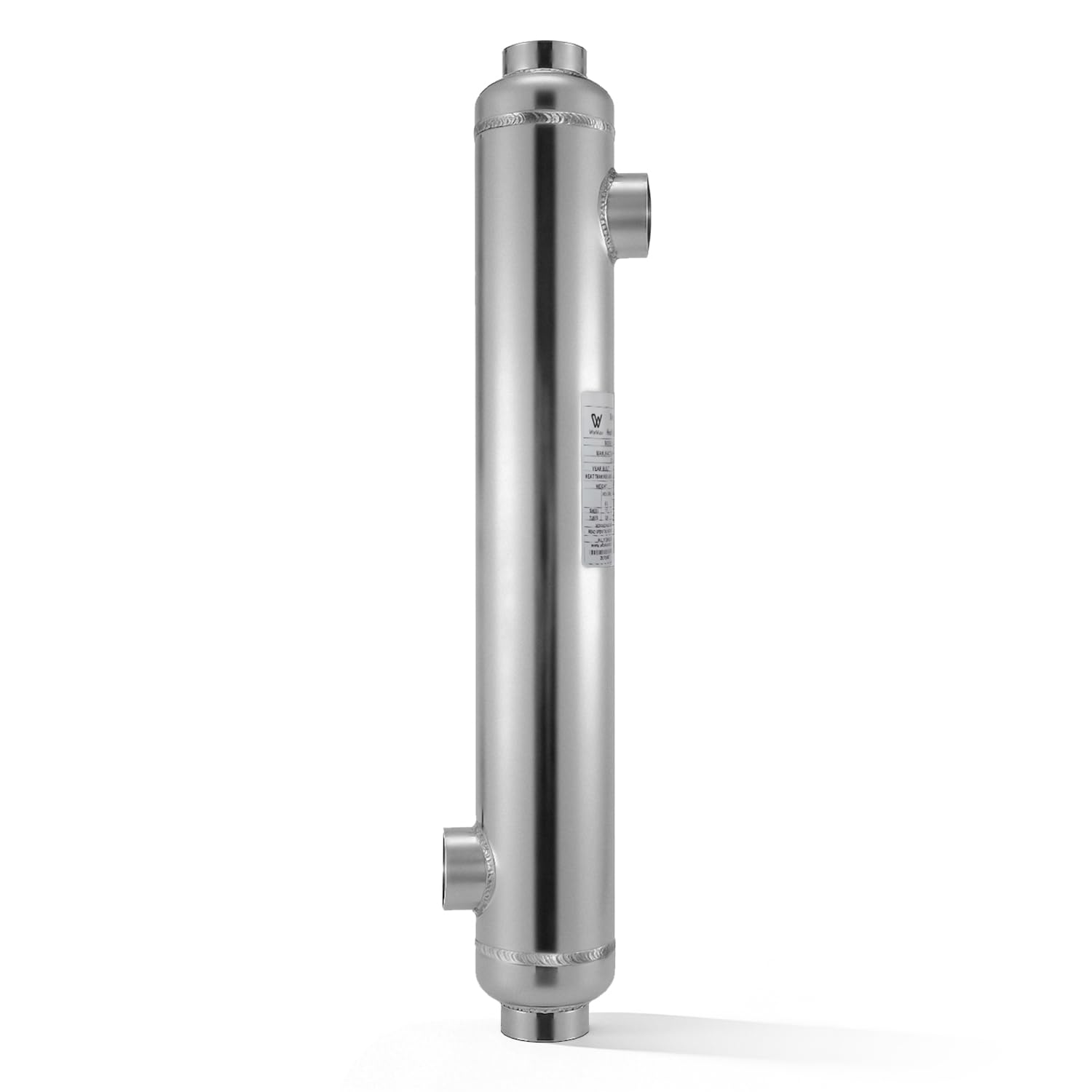
Figure 3.2: Product dimensions and port specifications. The shell side features a 1 1/2" NPT connection, and the tube side has a 1" NPT connection. The overall length is 17 inches.
4. Specifications
Detailed specifications for the AB Titanium Salt Pool Heat Exchanger (Model SP-155Kti):
| Feature | Specification |
|---|---|
| Model Number | SP-155Kti |
| Pool Heating Capacity | 155,000 BTU/hr |
| Recommended Pool Volume | Up to 11,900 gallons (salt pool) |
| Shell Side Ports | 1 1/2" FPT (Female Pipe Thread) |
| Tube Side Ports | 1" FPT (Female Pipe Thread) |
| Material | 99.99% Pure Titanium |
| Product Dimensions (L x W x H) | 17.32 x 2.99 x 2.99 inches |
| Item Weight | 3.69 pounds |

Figure 4.1: Series Parameters for AB Titanium Heat Exchangers. Note: Nominal values are based on a 140°F temperature difference.

Figure 4.2: Detailed product specifications and dimensions for different models.

Figure 4.3: Model vs. Maximum Pool Volume (Gallons) chart, indicating the capacity of various heat exchanger models.
5. Setup and Installation
Proper installation is crucial for the performance and safety of your heat exchanger. It is recommended that installation be carried out by a certified technician.
5.1 Placement Considerations
- Install the heat exchanger on a stable, level surface.
- Ensure adequate clearance around the unit for maintenance and airflow.
- Position the unit as close as possible to the pool pump and heater to minimize pipe runs and heat loss.
5.2 Plumbing Connections
The heat exchanger features 1 1/2" FPT connections for the pool water (shell side) and 1" FPT connections for the hot water (tube side). Ensure all connections are sealed properly to prevent leaks.
- Connect the pool water lines to the 1 1/2" FPT ports.
- Connect the hot water source (e.g., boiler, solar collectors) to the 1" FPT ports.
- Install shut-off valves on both the pool water and hot water lines to isolate the heat exchanger for maintenance.
- Consider installing a bypass valve on the pool water line to regulate flow through the heat exchanger.

Figure 5.1: Example of a Pool Heat Exchange System setup. Titanium construction is ideal for salt water systems.

Figure 5.2: Solar Pool Heating System setup with horizontal and vertical mounting options for the heat exchanger.
6. Operating Instructions
The heat exchanger operates by transferring heat from a primary hot water source to the cooler pool water without direct contact between the two fluids.
6.1 Heat Exchange Process
- Hot water (HP water) from your primary heating source enters the tube side of the heat exchanger.
- Cooler pool water (LP water) flows through the shell side, surrounding the hot water tubes.
- Heat is transferred from the hot water in the tubes to the cooler pool water in the shell.
- The heated pool water then returns to the pool, and the cooled hot water returns to its source for reheating.

Figure 6.1: Schematic of the Heat Exchange Process.
6.2 System Startup
- Ensure all plumbing connections are secure and leak-free.
- Open all valves to allow water flow through both the pool water and hot water circuits.
- Start the pool pump to circulate pool water through the heat exchanger.
- Activate your primary heating source to send hot water through the heat exchanger.
- Monitor the system for any unusual noises or leaks during initial operation.
7. Maintenance
Regular maintenance ensures the longevity and efficiency of your heat exchanger.
- Water Chemistry: Maintain proper pool water chemistry (pH, alkalinity, sanitizer levels) to prevent scaling and corrosion.
- Inspection: Periodically inspect the unit for any signs of leaks, corrosion, or damage.
- Cleaning: If a significant drop in heat transfer efficiency is observed, the heat exchanger may require cleaning to remove scale or debris. Consult a professional for chemical cleaning procedures.
- Winterization: In colder climates, drain both the pool water and hot water sides of the heat exchanger completely before freezing temperatures occur to prevent freeze damage.
8. Troubleshooting
Refer to the following table for common issues and their potential solutions:
| Problem | Possible Cause | Solution |
|---|---|---|
| No Heat Transfer / Low Efficiency | Insufficient hot water flow; Air in system; Scaling/fouling; Low pool water flow. | Check hot water pump and valves; Bleed air from system; Chemical cleaning (professional recommended); Check pool pump and filter. |
| Water Leakage | Loose connections; Damaged seals/gaskets; Unit damage. | Tighten connections; Replace seals/gaskets; Inspect unit for damage and replace if necessary. |
| Unusual Noises | Air in system; Vibration from pumps/piping. | Bleed air from system; Secure pumps and piping to reduce vibration. |
If you encounter issues not listed here or if solutions do not resolve the problem, contact a qualified service technician.
9. Warranty Information
This AB Titanium Salt Pool Heat Exchanger is covered by a manufacturer's warranty against defects in materials and workmanship. Specific warranty terms and duration may vary. Please retain your proof of purchase for warranty claims.
For detailed warranty information, please refer to the documentation provided at the time of purchase or contact AB customer support.
10. Support
For technical assistance, parts, or service inquiries, please contact AB customer support. When contacting support, please have your model number (SP-155Kti) and purchase date available.
You may also visit the official AB website for additional resources and frequently asked questions.
