
1. Introduction
This manual provides detailed instructions for the installation, operation, and maintenance of your ASRock AB350M-HDV MicroATX Motherboard. The ASRock AB350M-HDV is designed to support AMD Socket AM4 A-Series APUs (Bristol Ridge) and Ryzen Series CPUs (Summit Ridge), featuring a Digi Power design and 7 Power Phase design for stable performance. It supports DDR4 memory and offers various connectivity options including SATA3, USB 3.0, and an Ultra M.2 slot.
2. Product Overview
The ASRock AB350M-HDV motherboard is a MicroATX form factor board, ideal for compact PC builds. It features essential components for a modern computing system.

Figure 2.1: Angled view of the ASRock AB350M-HDV Motherboard, showcasing its compact MicroATX design and various components.
Key Features:
- Supports AMD Socket AM4 A-Series APUs (Bristol Ridge) and Ryzen Series CPUs (Summit Ridge).
- DDR4 memory support up to 3200+ (OC) for Ryzen CPUs and 2400 for A-series APUs.
- 1 PCIe 3.0 x16 slot and 1 PCIe 2.0 x1 slot for expansion cards.
- 4 SATA3 ports and 1 Ultra M.2 (PCIe Gen3 x4 & SATA3) slot for storage.
- 6 USB 3.0 ports (2 front, 4 rear) and 2 USB 2.0 ports for peripheral connectivity.
- Integrated Gigabit Ethernet for network connectivity.
- Video outputs: VGA, DVI, HDMI.

Figure 2.2: Top-down view of the ASRock AB350M-HDV Motherboard, highlighting the CPU socket, RAM slots, M.2 slot, and PCIe slots.
3. Setup and Installation
Follow these steps carefully to install your ASRock AB350M-HDV motherboard and its components.
3.1 CPU Installation
- Locate the AM4 CPU socket on the motherboard.
- Lift the load lever on the side of the socket.
- Align the triangular mark on the CPU with the corresponding mark on the socket. Carefully place the CPU into the socket without forcing it.
- Lower the load lever to secure the CPU in place.
- Install the CPU cooler according to its manufacturer's instructions.
3.2 RAM (Memory) Installation
- Locate the DDR4 DIMM slots. This motherboard has 4 slots.
- Open the clips at both ends of the DIMM slot.
- Align the notch on the RAM module with the key in the DIMM slot.
- Insert the RAM module firmly into the slot until the clips snap into place. Ensure both clips are closed.
3.3 Storage Device Installation (SATA & M.2)
SATA Drives:
- Connect one end of a SATA data cable to a SATA3 port on the motherboard.
- Connect the other end of the SATA data cable to your hard drive or SSD.
- Connect a SATA power cable from your power supply unit (PSU) to the storage device.
M.2 SSD:
- Locate the Ultra M.2 slot on the motherboard.
- Remove the M.2 screw and standoff from the slot.
- Insert the M.2 SSD into the slot at a 30-degree angle.
- Push the M.2 SSD down and secure it with the screw and standoff.
3.4 Power Connections
- Connect the 24-pin ATX power connector from your PSU to the 24-pin power socket on the motherboard.
- Connect the 8-pin (or 4-pin) ATX 12V power connector from your PSU to the corresponding socket near the CPU.
3.5 Front Panel Connections
Connect the cables from your PC case (Power Button, Reset Button, HDD LED, Power LED, USB, Audio) to the corresponding headers on the motherboard. Refer to the motherboard layout diagram in your physical manual for exact header locations.
3.6 Graphics Card Installation
- Locate the PCIe 3.0 x16 slot.
- Remove the corresponding expansion slot cover from your PC case.
- Align the graphics card with the PCIe slot and press it down firmly until it clicks into place.
- Secure the graphics card to the case with a screw.
- Connect any required PCIe power cables from your PSU to the graphics card.
4. Operating Instructions
4.1 First Boot and BIOS/UEFI Setup
- After assembling all components, connect your monitor, keyboard, and mouse.
- Power on your system.
- During startup, repeatedly press the DEL or F2 key to enter the BIOS/UEFI setup utility.
- In the BIOS, you can configure boot order, system time, and other advanced settings. Save changes and exit to boot into your operating system installation media.
4.2 Driver Installation
After installing your operating system, install the necessary drivers for the motherboard components. These typically include chipset drivers, audio drivers, LAN drivers, and any specific utility drivers. Drivers can be found on the ASRock official website for your specific motherboard model.
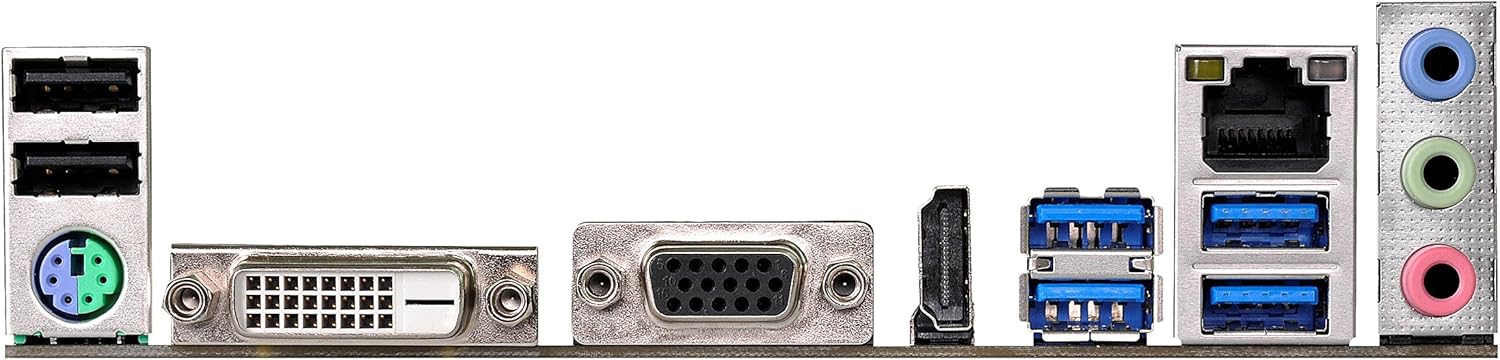
Figure 4.1: Rear I/O panel of the ASRock AB350M-HDV Motherboard, showing USB ports, video outputs (VGA, DVI, HDMI), LAN port, and audio jacks.
5. Maintenance
Proper maintenance ensures the longevity and optimal performance of your motherboard.
5.1 Cleaning
- Regularly clean dust from the motherboard and components using compressed air.
- Ensure the system is powered off and unplugged before cleaning.
- Avoid using liquid cleaners directly on components.
5.2 BIOS/UEFI Updates
Periodically check the ASRock website for BIOS/UEFI updates. Updates can improve compatibility, stability, and performance. Follow the instructions provided by ASRock carefully when performing a BIOS update to avoid system damage.
6. Troubleshooting
This section provides solutions to common issues you might encounter.
6.1 No Power / No POST (Power-On Self-Test)
- Check Power Connections: Ensure the 24-pin and 8-pin (or 4-pin) CPU power connectors are securely seated.
- Verify PSU: Test your power supply unit (PSU) to ensure it is functional and providing adequate power.
- Reseat Components: Remove and re-install the CPU, RAM, and graphics card to ensure they are properly seated.
- Clear CMOS: Refer to your physical manual for instructions on how to clear the CMOS (Complementary Metal-Oxide-Semiconductor) settings, which can resolve boot issues.
6.2 No Display Output
- Monitor Connection: Ensure your monitor is correctly connected to the graphics card or motherboard (if using an APU with integrated graphics).
- Graphics Card: If using a dedicated graphics card, ensure it is properly installed and has sufficient power. Test with another graphics card if possible.
- APU Compatibility: If using an AMD A-Series APU, ensure your monitor is connected to the motherboard's video outputs (VGA, DVI, HDMI). Ryzen CPUs without integrated graphics require a dedicated graphics card.
6.3 Operating System Not Booting
- Boot Order: Check the BIOS/UEFI settings to ensure the correct boot device (e.g., SSD/HDD with OS) is prioritized.
- Storage Device: Verify that your storage device is detected in the BIOS.
- OS Installation: If the OS is newly installed, ensure the installation process completed successfully.
7. Specifications
| Brand | ASRock |
| Model Name | AB350M-HDV |
| CPU Socket | Socket AM4 |
| Chipset Type | AMD Promontory B350 |
| Compatible Processors | AMD A-Series APUs (Bristol Ridge), Ryzen Series CPUs (Summit Ridge) |
| RAM Memory Technology | DDR4 |
| Memory Clock Speed | 2133 MHz (Base), up to 3200+ (OC) for Ryzen CPU |
| Memory Slots Available | 4 |
| Graphics Card Interface | PCI Express (1x PCIe 3.0 x16, 1x PCIe 2.0 x1) |
| Total SATA Ports | 4 (SATA3) |
| M.2 Slot | 1 (Ultra M.2, PCIe Gen3 x4 & SATA3) |
| Total USB Ports | 8 (6x USB 3.0, 2x USB 2.0) |
| Video Outputs | VGA, DVI, HDMI |
| Main Power Connector Type | 24-Pin ATX |
| Form Factor | MicroATX |
| Item Weight | 1.3 Pounds |
8. Warranty Information
The ASRock AB350M-HDV Motherboard comes with a 1 Year Warranty. For specific terms and conditions, please refer to the warranty card included with your product or visit the official ASRock website.
9. Support
For further assistance, technical support, or driver downloads, please visit the official ASRock website:
You can also find contact information for customer service and support resources on their website.


