
1. Introduction
This manual provides comprehensive instructions for the safe and efficient operation of your VERITAS Sarah Sewing Machine, Model 1301. Designed for ease of use, this machine is suitable for beginners and experienced sewers alike, offering essential functions for various sewing projects. Please read this manual thoroughly before using the machine to ensure proper setup, operation, and maintenance.

Image 1.1: The VERITAS Sarah Sewing Machine. This image displays the compact white sewing machine with red accents, featuring two rotary dials on the front for stitch selection and length adjustment.

Image 1.2: Key benefits for users. This image highlights the machine's suitability for all who want to start sewing, requiring no prior experience, offering particularly simple operation, and being excellent for all common fabrics, including fine materials like chiffon, silk, and satin.
2. Safety Warnings
To ensure safe operation and prevent injury or damage, please adhere to the following safety guidelines:
- Children and individuals with limited physical, sensory, or mental capabilities should only use the machine after receiving thorough instruction and under constant supervision.
- Never leave the machine unattended, especially in areas accessible to children.
- Always disconnect the machine from the power supply before cleaning, performing maintenance, or when not in use.
- Keep fingers away from all moving parts, especially the needle, during operation.
- Use only accessories and attachments recommended by the manufacturer.
- Do not operate the machine if it has a damaged cord or plug, or if it is not working properly.
- Ensure the machine is placed on a stable, level surface during use.
3. Box Contents
Upon unpacking your VERITAS Sarah Sewing Machine, please verify that all the following items are included:
- VERITAS Sarah Sewing Machine
- 5 Quality Needles
- All-round Sewing Foot
- Zipper Foot
- Buttonhole Foot
- Brush
- Seam Ripper
- 3 Bobbins
- Embroidery and Darning Plate
- Screwdriver
- Edge Ruler
- 2 Felt Pads
- Instruction Manual

Image 3.1: Extensive accessories included with the VERITAS Sarah. This image shows various accessories such as quality needles, a zipper foot, and highlights the machine's suitability for multi-layer fabrics.
4. Key Features
The VERITAS Sarah Sewing Machine is equipped with features designed for efficient and versatile sewing:
- 13 Stitch Programs: Offers a variety of essential stitches for different sewing needs.
- 4-Step Buttonhole Function: Simplifies the creation of consistent buttonholes.
- Adjustable Stitch Length: Easily set stitch length between 0 and 4 mm using a rotary wheel.
- High Torque Motor: Capable of handling thicker fabrics such as denim and canvas.
- Integrated Wire Cutter: For convenient thread trimming.
- Free Arm Function: Ideal for sewing cylindrical items like sleeves, cuffs, and pant hems.
- Glare-Free LED Light: Illuminates the sewing area for improved visibility.
- Automatic Thread Tensioner: Helps maintain optimal thread tension for balanced stitches.
- Snap-On Presser Foot System: Allows for quick and easy changing of presser feet, includes 6 different feet.
- Sewing Speed: Up to 750 stitches per minute.
- Removable Accessory Compartment: Provides convenient storage for tools and accessories.
- Robust Construction: Features a stable, durable aluminum die-cast frame.

Image 4.1: Performance features of the VERITAS Sarah. This image highlights a sewing speed of 750 stitches per minute, the Snap-On presser foot system including 6 presser feet, and the integrated LED sewing light.

Image 4.2: Stitch capabilities of the VERITAS Sarah. This image illustrates the maximum stitch length of 4 mm, maximum stitch width of 5 mm, 13 different stitches, a 4-step automatic buttonhole function, and adjustable stitch length.
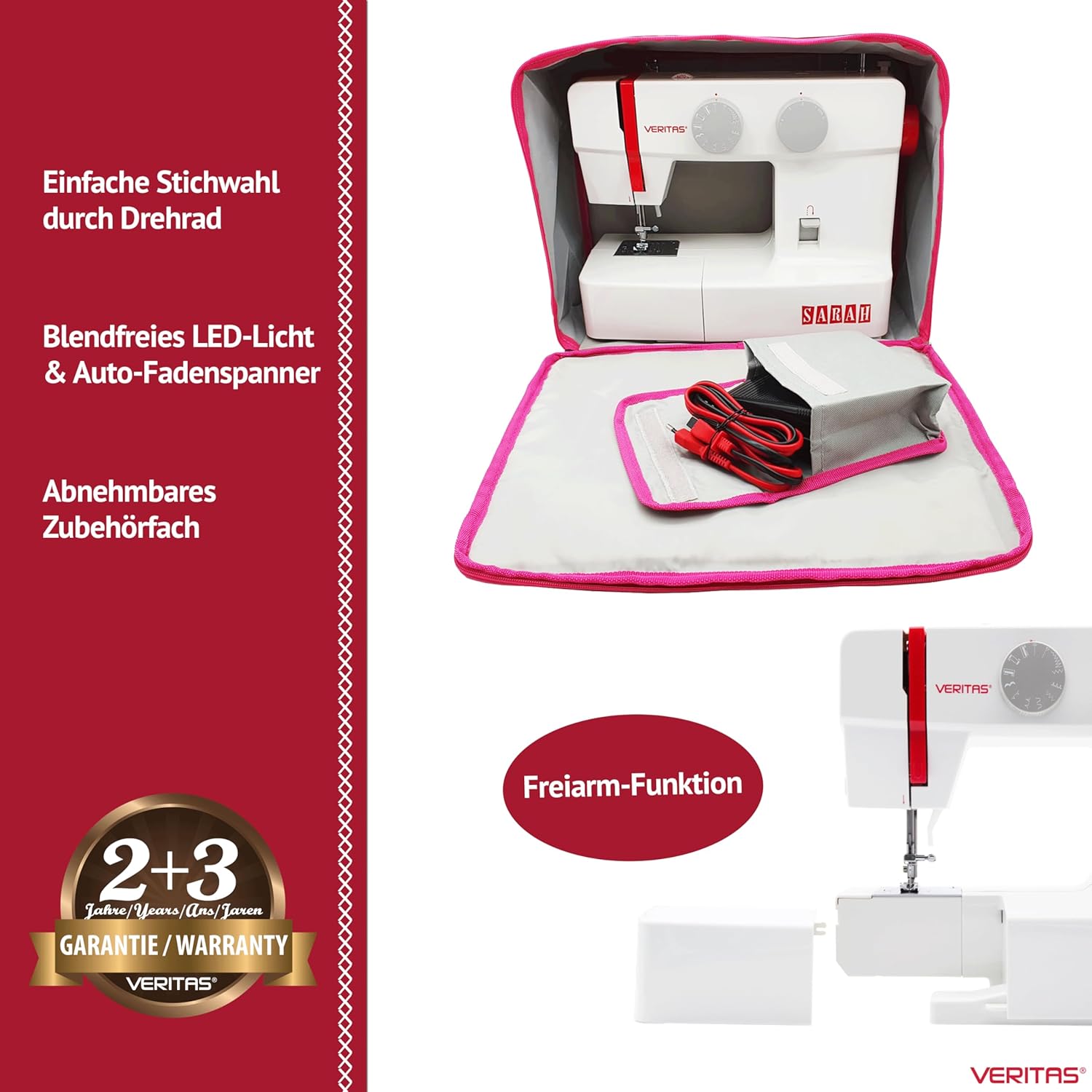
Image 4.3: Convenience features of the VERITAS Sarah. This image shows easy stitch selection via a rotary dial, glare-free LED light, auto-thread tensioner, a removable accessory compartment, and the free-arm function.
5. Setup
5.1 Unpacking and Placement
- Carefully remove the sewing machine from its packaging.
- Place the machine on a stable, flat surface with adequate lighting.
- Ensure there is enough space around the machine for comfortable operation and fabric handling.
5.2 Power Connection
- Connect the foot controller plug to the machine's power socket.
- Plug the power cord into a suitable electrical outlet.
- Turn on the machine using the power switch, usually located on the side or back.
5.3 Bobbin Winding
- Place a spool of thread on the spool pin.
- Guide the thread through the upper thread guide and around the bobbin winding tension disc.
- Insert the thread through the hole in the bobbin and place the bobbin onto the bobbin winder spindle.
- Push the bobbin winder spindle to the right.
- Gently press the foot controller to start winding. Stop when the bobbin is full.
- Cut the thread and push the bobbin winder spindle back to the left.
5.4 Inserting the Bobbin
- Open the bobbin cover plate.
- Insert the wound bobbin into the bobbin case, ensuring the thread unwinds in the correct direction (usually counter-clockwise).
- Guide the thread through the tension spring and into the thread guide slot.
- Close the bobbin cover plate.
5.5 Threading the Upper Thread
- Raise the presser foot lever.
- Place a spool of thread on the spool pin.
- Follow the numbered threading path indicated on the machine, guiding the thread through all guides and tension discs.
- Bring the thread down and through the needle eye from front to back.
- Pull about 15 cm (6 inches) of thread through the needle eye and under the presser foot.
5.6 Bringing Up the Bobbin Thread
- Hold the upper thread lightly with your left hand.
- Turn the handwheel towards you to lower the needle into the needle plate and then raise it again.
- The upper thread will catch the bobbin thread, forming a loop. Pull the loop to bring the bobbin thread up through the needle plate hole.
- Pull both threads (upper and bobbin) under the presser foot and towards the back of the machine.
6. Operating Instructions
6.1 Stitch Selection
The VERITAS Sarah offers 13 different stitch patterns. To select a stitch, turn the stitch selection dial (left rotary wheel) until the desired stitch pattern aligns with the indicator mark.
6.2 Adjusting Stitch Length
Adjust the stitch length using the stitch length dial (right rotary wheel). You can set the length between 0 and 4 mm. For most general sewing, a length of 2.5 mm is suitable.
6.3 Starting to Sew
- Place the fabric under the presser foot.
- Lower the presser foot lever.
- Gently press the foot controller to start sewing. The harder you press, the faster the machine will sew.
- Guide the fabric gently with both hands, but do not push or pull it forcefully.
6.4 Reverse Sewing
To reinforce stitches at the beginning and end of a seam, press and hold the reverse lever/button. The machine will sew backward. Release the lever/button to resume forward sewing.
6.5 Finishing a Seam
- Sew a few reverse stitches to secure the seam.
- Raise the needle to its highest position by turning the handwheel towards you.
- Raise the presser foot lever.
- Pull the fabric towards the back of the machine.
- Use the integrated thread cutter or scissors to cut the threads, leaving about 10-15 cm (4-6 inches) of thread.
6.6 Buttonhole Sewing (4-Step)
- Attach the buttonhole foot.
- Mark the buttonhole position on your fabric.
- Select the first step of the buttonhole program on the stitch selection dial.
- Sew the first side of the buttonhole.
- Change to the next step on the dial and sew the bar tack.
- Continue through all four steps, following the machine's instructions for each segment of the buttonhole.
- Use the seam ripper to carefully open the buttonhole.
6.7 Free Arm Sewing
To use the free arm, simply slide off the accessory compartment. This exposes the narrow free arm, making it easier to sew small, circular items.
7. Maintenance
Regular maintenance ensures the longevity and optimal performance of your sewing machine. Always disconnect the machine from the power supply before performing any maintenance.
7.1 Cleaning the Bobbin Area
- Remove the needle, presser foot, and needle plate.
- Remove the bobbin case.
- Use the small brush provided to remove any lint and dust accumulated in the bobbin area and feed dog teeth.
- Reassemble the parts.
7.2 Oiling (If Applicable)
Refer to the detailed instruction manual for specific oiling points and frequency. Generally, a few drops of sewing machine oil in designated areas can keep moving parts running smoothly. Avoid over-oiling.
7.3 Needle Replacement
Replace the needle regularly (after 8-10 hours of sewing) or if it becomes bent, dull, or broken. Use the screwdriver to loosen the needle clamp screw, remove the old needle, insert a new one with the flat side facing the back, and tighten the screw. Ensure the needle is fully inserted.
8. Troubleshooting
This section addresses common issues you might encounter. For more detailed troubleshooting, consult the full instruction manual.
8.1 Skipped Stitches
- Cause: Incorrect needle, bent needle, improper threading, wrong needle size for fabric.
- Solution: Replace the needle with a new, correct type and size for your fabric. Re-thread the machine completely, ensuring all guides are followed.
8.2 Thread Breakage (Upper Thread)
- Cause: Incorrect upper thread tension, improperly threaded, burr on needle eye or thread path, poor quality thread, needle inserted incorrectly.
- Solution: Check and adjust upper thread tension. Re-thread the machine. Inspect the needle and thread path for rough spots. Use good quality thread. Ensure needle is correctly inserted.
8.3 Thread Breakage (Bobbin Thread)
- Cause: Improperly wound bobbin, incorrect bobbin insertion, lint in bobbin case, incorrect bobbin tension.
- Solution: Re-wind the bobbin evenly. Re-insert the bobbin correctly. Clean the bobbin case area.
8.4 Uneven Stitches / Looping
- Cause: Incorrect thread tension (upper or bobbin), improper threading, wrong needle size, pulling fabric.
- Solution: Adjust thread tensions. Re-thread both upper and bobbin threads. Use the correct needle. Allow the feed dogs to move the fabric naturally.
8.5 Machine Not Starting
- Cause: Power cord not plugged in, power switch off, bobbin winder spindle engaged, machine jammed.
- Solution: Check power connections. Ensure power switch is on. Disengage bobbin winder spindle. Check for thread jams in the bobbin area or needle plate.
9. Specifications
| Brand | VERITAS |
| Model Number | 1301 |
| Product Dimensions (L x W x H) | 37 x 16 x 29.5 cm |
| Item Weight | 5 kg |
| Material | Metal (Aluminum Die-Cast Frame), Plastic |
| Stitch Programs | 13 |
| Buttonhole Type | 4-Step Automatic |
| Max. Stitch Length | 4 mm |
| Max. Stitch Width | 5 mm |
| Sewing Speed | 750 stitches/minute |
| Lighting | LED |
| Power Source | Corded Electric |

Image 9.1: Dimensions of the VERITAS Sarah Sewing Machine. This image provides a visual representation of the machine's length (37 cm), width (16 cm), and height (29.5 cm).
10. Warranty and Support
10.1 Warranty Information
The VERITAS Sarah Sewing Machine comes with a 5-year manufacturer's warranty. This typically includes a standard 2-year warranty, which can be extended by an additional 3 years upon product registration. Please refer to the warranty card included in your packaging or the manufacturer's official website for detailed terms and conditions regarding warranty claims and registration procedures.

Image 10.1: Comparison highlighting VERITAS quality and warranty. This image emphasizes the stable aluminum die-cast frame, high piercing power for all fabrics, modern manufacturing, and the 5-year extended manufacturer's warranty upon registration.
Image 10.2: Visual representation of the 2+3 year warranty for the VERITAS Sarah. This image clearly shows "2+3 Jahre/Years/Ans/Jaren GARANTIE/WARRANTY VERITAS".
10.2 Customer Support
For technical assistance, spare parts, or further inquiries, please contact VERITAS customer support. Contact details can typically be found on the manufacturer's website or in the documentation included with your product.


