1. Introduction
This manual provides instructions for the proper use, maintenance, and care of your FOUR E'S SCIENTIFIC Adjustable Micropipette (1-10ml). This single-channel micropipette is designed for precise and accurate liquid handling in laboratory and scientific applications. Its ergonomic design aims to maximize user comfort and reduce strain during operation.

Figure 1: FOUR E'S SCIENTIFIC Adjustable Micropipette (1-10ml) in use.
2. Product Components
Familiarize yourself with the various parts of the micropipette to ensure correct operation and maintenance.

Figure 2: Key components of the micropipette. This diagram highlights the digital display for volume setting, the push button for aspiration and dispensing, the tip ejector for safe tip removal, the nozzle connection for tip attachment, and the recommended original tip.

Figure 3: Detailed view of the micropipette's functional parts. This image shows the pump button (range adjustable button), the digital display for easy volume reading, the tip ejector, and indicates that the lower section is autoclavable at 121°C for 20 minutes.
Packing List
Upon unpacking, verify that all items listed below are present:

Figure 4: Contents of the product packaging. The package includes 1. Single Channel Micropipette, 2. Professional Color Box Packaging, 3. Instruction manual, 4. Calibration Report, 5. Lubricating Gel, 6. Filter Replacement Clip, 7. Filter for Nozzle Connection (x4), 8. Simple Pipette Holder, 9. Calibration Tool, 10. Pipette Tip (x1).
- Single Channel Micropipette x 1
- Professional Color Box Packaging x 1
- Instruction manual x 1
- Calibration Report x 1
- Lubricating Gel x 1
- Filter Replacement Clip x 1
- Filter for Nozzle Connection x 4
- Simple Pipette Holder x 1
- Calibration Tool x 1
- Pipette Tip x 1
3. Setup
3.1 Attaching a Pipette Tip
To ensure accurate and precise liquid transfer, it is crucial to properly attach a pipette tip. Use only FOUR E'S SCIENTIFIC tips designed for this micropipette (1-10ml) to ensure a complete seal and prevent leakage. Universal tips from other brands may not provide an adequate seal.
- Select a clean, appropriate 10ml pipette tip.
- Gently push the micropipette's nozzle into the tip with a slight twisting motion until a secure seal is formed. Do not force the tip on, as this can damage the nozzle.
- Visually inspect the connection to ensure there are no gaps.
4. Operating Instructions
4.1 Setting the Volume
The micropipette features a digital display for clear and precise volume adjustment. The volume range for this model is 1-10ml, with an increment of 100µL (0.1ml).
- Rotate the pump button (range adjustable button) clockwise to decrease the volume or counter-clockwise to increase it.
- Observe the digital display to set the desired volume. Ensure the volume is within the specified range of 1-10ml.
4.2 Aspirating Liquid
Follow these steps for accurate liquid aspiration:
- Attach a suitable pipette tip (refer to Section 3.1).
- Press the pump button down to the first stop.
- Immerse the tip into the liquid to be aspirated, ensuring it is submerged sufficiently but not touching the bottom of the container.
- Slowly release the pump button to draw the liquid into the tip. Allow the button to return to its original position smoothly.
- Remove the tip from the liquid, touching it against the edge of the container to remove any excess droplets.
4.3 Dispensing Liquid
To dispense the aspirated liquid:
- Place the tip against the inner wall of the receiving vessel at a slight angle.
- Press the pump button down slowly to the first stop to dispense the majority of the liquid.
- Continue pressing the pump button to the second stop (blow-out) to expel any remaining liquid from the tip.
- Hold the button at the second stop for a moment, then withdraw the tip from the vessel while keeping the button depressed.
- Release the pump button.
4.4 Tip Ejection
To safely remove the used tip:
- Press the tip ejector button firmly. The tip will be released into a waste container.

Figure 5: Example application of the micropipette for precise liquid transfer.
5. Maintenance
5.1 Cleaning
Regular cleaning ensures the longevity and accuracy of your micropipette.
- Wipe the exterior of the micropipette with a soft cloth dampened with mild detergent or 70% ethanol.
- Do not immerse the entire micropipette in liquid.
- The lower section of the micropipette can be detached and autoclaved.
5.2 Autoclaving
The lower section of the micropipette is autoclavable for sterilization.
- Detach the lower section from the main body of the micropipette.
- Autoclave the lower section at 121°C for 20 minutes.
- Allow the section to cool completely before reassembling.
5.3 Calibration
The micropipette is factory calibrated according to ISO 8655 standards. If recalibration is required, use the supplied calibration tool and follow standard laboratory procedures for gravimetric calibration. Regular calibration checks are recommended to maintain accuracy.
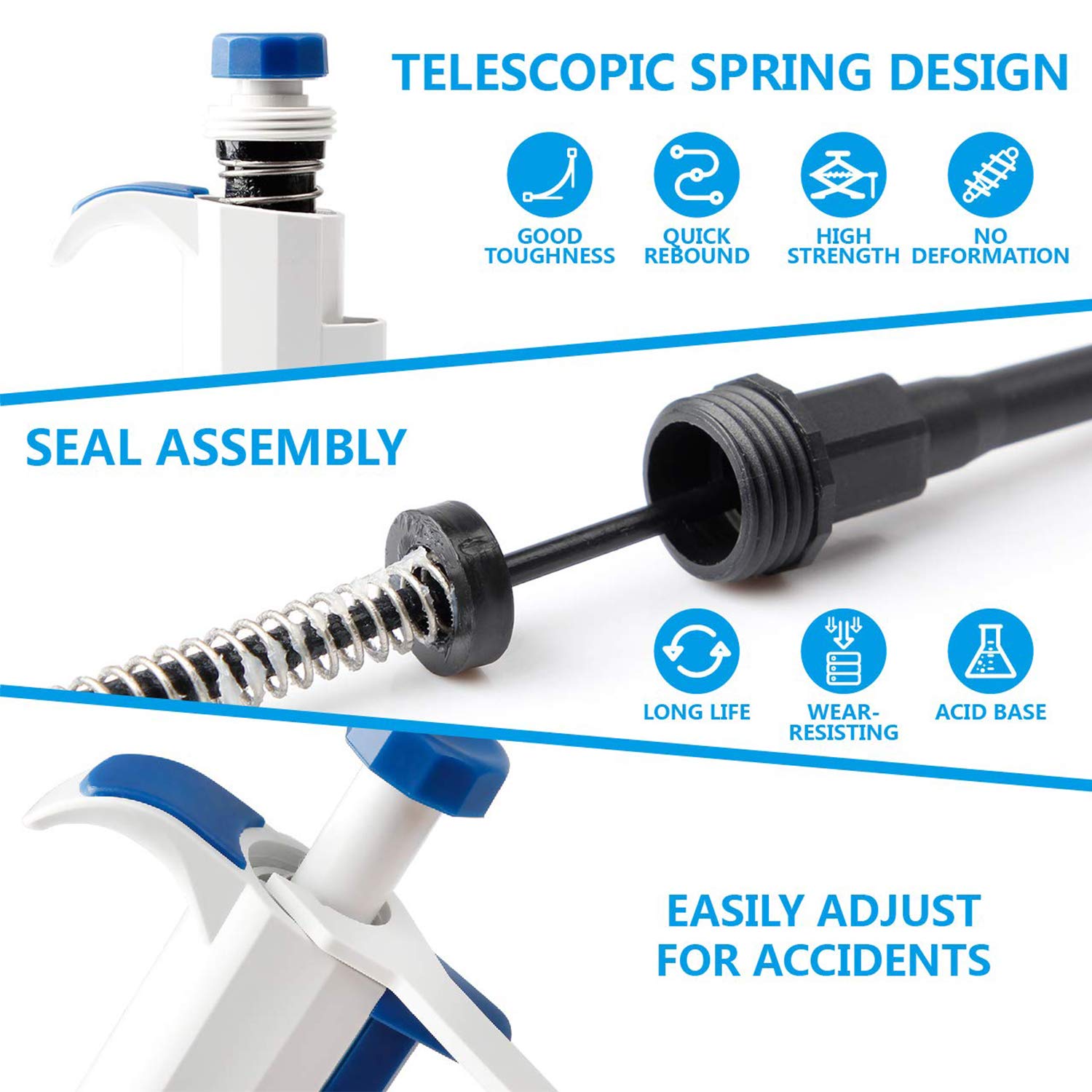
Figure 6: Internal components illustrating the telescopic spring design for consistent performance and the seal assembly for durability and resistance to acids and bases.
The internal telescopic spring design ensures good toughness, quick rebound, and high strength without deformation. The seal assembly is designed for long life, wear resistance, and compatibility with acid and base solutions.
6. Troubleshooting
| Problem | Possible Cause | Solution |
|---|---|---|
| Inaccurate volume dispensing | Improper tip attachment; worn seal; incorrect calibration; rapid aspiration/dispensing. | Ensure tip is securely attached. Check for leaks. Recalibrate the pipette. Aspirate and dispense slowly and smoothly. |
| Liquid leakage from tip | Loose or incompatible tip; damaged nozzle; worn O-ring/seal. | Use only FOUR E'S SCIENTIFIC tips. Inspect nozzle for damage. Replace O-ring/seal if necessary. |
| Pump button sticky or difficult to press | Lack of lubrication; internal contamination. | Apply a small amount of lubricating gel (supplied) to the plunger. Clean the internal mechanism if accessible and necessary. |
| Volume dial rotates unintentionally | Loose mechanism (less common for this model). | Ensure careful handling during operation. If persistent, contact customer support. |
7. Specifications
- Volume Range: 1 - 10 ml
- Increment: 100 µL (0.1 ml)
- Model Number: 4ESS-TB-GP-09-USA
- Ergonomic Design: Yes
- Digital Volume Display: Yes
- Calibration: Easy to calibrate with supplied tool, calibrated to ISO 8655 standards.
- Tip Cone Filters: Secure filters prevent internal contamination and damage.
- Autoclavable Section: Lower section (121°C, 20 min).
- Dimensions: 3 x 3 x 29 cm
- Weight: 68.04 g
Accuracy and Precision Data (1-10ml Micropipette)

Figure 7: Accuracy and Precision specifications for different volume ranges. For the 1-10ml range, at a test volume of 10000 µL (10ml), the Max Accuracy Error is 0.60% (60 µL) and Max Precision Error is 0.20% (20 µL). At 5000 µL (5ml), Accuracy Error is 1.20% (60 µL) and Precision Error is 0.30% (15 µL). At 2000 µL (2ml), Accuracy Error is 3.00% (60 µL) and Precision Error is 0.60% (12 µL).
The table above provides detailed accuracy and precision specifications for various volume ranges, including the 1-10ml model. These values are critical for ensuring reliable experimental results.
8. Warranty and Support
This FOUR E'S SCIENTIFIC Micropipette comes with a 1-year warranty from the date of purchase. This warranty covers manufacturing defects and material flaws under normal use conditions.
For technical support, warranty claims, or inquiries regarding replacement parts and accessories (such as pipette tips), please contact FOUR E'S SCIENTIFIC customer service. Refer to your purchase documentation for specific contact details.


