
1.0 Introduction
This manual provides comprehensive instructions for the safe and efficient operation, installation, and maintenance of Pacific J Series Press Brakes. It is essential to read and understand all sections of this manual before attempting to install, operate, or service the machine. This document covers critical information including safety guidelines, component identification, control functions, operational procedures, and troubleshooting.
Figure 1.1: Cover page of the Pacific J Series Press Brakes Operations, Installation, and Maintenance Manual. This image displays the title "PACIFIC HYDRAULIC J-SERIES PRESSBRAKES INSTALLATION, OPERATION & MAINTENANCE MANUAL" along with the manufacturer's details.
2.0 Safety Guidelines
Safety is paramount when operating industrial machinery. Adherence to all safety guidelines outlined in this section is mandatory to prevent injury to personnel and damage to equipment.
2.1 Management Safety Guidelines
- Ensure all operators and die setters are properly trained and authorized.
- Implement and enforce a comprehensive safety program.
- Regularly inspect machinery for proper functioning and safety features.
- Provide appropriate personal protective equipment (PPE).
2.2 Safety Guidelines for Operators
- Always wear appropriate PPE, including safety glasses, gloves, and steel-toed boots.
- Never operate the press brake without proper training and authorization.
- Ensure all safety guards are in place and functional before operation.
- Keep hands and body clear of moving parts during operation.
- Report any malfunctions or unsafe conditions immediately.
2.3 Safety Guidelines for Die Setters
- Ensure the machine is powered off and locked out before setting or changing dies.
- Use appropriate lifting equipment for heavy dies.
- Verify dies are securely fastened and aligned correctly.
- Perform a test cycle at a slow speed after die changes.
3.0 Press Components and Nomenclature
Understanding the various components of the Pacific J Series Press Brake is crucial for proper operation and maintenance. Refer to the diagram below for a visual representation and corresponding nomenclature.
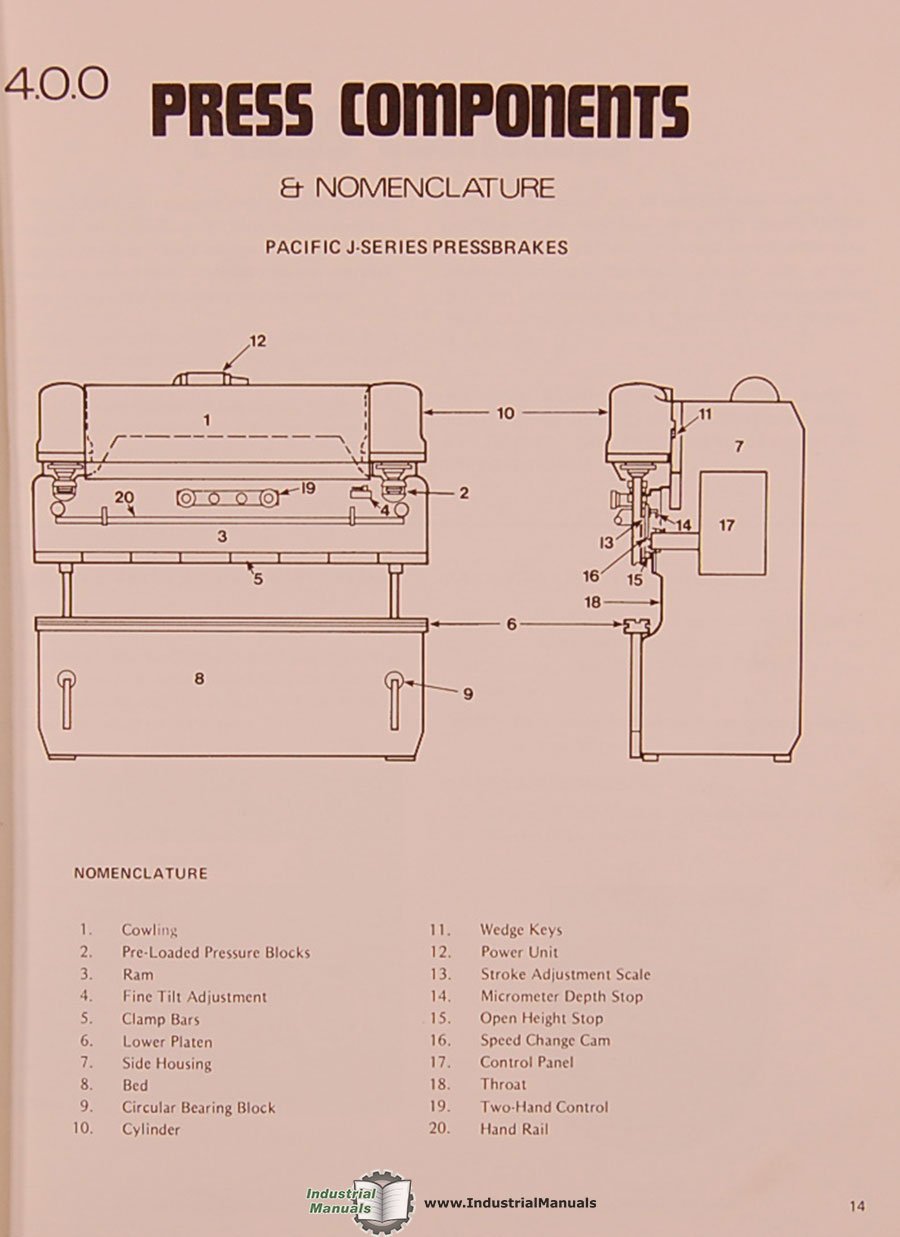
Figure 3.1: Detailed diagram illustrating the main components of the Pacific J Series Press Brake. Key components are numbered and include Cowling, Pre-Loaded Pressure Blocks, Ram, Fine Tilt Adjustment, Clamp Bars, Lower Platen, Side Housing, Bed, Circular Bearing Block, Cylinder, Wedge Keys, Power Unit, Stroke Adjustment Scale, Micrometer Depth Stop, Open Height Stop, Speed Change Cam, Control Panel, Throat, Two-Hand Control, and Hand Rail.
Nomenclature List:
- Cowling
- Pre-Loaded Pressure Blocks
- Ram
- Fine Tilt Adjustment
- Clamp Bars
- Lower Platen
- Side Housing
- Bed
- Circular Bearing Block
- Cylinder
- Wedge Keys
- Power Unit
- Stroke Adjustment Scale
- Micrometer Depth Stop
- Open Height Stop
- Speed Change Cam
- Control Panel
- Throat
- Two-Hand Control
- Hand Rail
4.0 Press Controls
The Pacific J Series Press Brake is equipped with various controls for precise operation. Familiarize yourself with the function of each control before operating the machine.
- Motor Starter & Main Circuit Breaker: Controls the main power to the machine.
- Motor Start/Stop Push Buttons: Initiates and halts the motor.
- Ground Connected Light: Indicates proper grounding.
- Mode Selector Switch: Allows selection between different operational modes (e.g., "Off," "Jog," "Single Stroke Automatic Return").
- Two-Hand Control: Requires simultaneous activation of two buttons for ram movement, ensuring operator safety.
- Emergency Stop Button: Immediately halts all machine functions in an emergency.
- Foot Switch: Provides an alternative or supplementary control for ram movement.
- Advanced Speed Selector Switch: Adjusts the ram speed for different operations.
- Stroke Adjustment: Controls the upper and lower limits of the ram's travel.
- Speed Change Cam: Adjusts the point at which the ram changes speed during its cycle.
5.0 Installation
Proper installation is critical for the safe and efficient operation of your press brake. Follow these steps carefully.
- Pre-Installation Instructions: Review site requirements, power supply, and foundation plans.
- Shipping & Receiving: Inspect the machine for any damage incurred during transit.
- Unloading & Lifting: Use appropriate lifting equipment and techniques to move the press brake to its installation location.
- Foundation: Ensure the foundation is level and capable of supporting the machine's weight and operational forces.
- Cleaning: Remove all packing materials and protective coatings.
- Press Installation Procedure: Position the machine accurately on the foundation.
- Leveling the Press: Use shims and a precision level to ensure the machine is perfectly level.
- Power Unit Piping Connection: Connect all hydraulic lines according to the provided diagrams.
- Hydraulic Oil: Fill the hydraulic reservoir with the specified type and quantity of hydraulic oil.
- Electrical Connection: Connect the machine to the main power supply, ensuring proper grounding and adherence to local electrical codes.
- Ground Connection: Verify all ground connections are secure.
- Motor Connection: Connect the motor wiring as per the electrical schematics.
- Footswitch Connection: Connect the footswitch if applicable.
- Electrical Check: Perform a thorough check of all electrical circuits before initial power-up.
6.0 Pre-Start Procedures
Before starting the press brake, perform these checks to ensure safe and optimal operation.
- Fluid Levels: Check hydraulic oil level and ensure it is within the recommended range.
- Lubrication: Verify all lubrication points have been serviced.
- Die Condition: Inspect dies for wear, damage, and proper seating.
- Work Area: Ensure the work area is clear of obstructions and debris.
- Safety Devices: Confirm all safety guards, light curtains, and emergency stops are functional.
- Electrical Connections: Visually inspect all electrical connections for security.
7.0 Initial Start-Up
Follow these steps for the initial start-up of the Pacific J Series Press Brake.
- Start-Up Procedure: Turn on the main power and motor.
- Testing of Controls: Test all control buttons, switches, and the footswitch for proper response.
- Checking Inch Mode: Verify the ram moves incrementally in "Inch" mode.
- Checking Single Stroke Automatic Return Mode: Confirm the ram completes a single stroke and returns automatically.
- Checking Three Speed Circuit: Test the ram's movement at different speed settings.
- Shutting Down the Press: Practice proper shutdown procedures.
- Blocking the Ram: Understand and practice safe ram blocking procedures for maintenance.
8.0 Press Operations
This section details the operational procedures for the Pacific J Series Press Brake.
- Operating Mode Chart: Refer to the chart for appropriate mode selection based on the task.
- Press Capacity: Do not exceed the rated tonnage capacity of the machine.
- Tonnage Control: Adjust tonnage settings according to material thickness and bend requirements.
- Stroke Adjustment: Set the upper and lower limits of the ram stroke.
- Depth Stop: Precisely set the depth the ram descends to achieve the desired bend angle.
- Open Height Stop: Adjust the maximum open height of the ram.
- Tilt Adjustment Procedure: Calibrate the ram tilt for accurate bending across the length of the workpiece.
- Sheet Selection: Choose appropriate dies and settings for the specific sheet material.
- Level Control Adjustment: Ensure the ram remains level throughout its stroke.
- Ram Level Bypass: Use only when necessary and with extreme caution, following specific safety protocols.
9.0 Maintenance
Regular maintenance is essential to ensure the longevity and reliable performance of your Pacific J Series Press Brake. Always ensure the machine is powered off and locked out before performing any maintenance.
- Lubrication: Follow the lubrication schedule for all moving parts and bearings.
- Centralized Manual One-Shot Lubrication System: Understand and operate this system for efficient lubrication.
- Replacing Hydraulic Oil: Periodically replace hydraulic oil as per manufacturer recommendations.
- Operating Temperature: Monitor hydraulic oil temperature to prevent overheating.
- Oil Filtration System: Maintain and clean the oil filtration system.
- Pump Maintenance: Inspect and maintain the hydraulic pump.
- Hydraulic Circuit: Regularly check for leaks and proper pressure.
- Valve Adjustment: Adjust hydraulic valves as needed for optimal performance.
- Pressure Control Valve Setting: Verify and adjust pressure settings.
- Relief Pilot Valve: Inspect and maintain the relief pilot valve.
- Pilot Relief Valves: Inspect and maintain pilot relief valves.
- Replacing Rod Packing: Replace worn rod packing to prevent leaks.
- Replacing Piston Packing: Replace worn piston packing as required.
- Level Control Adjustment: Re-calibrate level control after major maintenance.
- Slideway Assembly: Inspect and lubricate slideway assemblies.
- Preventative Maintenance Checks: Conduct routine checks as outlined in the maintenance schedule.
- Periodic Servicing: Schedule professional servicing at recommended intervals.
- Recommended Spare Parts: Keep a stock of essential spare parts.
10.0 Troubleshooting
This section provides guidance for identifying and resolving common issues that may arise during the operation of your Pacific J Series Press Brake. For complex problems, contact qualified service personnel.
| Problem | Possible Cause | Solution |
|---|---|---|
| Machine does not power on | Main circuit breaker tripped, emergency stop engaged, power supply issue. | Check circuit breaker, disengage emergency stop, verify power connection. |
| Ram does not move | Low hydraulic fluid, faulty control switch, safety interlock engaged. | Check hydraulic fluid level, inspect control switches, ensure all safety interlocks are clear. |
| Inaccurate bend angle | Incorrect depth stop setting, worn dies, material inconsistencies. | Adjust depth stop, inspect and replace worn dies, verify material properties. |
| Excessive noise or vibration | Low hydraulic fluid, loose components, worn bearings. | Check hydraulic fluid, tighten loose components, inspect and replace worn bearings. |
11.0 Specifications
The following are the general specifications for the Pacific J Series Press Brakes. Specific models may have variations.
- ASIN: B01E30RTZG
- Publisher: Pacific
- Publication Date: January 1, 2016
- Language: English
- Print Length: 51 pages
Figure 11.1: Page from the manual titled "BASIC DATA & CHARACTERISTICS OF PACIFIC HYDRAULIC PRESSES". This page typically contains fields for customer information, serial number, model number, maximum tonnage, punching tonnage, outline drawing, foundation plan, electrical control circuit drawing, and hydraulic circuit drawing.
12.0 Warranty Information
Specific warranty terms and conditions for the Pacific J Series Press Brake are typically provided at the time of purchase or can be obtained directly from Pacific or an authorized dealer. Please refer to your purchase documentation for detailed warranty coverage, duration, and claim procedures.
13.0 Customer Support
For technical assistance, spare parts, or service inquiries regarding your Pacific J Series Press Brake, please contact your authorized Pacific dealer or the manufacturer directly. Ensure you have your machine's model and serial number available when contacting support.
Contact information can typically be found on the machine's nameplate or in your purchase documentation.


