
1. Introduction
The E-flite F4U-4 Corsair 1.2M is a high-performance park flyer model airplane designed for enthusiasts. This manual provides essential information for the safe assembly, operation, and maintenance of your aircraft. Please read it thoroughly before operating the model.
Key Features:
- Easy to complete final assembly.
- AS3X technology for rock-solid flight stability.
- Accurate multi-sectional flaps with servos.
- Retractable 90° rotating electric main landing gear.
- 6-channel control with a steerable tail wheel.
- Spektrum 6-channel AR636A DSMX receiver.
- Powerful 15-size, 850Kv brushless motor.
- E-flite 40-amp brushless ESC.
- Accepts 2200mAh 3S 11.1V Li-Po battery packs (sold separately).
- 6 × Lightweight Spektrum micro servos.
- Constructed with durable Z-Foam material.
- Authentic US Marine Corps VMFT-20 training squadron trim scheme.
- Realistic cockpit, 4-blade propeller, and radial engine detail.
- Removable wing tanks included.
2. Setup and Assembly
The E-flite F4U-4 Corsair 1.2M is designed for easy final assembly. Follow these general steps to prepare your aircraft for flight.
2.1 Components Needed to Complete
To operate this aircraft, you will need the following items, sold separately:
- Full-range 6+ channel transmitter with Spektrum DSM2/DSMX technology.
- Flight battery – E-Flite 2200mAh 3S 11.1V 25C Li-Po (EFLB22003S30) recommended.
- Suitable charger for Li-Po batteries.

Image: Icons illustrating the necessary components: battery, charger, and transmitter.
2.2 Aircraft Overview
Familiarize yourself with the aircraft's structure and key features before beginning assembly.

Image: The E-flite F4U-4 Corsair 1.2M model airplane, showcasing its detailed design and livery, resting on a field.
2.3 Landing Gear Assembly
The model features retractable 90° rotating electric main landing gear and a steerable tail wheel. Ensure all landing gear components are securely attached and function smoothly before flight.

Image: A detailed view of the F4U-4 Corsair's retractable landing gear, showing the wheel and strut mechanism.
2.4 Wing and Flap Installation
The aircraft is equipped with multi-sectional flaps for enhanced control. Attach the wings securely and ensure the flap servos are correctly connected and calibrated.
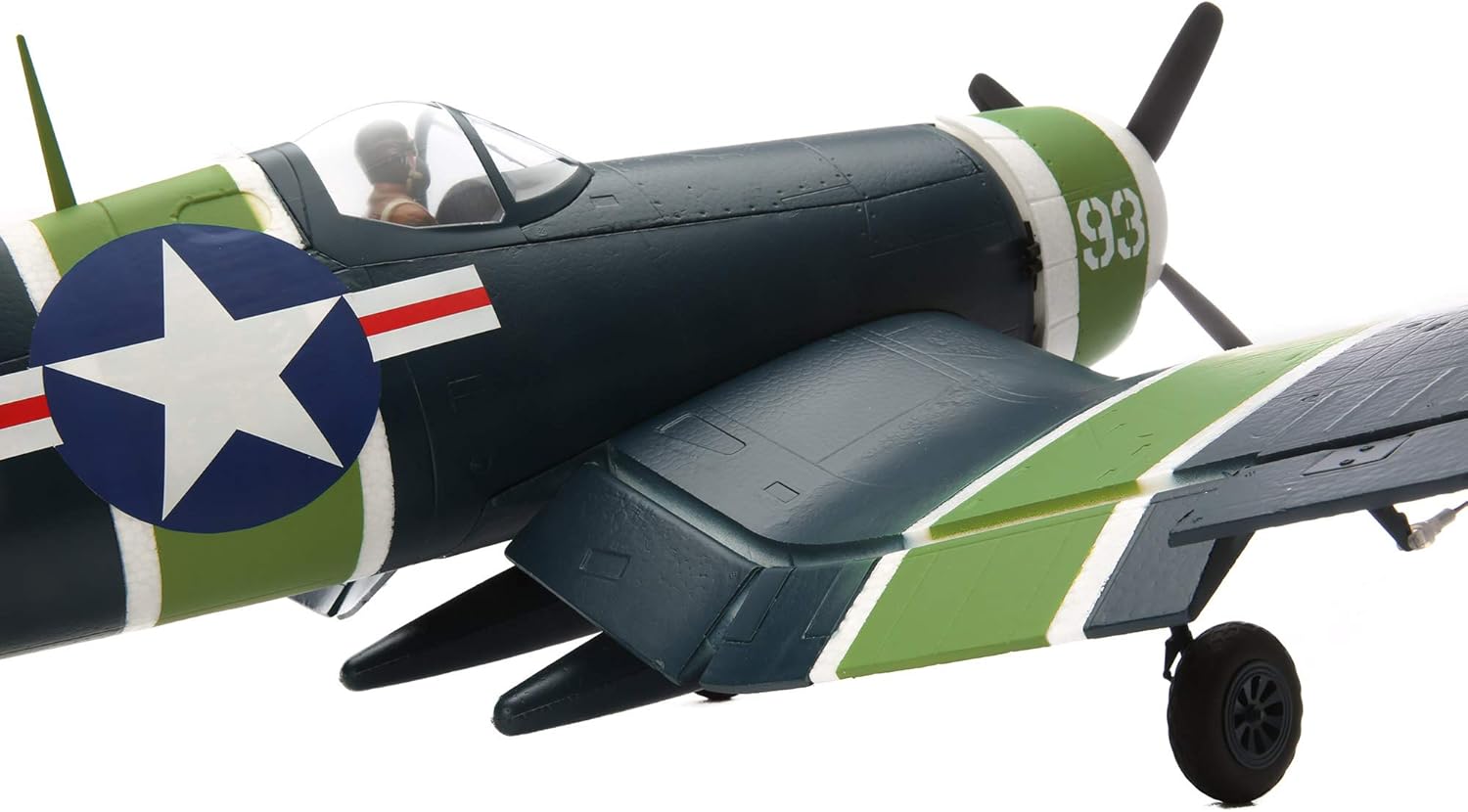
Image: A close-up shot highlighting the wing and fuselage junction, displaying the aircraft's detailed surface and markings.
2.5 Cockpit and Internal Electronics Access
The cockpit is removable, providing access to the internal electronics, including the Spektrum AR636A DSMX receiver and servos. Ensure all connections are firm and wiring is tidy.

Image: A hand lifting the cockpit canopy of the F4U-4 Corsair, revealing the pilot figure and access point to internal components.

Image: An overhead view into the fuselage of the F4U-4 Corsair, showing the neatly arranged receiver, servos, and battery strap.
3. Operating Instructions
The E-flite F4U-4 Corsair 1.2M is equipped with AS3X technology for enhanced flight stability. This system works behind the scenes to smooth out the effects of wind and turbulence, providing a more locked-in feel.
3.1 Pre-Flight Checks
- Ensure your Li-Po flight battery is fully charged and securely installed.
- Verify all control surfaces (ailerons, elevator, rudder, flaps) move freely and in the correct direction with your transmitter inputs.
- Check landing gear retraction and extension.
- Perform a range check of your radio system.
- Ensure the propeller is securely attached and free from damage.
3.2 Takeoff
For takeoff, apply throttle smoothly. The steerable tail wheel assists with ground handling. Be prepared to apply rudder input to maintain a straight path during acceleration.
3.3 Flight Characteristics
The AS3X system provides a stable flight experience. The multi-sectional flaps can be used for slower flight and improved landing approaches. Maintain adequate airspeed, especially during turns and climbs, to prevent tip stalls.
3.4 Landing
Approach landings with caution. Deploy flaps as needed to reduce speed. For grass landings, be mindful of the landing gear, as rough surfaces can cause damage. Maintain some throttle during descent to ensure adequate control until touchdown.

Image: The F4U-4 Corsair model airplane positioned on a runway at sunset, viewed from behind, highlighting its silhouette against the sky.
4. Maintenance
Regular maintenance ensures the longevity and safe operation of your E-flite F4U-4 Corsair 1.2M.
- Cleaning: Clean the Z-Foam airframe with a soft, damp cloth after each flight to remove dirt and debris. Avoid harsh chemicals.
- Inspection: Regularly inspect all components for damage, wear, or loose connections. Pay close attention to control linkages, hinges, landing gear, and the propeller.
- Motor and ESC: Ensure the brushless motor and ESC are free from obstructions and overheating.
- Servos: Check servo operation and ensure they are securely mounted. Replace any faulty servos promptly.
- Battery Care: Follow all manufacturer guidelines for Li-Po battery charging, storage, and discharge.
5. Troubleshooting
This section addresses common issues you might encounter with your E-flite F4U-4 Corsair 1.2M.
| Problem | Possible Cause | Solution |
|---|---|---|
| Aircraft tip stalls at low speed. | Insufficient airspeed, especially during turns or landing approach. | Maintain adequate throttle and airspeed. Avoid sharp turns at low speeds. Use flaps appropriately. |
| Landing gear breaks easily. | Rough landings, especially on uneven surfaces like grass. | Practice smoother landings. Consider landing on paved surfaces if possible. Inspect and reinforce landing gear if issues persist. |
| Motor mounted crooked. | Manufacturing defect or damage during transport/assembly. | Inspect motor mount for proper alignment. If crooked, contact support for assistance or carefully adjust if possible. |
| Receiver not activating. | Loose connections, un-bound receiver, faulty battery. | Check all power connections. Ensure receiver is properly bound to your transmitter. Verify flight battery is charged. |
| Difficulty with rudder control on takeoff. | Torque effect from propeller, improper trim, or strong crosswind. | Apply appropriate rudder input during takeoff roll. Adjust rudder trim. Consider taking off into the wind. |
| Servo issues (e.g., not responding, jittering). | Damaged servo, loose connection, or power issue. | Check servo connections. Test servo with a servo tester. Replace damaged servos. |
6. Specifications
| Specification | Value |
|---|---|
| Product Dimensions | 51.6 x 15.7 x 10.7 inches |
| Item Weight | 8.8 pounds |
| Item Model Number | EFL8550 |
| Manufacturer Recommended Age | 14 years and up |
| Manufacturer | Horizon Hobby |
| Date First Available | January 15, 2016 |
7. Warranty and Support
For warranty information and detailed support, please refer to the official E-flite website or contact Horizon Hobby directly. Specific warranty terms may vary by region and product.
You can also visit the E-flite Store on Amazon for additional product information and resources.