
1. Introduction
This manual provides detailed instructions for the safe and effective operation of the Extech EX355 True RMS Multimeter. The EX355 is a professional digital multimeter designed for a wide range of electrical measurements, including AC/DC voltage, current, resistance, capacitance, frequency, duty cycle, and temperature. It features True RMS for accurate readings of non-sinusoidal waveforms, Non-Contact Voltage (NCV) detection for enhanced safety, Low Impedance (LoZ) mode to prevent ghost voltage readings, and a Low Pass Filter (LPF) for noise reduction in electrical environments.
Please read this manual thoroughly before using the device to ensure proper function and to prevent potential hazards.
2. Safety Information
Always adhere to the following safety precautions to avoid personal injury or damage to the multimeter:
- Read all instructions: Familiarize yourself with the operation and safety features before use.
- Observe all warnings: Pay close attention to all warnings and cautions marked on the meter and in this manual.
- Use proper range: Always select the correct function and range for your measurement.
- Inspect test leads: Before each use, check test leads for damaged insulation or exposed metal. Replace if damaged.
- Do not exceed maximum input limits: Never apply voltage or current that exceeds the specified maximum limits for the meter.
- Avoid live circuits: Do not measure resistance, continuity, or diode on live circuits.
- Use caution with high voltages: Be extremely careful when working with voltages above 60V DC or 30V AC RMS, as these pose a shock hazard.
- Do not operate if damaged: If the meter appears damaged or is not operating properly, discontinue use immediately.
- Battery replacement: Replace batteries as soon as the low battery indicator appears to ensure accurate readings.
- CAT III 600V: This meter is designed for measurements in CAT III 600V environments.
3. Product Overview
The Extech EX355 is a versatile True RMS Multimeter equipped with several advanced features for accurate and safe electrical testing.
Key Features:
- 12 Measurement Functions: Includes AC/DC voltage, current, resistance, capacitance, frequency, duty cycle, and temperature.
- True RMS Accuracy: Ensures precise readings for both standard and distorted electrical waveforms.
- Non-Contact Voltage (NCV) Detection: Allows for quick and safe detection of AC voltage without direct contact.
- Low Impedance (LoZ) Mode: Prevents false readings caused by ghost voltages in circuits.
- Low Pass Filter (LPF): Reduces high-frequency noise for stable and accurate measurements in noisy environments.
- Display: 4000 count LCD display with backlight.
- Data Hold, Min/Max, Relative Mode: For capturing and analyzing measurements.
- Auto Power Off: Conserves battery life.
- Continuity and Diode Test: Essential for circuit diagnostics.

Figure 1: The Extech EX355 True RMS Multimeter. This image shows the front view of the multimeter, highlighting its display, rotary dial, function buttons, and input jacks.
4. Setup
4.1 Battery Installation
The Extech EX355 requires two (2) AA batteries for operation. These are typically included with the device.
- Ensure the multimeter is powered off.
- Locate the battery compartment cover on the rear of the unit.
- Unscrew the retaining screw(s) and carefully remove the cover.
- Insert two AA batteries, observing the correct polarity (+ and -) as indicated inside the compartment.
- Replace the battery compartment cover and secure it with the screw(s).
Note: Replace batteries immediately when the low battery indicator appears on the display to maintain measurement accuracy.
4.2 Connecting Test Leads
Always connect the test leads correctly for the desired measurement function.
- For most voltage, resistance, continuity, diode, capacitance, and frequency measurements, insert the red test lead into the VΩHzCAP jack and the black test lead into the COM jack.
- For current measurements up to 10A, insert the red test lead into the 10A jack and the black test lead into the COM jack.
- For current measurements up to 400mA, insert the red test lead into the mAµA jack and the black test lead into the COM jack.
- Ensure test leads are fully inserted into the jacks.
5. Operating Instructions
This section details how to perform various measurements using the Extech EX355 multimeter.
5.1 AC/DC Voltage Measurement
- Set the rotary dial to the V~ (AC Voltage) or V- (DC Voltage) position.
- Connect the red test lead to the VΩHzCAP jack and the black test lead to the COM jack.
- Touch the test probes to the circuit points where voltage is to be measured.
- Read the voltage value on the display.
5.2 AC/DC Current Measurement
Caution: Never connect the multimeter in parallel with a voltage source when measuring current. Always connect in series with the load.
- Set the rotary dial to the appropriate A~ (AC Current) or A- (DC Current) range (e.g., 10A or mAµA).
- Connect the red test lead to the 10A or mAµA jack and the black test lead to the COM jack.
- Open the circuit where current is to be measured and connect the test probes in series.
- Read the current value on the display.
5.3 Resistance Measurement
Warning: Ensure the circuit is de-energized before measuring resistance.
- Set the rotary dial to the Ω (Resistance) position.
- Connect the red test lead to the VΩHzCAP jack and the black test lead to the COM jack.
- Touch the test probes across the component or circuit segment to be measured.
- Read the resistance value on the display.
5.4 Capacitance Measurement
Warning: Discharge capacitors before measuring to prevent damage to the meter.
- Set the rotary dial to the CAP (Capacitance) position.
- Connect the red test lead to the VΩHzCAP jack and the black test lead to the COM jack.
- Touch the test probes across the capacitor terminals.
- Read the capacitance value on the display.
5.5 Frequency and Duty Cycle Measurement
- Set the rotary dial to the Hz/% (Frequency/Duty Cycle) position.
- Connect the red test lead to the VΩHzCAP jack and the black test lead to the COM jack.
- Touch the test probes to the signal source.
- Press the Hz/% button to toggle between frequency and duty cycle readings.
5.6 Temperature Measurement
The EX355 includes a general purpose bead wire temperature probe.
- Set the rotary dial to the Temp (Temperature) position.
- Insert the temperature probe into the VΩHzCAP (positive) and COM (negative) jacks, observing polarity.
- Place the tip of the temperature probe on or in the object to be measured.
- Read the temperature value on the display. The unit can display in Celsius or Fahrenheit.

Figure 2: Using the Extech EX355 to measure temperature in an HVAC vent. The image shows a person holding the multimeter and inserting the temperature probe into an air conditioning vent.
5.7 Non-Contact Voltage (NCV) Detection
NCV mode allows for quick detection of AC voltage without direct contact, enhancing safety.
- Set the rotary dial to the NCV position.
- Move the top of the multimeter near a conductor or outlet.
- The NCV indicator light will illuminate and an audible beep will sound if AC voltage is detected. The intensity of the beep and light may increase with stronger fields.
5.8 Low Impedance (LoZ) Mode
LoZ mode helps eliminate false readings caused by ghost voltages.
- Set the rotary dial to the LoZ V position.
- Connect the test leads as for standard voltage measurement.
- The meter will present a low impedance load to the circuit, dissipating ghost voltages and providing a more accurate reading of actual voltage.
5.9 Low Pass Filter (LPF)
The LPF function is used to filter out high-frequency noise, providing stable readings in variable frequency drive (VFD) applications or other noisy electrical environments.
- Set the rotary dial to an AC Voltage (V~) or AC Current (A~) range.
- Press the LPF button to activate the low pass filter. The LPF icon will appear on the display.
- Perform your measurement as usual. The meter will now display readings with high-frequency noise attenuated.
- Press the LPF button again to deactivate the filter.
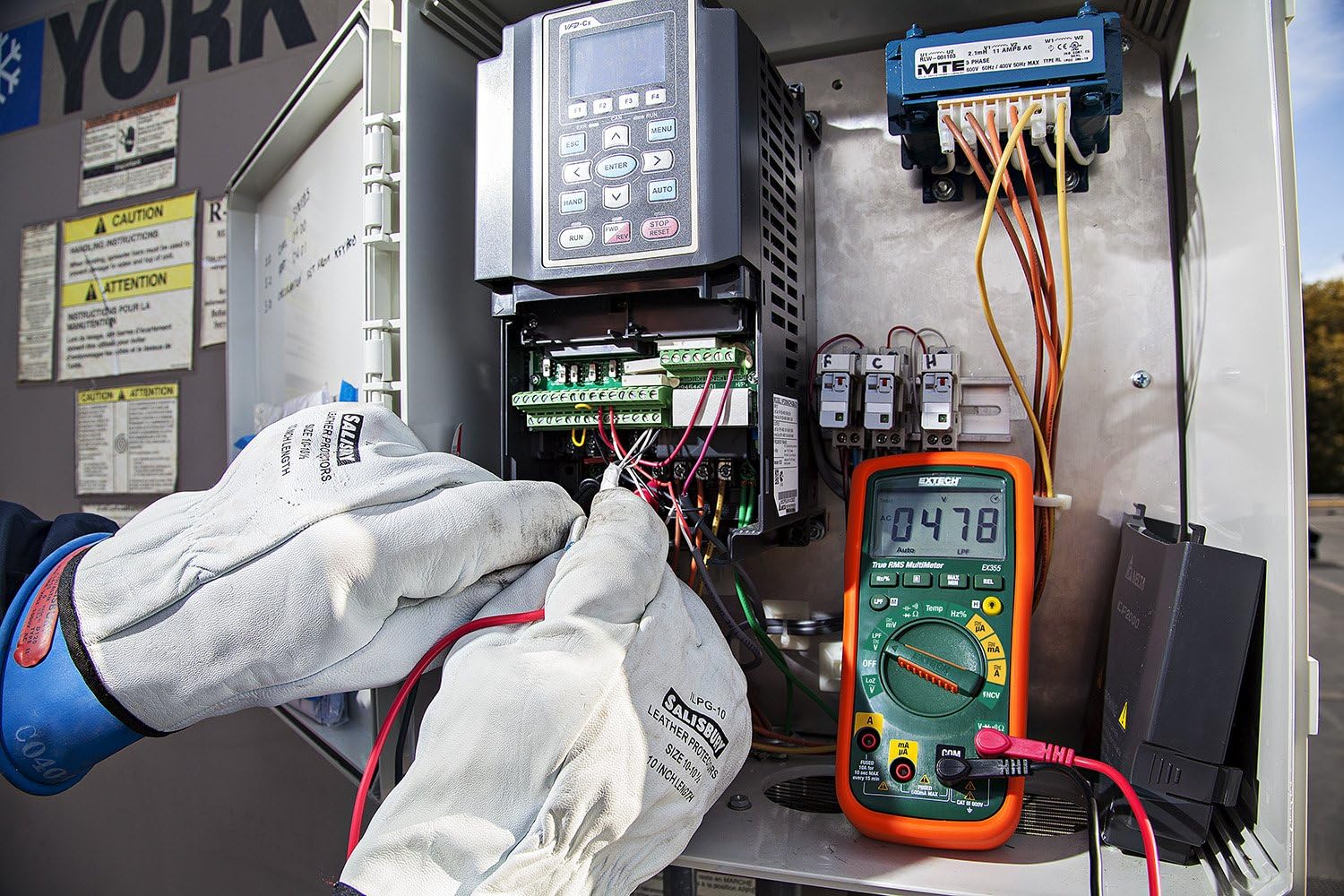
Figure 3: The Extech EX355 Multimeter in use, connected to an electrical control panel. This image demonstrates the multimeter's application in industrial or commercial electrical diagnostics.

Figure 4: The Extech EX355 Multimeter connected to a fuse box. This image illustrates the multimeter being used for testing within a residential or commercial electrical distribution system.
5.10 Data Hold, Min/Max, Relative Mode
- Data Hold: Press the HOLD button to freeze the current reading on the display. Press again to release.
- Min/Max: Press the MIN/MAX button to enter Min/Max recording mode. The meter will display the maximum reading. Press again to cycle through minimum and average readings. Hold the button to exit.
- Relative Mode: Press the REL button to store the current reading as a reference value. Subsequent measurements will be displayed as a difference from this reference. Press again to exit.
5.11 Continuity and Diode Test
Warning: Ensure the circuit is de-energized before performing continuity or diode tests.
- Continuity: Set the rotary dial to the Ω (Resistance) position and press the SELECT button until the continuity symbol (♫) appears. A continuous beep indicates a low resistance path (continuity).
- Diode Test: Set the rotary dial to the Ω (Resistance) position and press the SELECT button until the diode symbol (→|) appears. Connect the red lead to the anode and black lead to the cathode for forward bias voltage drop. Reverse leads for reverse bias.
6. Maintenance
6.1 Battery Replacement
Refer to section 4.1 for detailed instructions on replacing the two AA batteries. Always use fresh, high-quality AA batteries.
6.2 Fuse Replacement
If the current measurement functions cease to work, the fuse may need replacement. This procedure should only be performed by qualified personnel.
- Ensure the multimeter is powered off and all test leads are disconnected.
- Remove the battery compartment cover and batteries.
- Unscrew the case screws and carefully separate the two halves of the meter casing.
- Locate the blown fuse(s). The EX355 typically uses two fuses: a 0.5A/600V fast-blow fuse for the mA/µA input and a 10A/600V fast-blow fuse for the 10A input.
- Replace the fuse(s) with fuses of the exact same type and rating. Never use a fuse with a different rating.
- Carefully reassemble the meter casing, ensuring all screws are tightened. Reinstall batteries and the battery cover.
6.3 Cleaning and Storage
- Clean the meter regularly with a damp cloth and mild detergent. Do not use abrasives or solvents.
- Ensure the meter is completely dry before use.
- When storing the meter for extended periods, remove the batteries to prevent leakage.
- Store the meter in a cool, dry place, away from direct sunlight and extreme temperatures.
7. Troubleshooting
| Problem | Possible Cause | Solution |
|---|---|---|
| No display or faint display | Dead or low batteries | Replace batteries (refer to Section 4.1). |
| Incorrect readings | Incorrect function/range selected; Damaged test leads; External interference; Blown fuse (for current) | Verify function/range; Inspect/replace test leads; Move away from strong electromagnetic fields; Check/replace fuses (refer to Section 6.2). |
| No continuity beep | Open circuit; High resistance; Incorrect mode | Ensure circuit is closed; Check for high resistance; Verify continuity mode is selected. |
| Current measurement not working | Blown fuse; Incorrect lead connection | Check and replace appropriate fuse (refer to Section 6.2); Ensure leads are in the correct current jacks. |
| NCV not detecting voltage | No AC voltage present; Weak field; Incorrect mode | Verify AC voltage with direct contact method; Ensure NCV mode is selected; Move closer to the conductor. |
8. Specifications
The following table outlines the key specifications for the Extech EX355 True RMS Multimeter:
| Parameter | Value |
|---|---|
| Model Number | EX355 |
| Measurement Functions | AC/DC Voltage, AC/DC Current, Resistance, Capacitance, Frequency, Duty Cycle, Temperature, Diode, Continuity |
| True RMS | Yes |
| Non-Contact Voltage (NCV) | Yes |
| Low Impedance (LoZ) | Yes |
| Low Pass Filter (LPF) | Yes |
| Maximum Operating Voltage | 600 Volts |
| Measurement Accuracy | +/-0.5% (typical, varies by function/range) |
| Display | 4000 Count LCD |
| Power Source | 2 x AA Batteries (included) |
| Dimensions (L x W x H) | 8.1 x 4.8 x 17 cm (3.2 x 1.9 x 6.7 inches) |
| Item Weight | 372 g (0.82 lbs) |
| Material | ABS |
| Certification | IEC 61010-1, CE, CAT III 600V |
| Included Components | Test leads, two AA batteries, general purpose bead wire temperature probe |
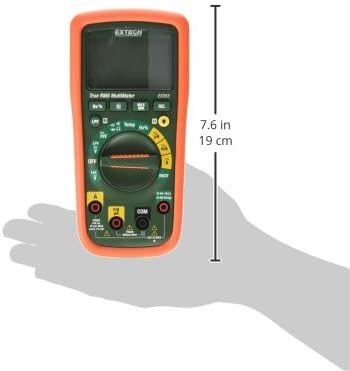
Figure 5: Extech EX355 Multimeter with approximate dimensions shown in inches and centimeters. This image provides a visual reference for the physical size of the device.
9. Warranty Information
Extech provides a warranty for its products. Specific warranty terms and conditions, including duration and coverage, may vary by region and product. For detailed warranty information, please refer to the warranty card included with your product or visit the official Extech website. Keep your purchase receipt as proof of purchase for any warranty claims.
10. Customer Support
For technical assistance, troubleshooting, or service inquiries regarding your Extech EX355 Multimeter, please contact Extech customer support. You can typically find contact information, including phone numbers and email addresses, on the official Extech website or in the documentation provided with your product.
Online Resources: Visit the official Extech website for FAQs, product downloads, and additional support resources.


