
1. Introduction
This manual provides detailed instructions for the safe and efficient operation of your Retevis RT1 Walkie Talkie. The RT1 is a professional-grade two-way radio designed for reliable long-range communication in various environments, including construction sites and outdoor activities. It features a robust design, a high-capacity battery, and clear audio quality.

Image: Two Retevis RT1 walkie talkies with their charging bases and two additional long-gain antennas.
2. Package Contents
Please check the package contents carefully. If any items are missing or damaged, contact your retailer.
- 2 x RT1 Walkie Talkie units
- 4 x Antennas (2 standard, 2 high-gain)
- 2 x RT1 Headsets
- 2 x 3000 mAh Li-ion Batteries
- 2 x Charging Bases with Plugs

Image: All components included in the Retevis RT1 package.
3. Product Features
- Long Range Communication: High power output and two types of antennas (standard and high-gain) for extended communication range.
- Durable Construction: Robust design capable of withstanding drops from 2 meters, suitable for demanding environments.
- High Capacity Battery: Equipped with a 3000 mAh Li-ion battery, providing up to two weeks of standby time.
- Clear Audio: Powerful speakers and 1-9 level Squelch function ensure clear communication even in noisy conditions.
- 16 Channels: Simple channel selection for ease of use.
- VOX Function: Voice-activated transmission for hands-free operation.
- CTCSS/DCS: Provides enhanced privacy and reduces interference.
- High/Low Power Selection: Adjustable power output to optimize range and battery life.
- Emergency Alarm: Pressing the side button activates an alarm to alert your team.

Image: The Retevis RT1 walkie talkie highlighting its 3000 mAh battery for extended working time.
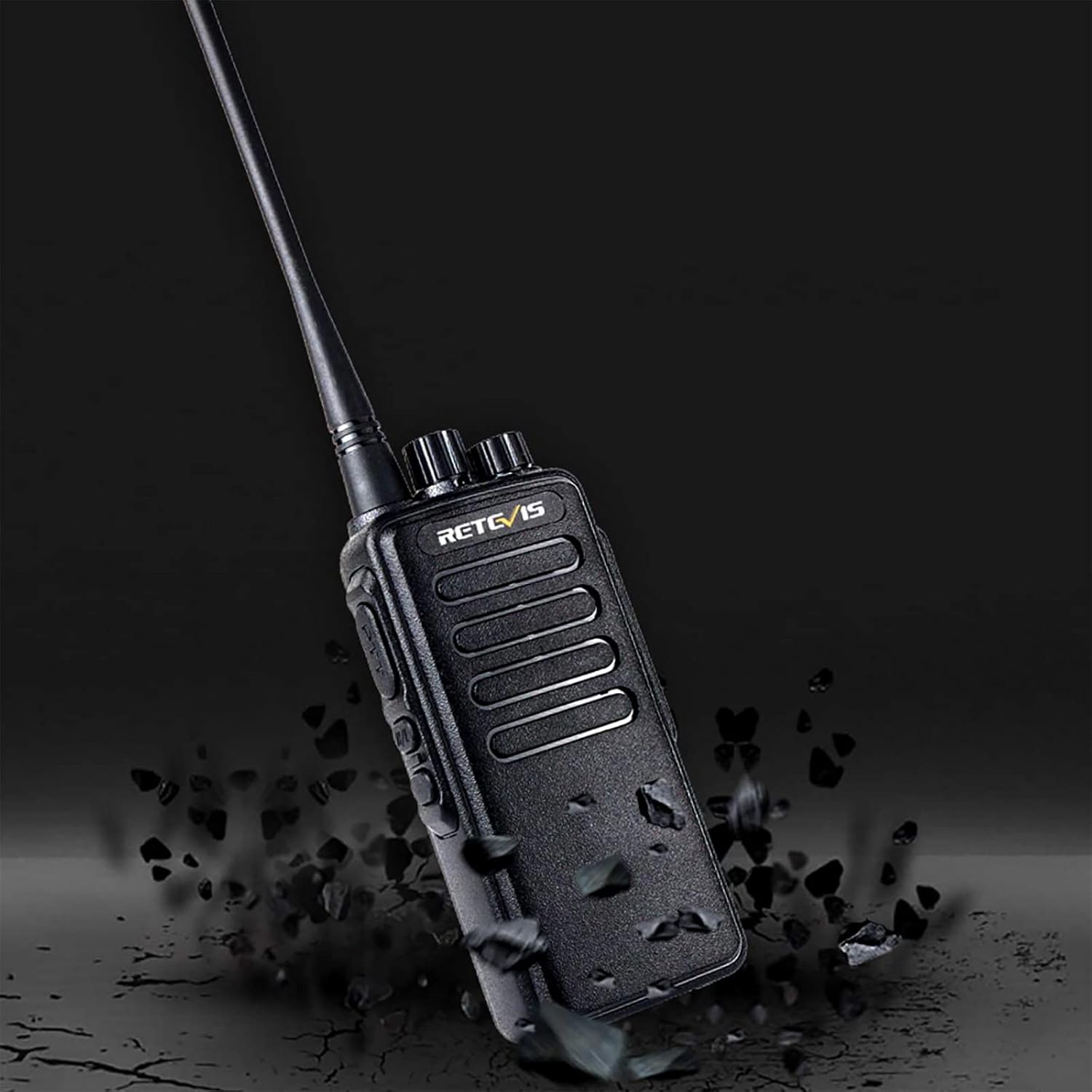
Image: The RT1 walkie talkie demonstrating its robust, anti-drop construction.

Image: Illustration of the long-range communication capability of the RT1 walkie talkie with different antenna types.

Image: The RT1 walkie talkie emphasizing its clear sound capabilities.
4. Setup
4.1. Battery Installation
- Ensure the walkie talkie is powered off.
- Locate the battery compartment on the back of the unit.
- Slide the battery into the compartment, ensuring the contacts align.
- Press firmly until the battery clicks into place.
Video: Demonstrates battery installation and other key features of the Retevis RT1 walkie talkie.
4.2. Antenna Attachment
- Select the desired antenna (standard or high-gain).
- Screw the antenna clockwise onto the connector at the top of the walkie talkie until it is finger-tight. Do not overtighten.

Image: Detailed view of the RT1 walkie talkie, including the antenna connection point.
4.3. Charging the Battery
- Connect the charging base to a power outlet using the provided plug.
- Place the walkie talkie (with battery installed) into the charging base.
- The LED indicator on the charging base will show the charging status (typically red for charging, green for fully charged).

Image: The RT1 walkie talkie being charged in its desktop charger.
5. Operating Instructions
5.1. Power On/Off and Volume Control
Rotate the Power/Volume knob (top left) clockwise to turn the radio on and increase the volume. Rotate counter-clockwise to decrease volume and turn the radio off.
5.2. Channel Selection
Rotate the Channel Selecting knob (top right) to choose one of the 16 available channels. The radio will announce the selected channel number.
5.3. Transmitting and Receiving (PTT)
To transmit, press and hold the Push-to-Talk (PTT) button on the side of the radio. Speak clearly into the microphone. Release the PTT button to receive.
5.4. High/Low Power Selection
The RT1 supports high and low power output. To switch between high and low power, press the designated side button (often labeled H/L or programmable). The radio will announce the current power setting.
Video: Demonstrates the high/low power selection feature of the Retevis RT1 walkie talkie.
5.5. VOX Function
The Voice Operated Exchange (VOX) function allows for hands-free transmission. When VOX is enabled, the radio will automatically transmit when it detects your voice, without needing to press the PTT button. Refer to the full user manual for programming VOX sensitivity levels.

Image: The RT1 walkie talkie illustrating the VOX hands-free communication feature.
5.6. Using the Headset
Connect the provided headset to the audio jack on the side of the walkie talkie. This allows for private listening and hands-free communication, especially useful in noisy environments.

Image: A user communicating clearly with the RT1 walkie talkie using a headset.
6. Maintenance
- Cleaning: Use a soft, damp cloth to clean the radio's surface. Do not use harsh chemicals or solvents.
- Battery Care: Avoid overcharging or completely draining the battery. Store the battery in a cool, dry place when not in use.
- Antenna: Ensure the antenna is securely attached. Do not bend or force the antenna, as this can damage the unit.
- Storage: Store the walkie talkie in a dry, dust-free environment away from extreme temperatures.
7. Troubleshooting
| Problem | Possible Cause | Solution |
|---|---|---|
| No power | Battery is low or not installed correctly. | Charge the battery or re-install it securely. |
| Cannot transmit or receive | Incorrect channel selected; out of range; antenna loose. | Verify channel, move closer to other radios, check antenna connection. |
| Poor audio quality | Volume too low; Squelch level too high; interference. | Adjust volume, lower Squelch level, move away from sources of interference. |
| Short communication range | Low power setting; environmental obstructions. | Switch to high power, use high-gain antenna, move to a more open area. |
8. Specifications
| Feature | Detail |
|---|---|
| Brand | Retevis |
| Model | RT1 (EUA9106CX2) |
| Dimensions | 24 x 17.5 x 7 cm |
| Weight | 788 g |
| Battery Type | 2 Litio Ion (included) |
| Battery Capacity | 3000 mAh |
| Average Battery Life (Stand-by) | 260 Hours (approx. 2 Weeks) |
| Tuner Technology | VHF |
| Frequency Range | 400-430MHz |
| Number of Channels | 16 |
| Max Talk Range | 5 Kilometers (environmental dependent) |
| Voltage | 8 Volts |
| Electrical Power | 10 Watts |
| Noise Level | 40 Decibels |
| Water Resistance Level | Not water resistant |
9. Warranty and Support
Retevis products are designed for reliability and performance. For warranty information, technical support, or service inquiries, please refer to the official Retevis website or contact your local distributor. Keep your purchase receipt as proof of purchase for warranty claims.
For additional resources and product information, visit the Retevis Brand Store.


