
1. Introduction
This service manual provides detailed information for the maintenance, troubleshooting, and repair of Ford VSG-411 and VSG-413 engines. It is intended for qualified service technicians and individuals with a thorough understanding of engine mechanics. Adherence to the procedures outlined in this manual is crucial for ensuring the safe and efficient operation of the engine.
Always prioritize safety. Wear appropriate personal protective equipment (PPE) and follow all local safety regulations. Disconnect the battery before performing any electrical work. Allow the engine to cool before servicing to prevent burns.
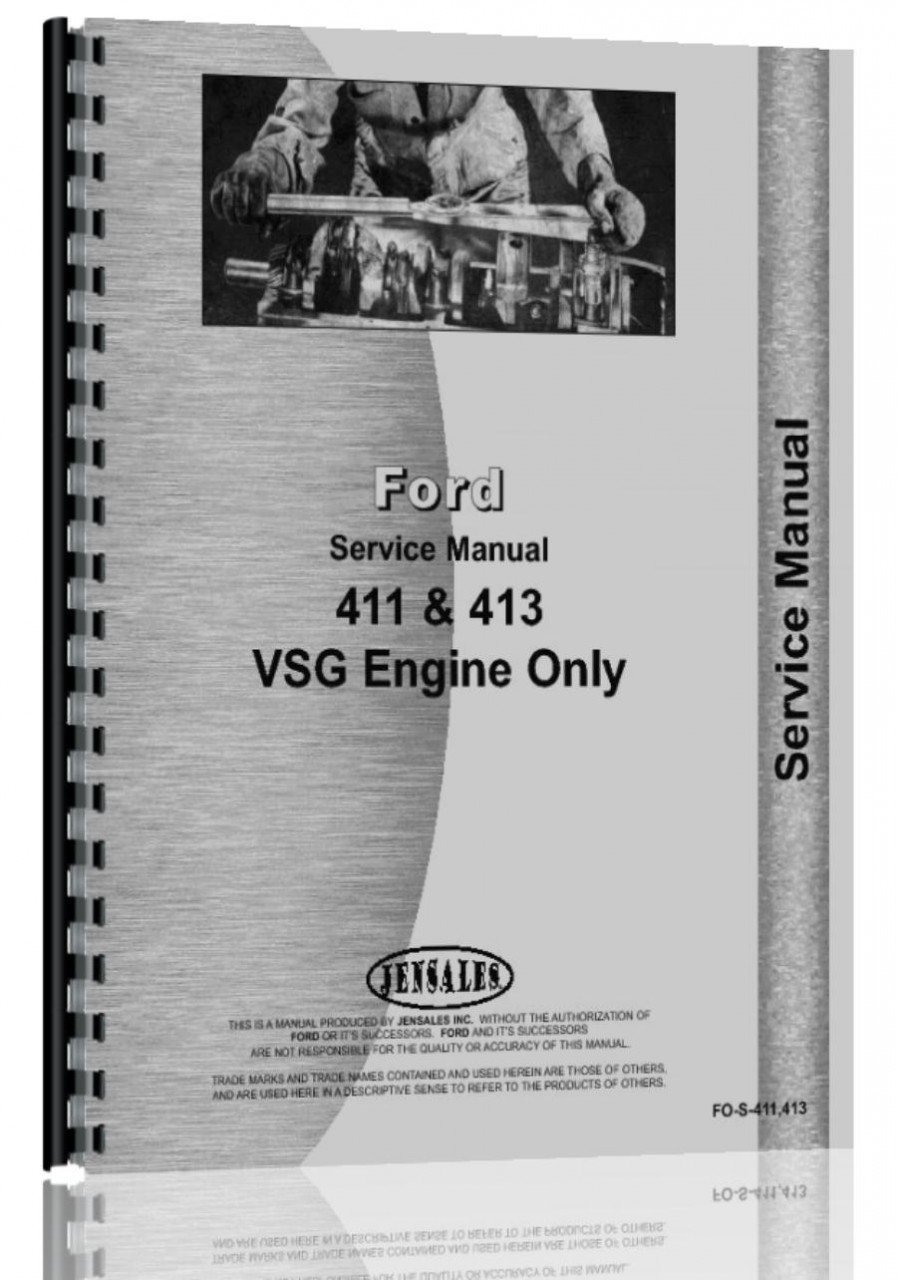
This image displays the front cover of the official service manual for Ford VSG-411 and VSG-413 engines, indicating its comprehensive nature for repair and maintenance.
2. Initial Setup and Preparation for Service
Before commencing any service or repair work, proper preparation is essential. This section outlines the steps required to safely prepare the engine for service.
- Secure the Vehicle/Equipment: Ensure the vehicle or equipment housing the engine is on a stable, level surface and properly secured to prevent movement.
- Disconnect Battery: Always disconnect the negative battery terminal first to prevent accidental starting or electrical shorts.
- Drain Fluids: If required for the specific service, drain engine oil, coolant, and fuel into appropriate containers. Dispose of fluids responsibly.
- Clean Engine Area: A clean work environment helps prevent contamination and makes it easier to identify components.
- Gather Tools: Ensure all necessary tools, including specialized tools, are available before starting work.
3. Basic Engine Operation
This section provides a brief overview of basic engine operation for reference. For detailed operational instructions of the complete vehicle or equipment, refer to its specific operator's manual.
3.1 Starting the Engine
- Ensure the fuel tank has adequate fuel and the battery is charged.
- Check engine oil and coolant levels.
- Turn the ignition key to the "ON" position and wait for system checks to complete.
- Turn the ignition key to the "START" position. Release once the engine starts. Do not crank for more than 10 seconds at a time.
- Allow the engine to warm up for a few minutes before applying load.
3.2 Stopping the Engine
- Reduce engine load to idle speed.
- Turn the ignition key to the "OFF" position.
4. Maintenance Procedures
Regular maintenance is critical for the longevity and performance of your Ford VSG-411 or VSG-413 engine. This section details routine maintenance tasks.
4.1 Engine Oil and Filter Change
Change engine oil and filter every 100-200 operating hours or annually, whichever comes first. Refer to specifications for correct oil type and capacity.
- Warm up the engine to operating temperature, then shut it off.
- Place a drain pan under the oil drain plug. Remove the plug and allow oil to drain completely.
- Remove the old oil filter. Apply a thin film of new oil to the gasket of the new filter before installing.
- Install the new oil filter and tighten according to manufacturer specifications (typically hand-tight plus 1/2 to 3/4 turn).
- Reinstall the drain plug with a new washer if necessary, and tighten to specified torque.
- Fill the engine with the recommended type and quantity of new engine oil.
- Start the engine and check for leaks. Shut off and recheck oil level, adding if necessary.
4.2 Air Filter Replacement
Inspect the air filter every 50 operating hours and replace as needed, or at least annually. A dirty air filter can reduce engine performance and fuel efficiency.
4.3 Spark Plug Inspection and Replacement
Inspect spark plugs every 200 operating hours. Replace if electrodes are worn or fouled. Ensure correct gap setting.
5. Troubleshooting Common Issues
This section provides guidance for diagnosing and resolving common engine problems. For complex issues, consult a qualified technician.
| Symptom | Possible Cause | Action |
|---|---|---|
| Engine Fails to Start | Low fuel, dead battery, faulty spark plugs, clogged fuel filter. | Check fuel level, charge/replace battery, inspect/replace spark plugs, replace fuel filter. |
| Engine Overheats | Low coolant, clogged radiator, faulty thermostat, worn fan belt. | Check coolant level, clean radiator, test/replace thermostat, inspect/replace fan belt. |
| Loss of Power | Dirty air filter, restricted exhaust, fuel delivery issues, ignition problems. | Inspect/replace air filter, check exhaust system, verify fuel pressure, inspect ignition components. |
6. Technical Specifications
This section provides key technical specifications for the Ford VSG-411 and VSG-413 engines. Always refer to the specific engine plate for exact model variations.
- Engine Type: 4-cylinder, Liquid-cooled, Gasoline
- Displacement: VSG-411 (1.1L), VSG-413 (1.3L)
- Oil Capacity: Refer to dipstick markings; typically 3.5 - 4.0 liters with filter.
- Recommended Oil: SAE 5W-30 or 10W-30, API SN or higher.
- Coolant Type: Ethylene Glycol based, 50/50 mix with distilled water.
- Spark Plug Gap: 0.030 - 0.032 inches (0.76 - 0.81 mm).
- Ignition Timing: Refer to engine service sticker.
- Valve Clearance (Cold): Intake: 0.008 in (0.20 mm), Exhaust: 0.010 in (0.25 mm).
- Torque Specifications:
- Spark Plugs: 18-22 Nm (13-16 lb-ft)
- Oil Drain Plug: 25-30 Nm (18-22 lb-ft)
- Wheel Lug Nuts (if applicable to vehicle): 100-120 Nm (74-88 lb-ft)
7. Warranty and Support
This service manual is a guide for repair and maintenance. For information regarding engine warranty, please refer to the original purchase documentation or contact your authorized Ford engine dealer or the equipment manufacturer. Warranty terms and conditions vary based on the specific engine application and region.
For technical support or to order genuine Ford engine parts, please contact your local authorized service center. You can typically find contact information on the manufacturer's official website or through your original point of purchase.
Important: Use of non-genuine parts or unauthorized modifications may void your engine's warranty.