
1. Introduction
This manual provides essential information for the safe and effective installation, operation, and maintenance of the Bussmann FRS-R-400 T23 Fusetron Time-Delay Fuse. The FRS-R-400 is a 400 Ampere, 600 Vac / 300 Vdc rated, Class RK5, time-delay fuse designed for general purpose circuit protection. It offers superior protection for motors, transformers, and other inductive loads against overcurrents and short circuits, minimizing nuisance openings.
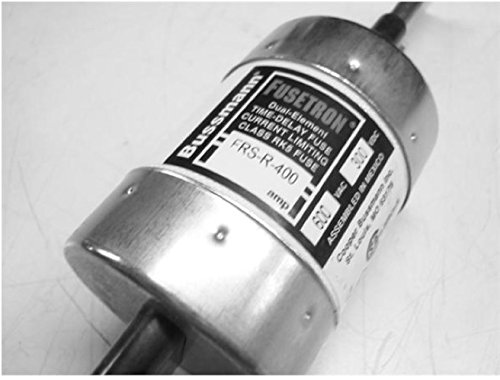
Figure 1: Bussmann FRS-R-400 T23 Fusetron Time-Delay Fuse. This image displays the cylindrical body of the fuse with metal end caps and a label indicating "Bussmann Fusetron FRS-R-400". The fuse is designed for robust electrical circuit protection.
2. Safety Information
WARNING: Electrical shock hazard. Improper installation or handling of fuses can result in serious injury or death. Always follow local electrical codes and safety regulations. Only qualified personnel should perform installation and maintenance.
- ALWAYS disconnect power before installing, removing, or inspecting fuses.
- NEVER replace a fuse with one of a higher ampere rating or different type than specified.
- Ensure the replacement fuse has the correct voltage and current ratings for the circuit.
- Use appropriate personal protective equipment (PPE), such as insulated gloves and safety glasses.
- Verify that the fuse holder is compatible with the fuse dimensions and ratings.
3. Setup and Installation
The FRS-R-400 T23 fuse is a cartridge-type fuse designed for installation in compatible fuse blocks or holders. Ensure the fuse holder is rated for 400 Amperes and 600 Vac / 300 Vdc or higher.
- De-energize the Circuit: Locate the main power disconnect for the circuit where the fuse will be installed and turn it OFF. Verify zero voltage with a suitable testing device.
- Inspect Fuse Holder: Ensure the fuse holder terminals are clean, free from corrosion, and properly sized for the fuse.
- Insert Fuse: Carefully insert the FRS-R-400 T23 fuse into the fuse block or holder. Ensure both ends of the fuse make firm, secure contact with the terminals. Do not force the fuse.
- Secure Connections: If applicable, tighten any retaining clips or screws on the fuse holder to ensure proper contact and prevent loosening due to vibration.
- Re-energize Circuit: Once the fuse is securely installed and all safety checks are complete, restore power to the circuit.
Note: The FRS-R series fuses are non-indicating. A blown fuse will not provide a visual indication. Testing with a multimeter may be required to confirm continuity.
4. Operating Principles
The Bussmann FRS-R-400 T23 is a time-delay fuse. This means it is designed to withstand temporary overcurrents, such as those caused by motor starting or transformer inrush currents, without opening. However, it will quickly open under sustained overloads or short-circuit conditions to protect the electrical system and connected equipment.
- Overload Protection: The time-delay characteristic allows for harmless overloads to pass, preventing nuisance tripping.
- Short-Circuit Protection: In the event of a severe short circuit, the fuse will rapidly interrupt the current flow, minimizing damage.
- Current Limiting: As a Class RK5 fuse, it provides current-limiting protection, reducing the peak current and energy let-through during a short circuit.
5. Maintenance
Fuses are generally maintenance-free components. However, periodic inspection of the fuse and its holder is recommended, especially in critical applications or harsh environments.
- Visual Inspection: With power disconnected, visually inspect the fuse and holder for signs of overheating, discoloration, arcing, or physical damage.
- Terminal Integrity: Ensure all connections to the fuse holder are tight and free from corrosion. Loose connections can cause overheating.
- Replacement: If a fuse has blown, it must be replaced with an identical fuse (same brand, model, ampere, and voltage rating). Do not attempt to repair a blown fuse.
6. Troubleshooting
If a circuit protected by an FRS-R-400 T23 fuse loses power, the fuse may have opened due to an overcurrent condition.
- Disconnect Power: Always de-energize the circuit before troubleshooting.
- Test the Fuse: Remove the fuse from its holder. Use a multimeter set to continuity mode to test the fuse. A good fuse will show continuity (a very low resistance reading or a beep). A blown fuse will show an open circuit (infinite resistance).
- Identify Cause: If the fuse is blown, investigate the cause of the overcurrent. Common causes include:
- Short circuit in the wiring or connected equipment.
- Overloaded circuit (too many devices drawing current).
- Faulty motor or transformer.
- Ground fault.
- Replace Fuse: Only replace the fuse after the cause of the fault has been identified and corrected. Use only a Bussmann FRS-R-400 T23 or an equivalent fuse with identical ratings.
7. Specifications
| Characteristic | Value |
|---|---|
| Model Number | FRS-R-400 T23 |
| Brand | Bussmann |
| Fuse Type | Fusetron Time-Delay, Class RK5 |
| Ampere Rating | 400 Amperes |
| Voltage Rating | 600 Vac, 300 Vdc |
| Interrupting Rating | 200 kA RMS Sym. (AC), 20 kA (DC) |
| Material | Zinc (element), Fiber/Melamine (body) |
| Mounting | Fuse Block / Holder (Cartridge Type) |
| Weight | Approximately 2.2 Pounds (1 kg) |
Note: The voltage rating of "400 Volts" found in some general specifications may refer to a specific test condition or a less common variant. The primary operational voltage ratings for the FRS-R-400 are 600 Vac and 300 Vdc as indicated by the product title and standard specifications for this fuse class.
8. Warranty and Support
Bussmann products are manufactured to high-quality standards. For specific warranty information, please refer to the official Bussmann website or contact your authorized distributor. Technical support and further assistance can be obtained through Bussmann's customer service channels.
For more information, visit the Eaton Bussmann website (Eaton is the parent company of Bussmann).


