
1. Introduction
The TP-Link UH720 is a high-performance USB 3.0 hub designed to expand your computer's connectivity. It features seven USB 3.0 data ports for high-speed data transfer and two dedicated smart charging ports for efficient device charging. This manual provides instructions for setting up, operating, maintaining, and troubleshooting your UH720 hub.
2. Package Contents
Verify that your package contains the following items:
- TP-Link UH720 USB 3.0 Hub
- 12V/4A Power Adapter
- USB 3.0 Data Cable
- User Guide
- Technical Support Information

Image: Contents of the TP-Link UH720 package, showing the hub, power adapter, USB cable, and user guides.
3. Product Overview
The TP-Link UH720 offers robust expansion and charging capabilities. It is compatible with Windows, Mac, Chrome, and Linux operating systems, requiring no driver installation.
Key Features:
- 7 USB 3.0 Data Ports: Provides data transfer speeds up to 5Gbps, which is 10 times faster than USB 2.0. Ideal for connecting keyboards, mice, printers, external hard drives, and other USB devices.
- 2 Smart Charging Ports: Dedicated 5V/2.4A ports designed for ultra-fast charging of smartphones, tablets, and other USB-powered devices. TP-Link's charging technology intelligently identifies connected devices to deliver the fastest possible charge.
- Power On/Off Button: Allows convenient control over the hub's power.
- Advanced Protection: Features a sophisticated circuit design with multiple protections against overheat, overload, overvoltage, and short circuits, safeguarding both your devices and data.
- Hot-Swap Support: USB ports can be safely connected and disconnected while the computer is running.

Image: Angled view of the TP-Link UH720 USB Hub, highlighting its sleek design and the arrangement of the seven USB 3.0 data ports and the power button.

Image: The TP-Link UH720 USB Hub in use, connected to a laptop and multiple peripheral devices, demonstrating its expansion capabilities.
4. Setup
Follow these steps to set up your TP-Link UH720 USB Hub:
- Connect the Power Adapter: Plug the provided 12V/4A power adapter into the power input port on the back of the UH720 hub, then plug the adapter into a power outlet. The power LED on the hub should illuminate.
- Connect to Your Computer: Use the supplied USB 3.0 data cable to connect the UH720 hub's upstream port (USB 3.0 Micro B) to an available USB 3.0 port on your computer. For optimal performance, ensure you connect it to a USB 3.0 port on your PC.
- Power On the Hub: Press the power On/Off button on the hub. The hub is now ready for use.
- Connect Devices: Plug your USB devices into the available USB 3.0 data ports or charging ports on the hub.
Note: The UH720 is Plug & Play for Windows, Mac, Linux, and Chrome OS, meaning no driver installation is required. However, 2.4GHz wireless devices (e.g., wireless keyboard/mouse adapters) may experience interference when in close proximity to USB 3.0 devices or hubs. Connecting such devices to a USB 2.0 port on your computer is recommended if interference occurs.
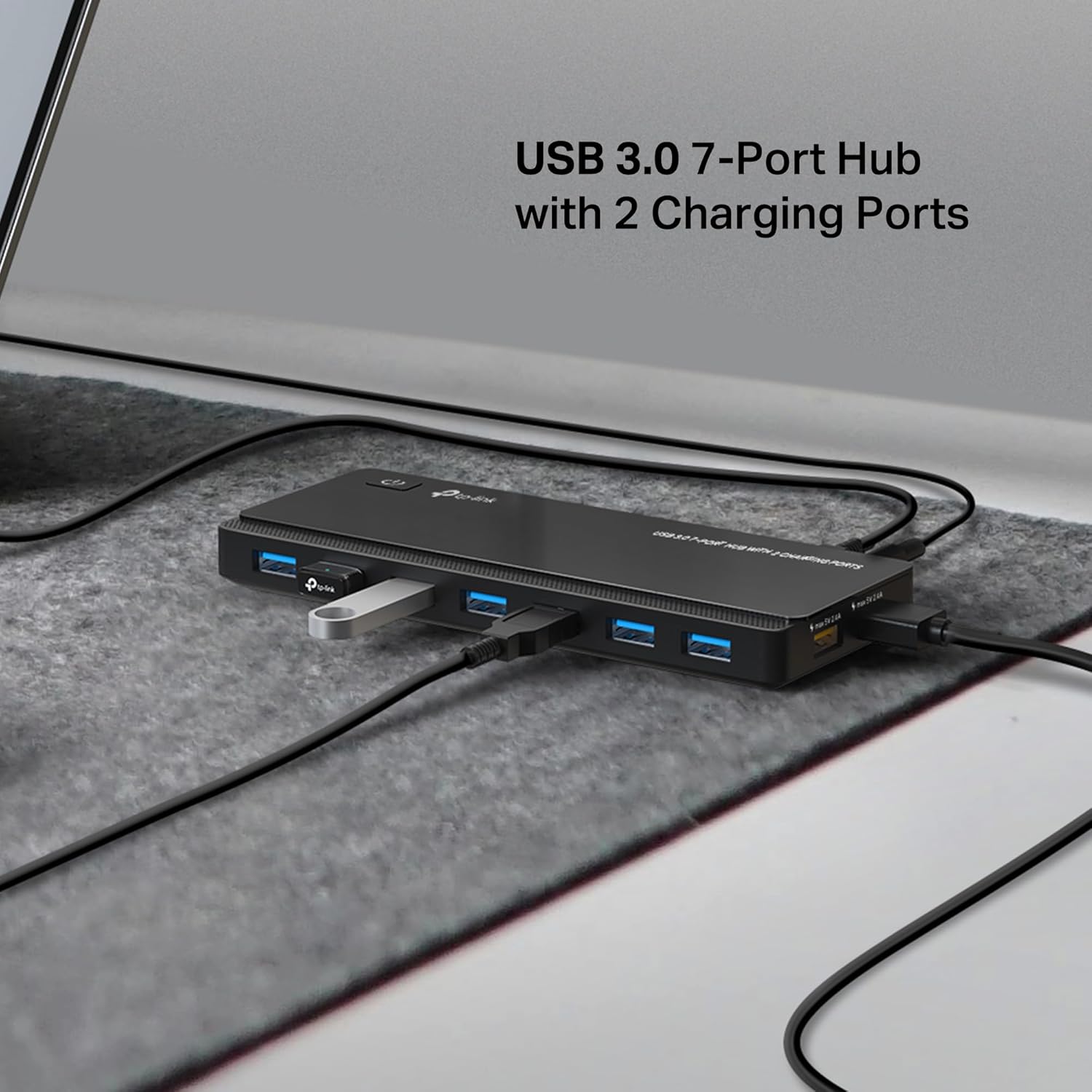
Image: The TP-Link UH720 USB Hub connected to a laptop, with multiple USB devices such as a flash drive and external hard drive plugged into its data ports.
5. Operating the Hub
Using Data Ports:
The seven blue-colored USB 3.0 ports are designed for data transfer. Connect your USB storage devices, peripherals, or other data-oriented devices to these ports. You will experience data transfer speeds of up to 5Gbps when connected to a USB 3.0 host port and using USB 3.0 compatible devices.

Image: A visual comparison illustrating the faster data transfer speeds achievable with USB 3.0 ports (2 minutes 18 seconds) compared to USB 2.0 ports (7 minutes 36 seconds).
Using Charging Ports:
The two yellow-colored ports are dedicated smart charging ports, providing up to 2.4A output. These ports are optimized for charging mobile devices like smartphones and tablets. TP-Link's intelligent charging technology automatically detects the connected device and delivers the optimal charging current.
Important: The non-charging data ports are intended for data transfer only and provide insufficient power for charging. The dedicated charging ports are for charging only and do not support data synchronization.

Image: The TP-Link UH720 USB Hub actively charging a smartphone and a tablet simultaneously using its two dedicated charging ports.

Image: A graphic demonstrating the charging efficiency of the UH720, showing it can charge a device to 100% while an original charger reaches 60% in the same timeframe.
6. Maintenance
To ensure the longevity and optimal performance of your TP-Link UH720 USB Hub, follow these maintenance guidelines:
- Keep the device away from water, fire, humidity, or hot environments.
- Do not attempt to disassemble, repair, or modify the device. If you need service, please contact technical support.
- Avoid dropping or subjecting the device to strong impacts.
- Clean the device with a soft, dry cloth. Do not use liquid or chemical cleaners.
- Ensure proper ventilation around the hub to prevent overheating.
7. Troubleshooting
If you encounter issues with your UH720 hub, refer to the following common problems and solutions:
Problem: Devices are not recognized or function intermittently.
- Solution 1: Ensure the power adapter is securely connected to the hub and a power outlet. The hub requires external power for stable operation, especially with multiple devices.
- Solution 2: Verify that the USB 3.0 data cable is firmly connected between the hub and your computer's USB 3.0 port.
- Solution 3: Try connecting the device directly to your computer's USB port to rule out the device itself as the cause.
- Solution 4: If using 2.4GHz wireless devices (e.g., mouse/keyboard), try connecting their receivers to a USB 2.0 port on your computer to avoid potential interference with USB 3.0 signals.
Problem: Data transfer speeds are slow.
- Solution 1: Ensure both the hub and the connected device are plugged into a USB 3.0 port on your computer. USB 2.0 ports will limit speeds to USB 2.0 standards.
- Solution 2: Confirm that the connected device itself supports USB 3.0 speeds.
Problem: Devices are not charging or charging slowly.
- Solution 1: Ensure the power adapter is connected to the hub. The charging ports require external power.
- Solution 2: Make sure you are using the dedicated yellow-colored charging ports, not the blue data ports.
- Solution 3: Check the charging cable for damage and ensure it is properly connected to both the device and the hub.

Image: Icons illustrating the built-in safety features of the UH720, including protection against short circuits, over-voltage, over-current, and over-heating.
8. Specifications
| Feature | Specification |
|---|---|
| Model Number | UH720 |
| USB Ports | 7x USB 3.0 Data Ports, 2x 5V/2.4A Smart Charging Ports |
| Interface | USB 3.0 Standard A (downstream), USB 3.0 Micro B (upstream) |
| Data Transfer Rate | Up to 5Gbps (USB 3.0) |
| Power Adapter | 12V/4A |
| Operating System Compatibility | Windows, Mac OS X, Linux systems |
| Dimensions (L x W x H) | 7.8 x 5.8 x 2.8 inches |
| Item Weight | 1.1 pounds |
| Color | Black |
9. Warranty and Support
TP-Link provides a 2-year manufacturer's warranty for the UH720 USB Hub. For technical assistance, product information, and support resources, please use the following contact methods:
- Phone Support: (866) 225-8139
- Product Website: myproducts.tp-link.com/us
- Email Support: support.USA@tp-link.com
You can also visit the official TP-Link Store for more information and products: TP-Link Store on Amazon

Image: A graphic displaying TP-Link's customer support contact details, including phone number, product website, and email address.


