1. Introduction
This manual provides detailed instructions for the installation, configuration, and maintenance of your ASRock FM2A58M-VG3+ R2.0 Micro ATX Motherboard. Please read this manual thoroughly before attempting any installation or configuration to ensure proper operation and to prevent damage to your system components.
2. Package Contents
Upon opening the motherboard package, verify that all items are present and in good condition. The standard package typically includes:
- ASRock FM2A58M-VG3+ R2.0 Motherboard
- I/O Panel Shield
- SATA Data Cables
- Quick Installation Guide
- Support CD (containing drivers and utilities)
If any items are missing or damaged, contact your retailer for assistance.
3. Motherboard Layout
Familiarize yourself with the layout of the motherboard before installation. This section provides an overview of key components and connectors.
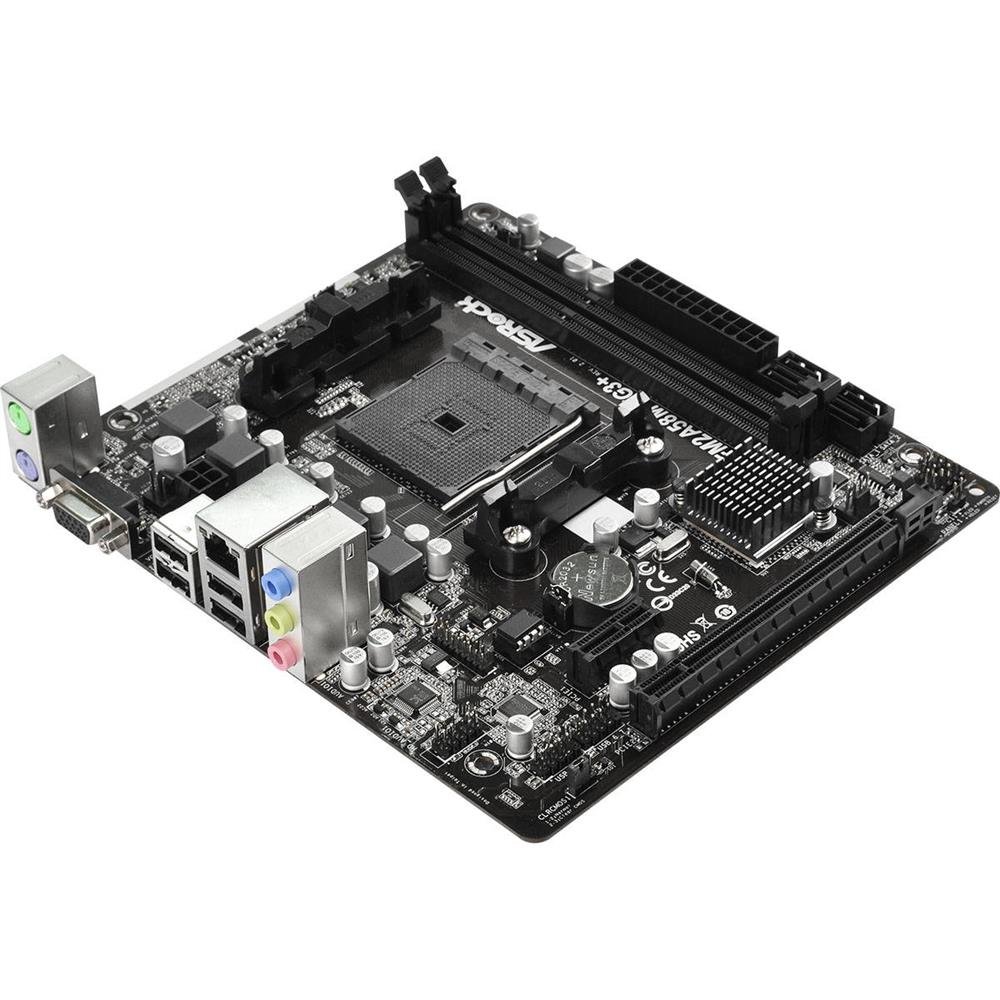
This image displays the ASRock FM2A58M-VG3+ R2.0 Micro ATX motherboard, highlighting its various components such as the CPU socket, DIMM slots, PCI-Express slots, and SATA ports.
Key areas include the CPU socket (FM2+), DDR3 DIMM slots, PCI-Express expansion slots, SATA ports, and various headers for front panel connectivity.
4. Setup and Installation
4.1. CPU Installation
- Open the CPU socket lever.
- Align the CPU (AMD FM2/FM2+) with the socket, ensuring the golden triangle on the CPU matches the triangle on the socket.
- Gently place the CPU into the socket without forcing it.
- Close the socket lever to secure the CPU.
- Apply thermal paste to the CPU surface and install the CPU cooler according to its manufacturer's instructions.
4.2. RAM (Memory) Installation
- Open the clips at both ends of the DDR3 DIMM slots.
- Align the memory module with the slot, ensuring the notch on the module matches the key in the slot.
- Press down firmly on both ends of the memory module until the clips snap into place.
4.3. Motherboard Mounting
- Install the I/O shield into the rear opening of your computer case.
- Align the motherboard with the standoffs inside the case.
- Secure the motherboard with screws, ensuring it is firmly seated but not overtightened.
4.4. Connecting Peripherals
- Power Connectors: Connect the 24-pin ATX power connector and the 4-pin ATX 12V power connector from your power supply to the motherboard.
- SATA Devices: Connect your storage drives (HDDs/SSDs) to the SATA2 ports using the provided SATA cables.
- Front Panel Headers: Connect the power button, reset button, HDD LED, power LED, and front panel USB/audio connectors to their respective headers on the motherboard. Refer to the motherboard diagram for exact locations.
- Expansion Cards: Install any PCI-Express graphics cards or other expansion cards into the appropriate slots and secure them.
5. Operating Your System
5.1. BIOS/UEFI Configuration
Upon first boot, or if you need to adjust system settings, you can enter the BIOS/UEFI setup utility. Typically, this is done by pressing the DEL or F2 key during the Power-On Self-Test (POST) phase. The UEFI interface allows you to configure boot order, system time, CPU/memory settings, and other hardware parameters.
5.2. Driver Installation
After installing your operating system, install the necessary drivers for the motherboard's components. These can be found on the included support CD or downloaded from the official ASRock website. Install drivers for chipset, audio, LAN, and any integrated graphics (if using an APU).
5.3. Operating System Installation
Insert your operating system installation media (USB drive or DVD) and follow the on-screen prompts to install your preferred operating system. Ensure the boot order in the UEFI is set to prioritize your installation media.
6. Maintenance
6.1. Cleaning
Regularly clean your computer's interior to prevent dust buildup, which can lead to overheating and component failure. Use compressed air to remove dust from fans, heatsinks, and other components. Ensure the system is powered off and unplugged before cleaning.
6.2. BIOS Updates
Periodically check the ASRock website for BIOS/UEFI updates. Updates can provide improved compatibility, stability, and new features. Follow the instructions provided by ASRock carefully when performing a BIOS update to avoid system instability or damage.
7. Troubleshooting
This section addresses common issues you might encounter.
- No Power: Ensure all power cables (24-pin ATX, 4-pin ATX 12V) are securely connected to the motherboard and power supply. Verify the power supply switch is on.
- No Display: Check that the monitor is connected to the correct video output (either integrated graphics or discrete graphics card). Reseat the graphics card and memory modules.
- System Instability/Crashes: This can be caused by incompatible RAM, overheating, or outdated drivers. Verify RAM compatibility, check CPU/GPU temperatures, and update all drivers.
- POST Code Errors: If your motherboard has a POST code display or emits beep codes, consult the ASRock website or the full manual for the meaning of these codes to diagnose the issue.
- USB Device Issues: Ensure USB devices are properly connected. If issues persist, try different USB ports or update USB drivers.
For more complex issues, refer to the comprehensive manual available on the ASRock support website or contact ASRock technical support.
8. Specifications
Below are the technical specifications for the ASRock FM2A58M-VG3+ R2.0 Motherboard:
| Feature | Specification |
|---|---|
| CPU Socket | AMD Socket FM2+ |
| Chipset | AMD A58 FCH (Bolton-D2) |
| Memory | 2x DDR3 DIMM Slots, Dual Channel, Non-ECC, Unbuffered, Max 32GB, Supports DDR3 2400+(OC)/ 2133/ 1866/ 1600/ 1333/ 1066 MHz |
| SATA Ports | 4x SATA2 (3.0 Gb/s) Ports |
| Expansion Slots | 1x PCI-Express 3.0 x16, 1x PCI-Express 2.0 x1 |
| Form Factor | Micro ATX |
| USB Ports | 4x USB 2.0 (Rear Panel) |
| Dimensions (LxWxH) | 14 x 13 x 2 inches |
| Weight | 1.32 pounds |
| Operating System Support | Windows |
9. Warranty and Support
ASRock provides a limited warranty for its products. The duration and terms of the warranty may vary by region and retailer. Please retain your proof of purchase for warranty claims.
For technical support, driver downloads, BIOS updates, and additional documentation, please visit the official ASRock website. You can also contact ASRock customer service for direct assistance.
ASRock Official Website: www.asrock.com


