1. Introduction
This manual provides essential instructions for the safe and effective use of your Hobbypower 30A Brushless Electronic Speed Controller (ESC) and Emax CF2822 1200KV Brushless Motor. This combination is designed for various remote-controlled aircraft, including 300-400 size helicopters, airplanes, and quad-rotor multi-copters. Please read this manual thoroughly before installation and operation to ensure proper function and longevity of your components.
2. Safety Precautions
WARNING: Failure to follow these safety instructions may result in injury or damage to the product or property.
- Age Recommendation: This product is recommended for users 18 years of age and older.
- Power Source: Always ensure the power source (battery) is correctly connected and within the specified voltage range for the ESC and motor. Incorrect voltage can cause severe damage.
- Propeller Safety: Brushless motors can generate significant thrust. Always remove propellers before performing any setup, calibration, or maintenance to prevent accidental injury. Keep hands and loose clothing clear of rotating parts.
- Heat: The motor and ESC can become hot during operation. Allow components to cool before handling. Ensure adequate ventilation during use.
- Wiring: Double-check all wiring connections for correct polarity and secure fit. Loose connections can lead to intermittent operation or damage.
- Water and Moisture: Keep all electronic components away from water and moisture unless they are specifically rated as waterproof.
3. Package Contents
Verify that all items listed below are included in your package:
- 1x Hobbypower 30A Brushless Electronic Speed Controller (ESC)
- 1x Emax CF2822 1200KV Brushless Motor
- 1x Propeller Adapter Set
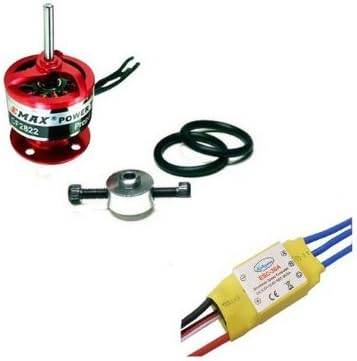
Image 1: Contents of the Hobbypower 30A ESC and Emax 1200KV Brushless Motor package. Shown are the red Emax brushless motor, the silver propeller adapter with black O-rings, and the yellow Hobbypower 30A ESC.
4. Specifications
4.1 Emax CF2822 1200KV Brushless Motor
| Type | CF2822 |
| No. of Cells (Li-Poly) | 2-3 Li-Poly |
| RPM/V (KV) | 1200 RMP/V |
| Max. Efficiency | 82% |
| Max. Efficiency Current | 7 - 16 A (>75%) |
| No Load Current / 10V | 0.9 A |
| Current Capacity | 16 A / 60 s |
| Internal Resistance | 150 mOhm |
| Stator Dimensions | 22x10 mm |
| Shaft Diameter | 3 mm |
| Weight | 39 g |
4.2 Hobbypower 30A Brushless ESC
| Output | Continuous 30A, Burst 40A (up to 10 Secs) |
| Input Voltage | 2-3 cells Li-Po battery or 5-9 cells NiCd/NiMH battery |
| BEC (Battery Eliminator Circuit) | 1A / 5V (Linear mode) |
| Max Speed (BLM) | 210,000rpm for 2 Poles BLM, 70,000rpm for 6 poles BLM, 35,000rpm for 12 poles BLM |
| Dimensions (L*W*H) | 45mm * 24mm * 11mm |
| Weight | 25g |
| Compatibility | 400-450 helicopters / Aircraft or Quad-Rotor Multi RC Helicopter |
5. Setup and Installation
5.1 Motor Installation
- Mounting: Securely mount the Emax CF2822 motor to your aircraft's motor mount using appropriate screws. Ensure the motor is firmly attached and does not wobble.
- Propeller Adapter: Attach the propeller adapter to the motor shaft. Ensure the set screws on the adapter are tightened securely onto the motor shaft (3mm diameter).
- Propeller: Once all other connections and calibrations are complete, attach the propeller to the adapter. Ensure it is balanced and tightened correctly. Always remove the propeller during initial setup and testing.
5.2 ESC Connection
- Motor to ESC: Connect the three wires from the Emax motor to the three output wires of the 30A ESC. The order of these wires may affect the motor's rotation direction. If the motor spins in the wrong direction, swap any two of the three wires.
- ESC to Receiver: Connect the signal cable (usually a three-wire servo connector: signal, positive, negative) from the ESC to the throttle channel (typically channel 3) on your RC receiver. The BEC (Battery Eliminator Circuit) in the ESC will provide 5V power to your receiver and servos.
- Battery to ESC: Connect your Li-Po (2-3 cells) or NiCd/NiMH (5-9 cells) battery to the input power leads of the ESC. Ensure correct polarity (red to positive, black to negative).
5.3 Throttle Range Calibration
It is crucial to calibrate the ESC's throttle range with your radio transmitter for optimal performance and safety. The exact procedure may vary slightly depending on your radio system, but a common method is:
- Turn on your radio transmitter and set the throttle stick to its maximum (full throttle) position.
- Connect the battery to the ESC. The ESC will emit a series of beeps.
- When you hear a specific tone or sequence of beeps (refer to your ESC's specific manual if available for exact tones), move the throttle stick to its minimum (idle/off) position.
- The ESC will emit another series of beeps, indicating that the throttle range has been successfully calibrated.
- Disconnect the battery, then reconnect it. The ESC should now arm correctly, and the motor should respond to throttle input.
6. Operating Instructions
- Pre-Flight Check: Before each flight, ensure all connections are secure, the battery is fully charged, and the propeller is firmly attached and undamaged. Verify that the motor spins freely and in the correct direction.
- Power On Sequence:
- Turn on your radio transmitter.
- Ensure the throttle stick is at the minimum position.
- Connect the flight battery to the ESC.
- Wait for the ESC to initialize and arm (indicated by beeps).
- Throttle Control: Gradually increase the throttle stick to control motor speed. Avoid sudden, rapid changes in throttle, especially with a propeller attached, to prevent excessive current draw and potential damage.
- Power Off Sequence:
- Reduce the throttle stick to the minimum position.
- Disconnect the flight battery from the ESC.
- Turn off your radio transmitter.
7. Maintenance
- Cleaning: Keep the motor and ESC free from dust, dirt, and debris. Use a soft brush or compressed air for cleaning.
- Inspection: Regularly inspect all wires and connectors for signs of wear, fraying, or corrosion. Ensure motor bearings are smooth and free of resistance.
- Storage: Store components in a cool, dry place away from direct sunlight and extreme temperatures. Disconnect batteries when not in use.
8. Troubleshooting
| Problem | Possible Cause | Solution |
|---|---|---|
| Motor does not spin or stutters. |
|
|
| ESC beeps continuously or irregularly. |
|
|
| Motor spins in the wrong direction. | Incorrect motor wire connection. | Swap any two of the three motor wires between the ESC and motor. |
9. Warranty and Support
Hobbypower products are manufactured to high standards. For any technical support, warranty claims, or inquiries regarding your Hobbypower 30A Brushless ESC and Emax 1200KV Brushless Motor, please contact your retailer or the Hobbypower customer service directly. Please retain your proof of purchase for warranty purposes.
For further assistance, you may visit the official Hobbypower store or support channels: