
KTC PD-2
KTC PD-2 Wooden Handle Screwdriver User Manual
Model: PD-2
1. Product Overview
The KTC PD-2 Wooden Handle Screwdriver is a traditional cross-penetrating type screwdriver designed for general fastening and loosening tasks. It features a durable wooden handle for a comfortable grip and a robust S55C shaft (for PD-1, 2, 3 models) or S45C shaft (for PD-4 model) for effective torque transfer.

Image: KTC PD-2 Wooden Handle Screwdriver, showcasing its wooden handle and metal shaft.
2. Specifications
The KTC PD-2 screwdriver is engineered with specific dimensions and materials to ensure optimal performance and durability.
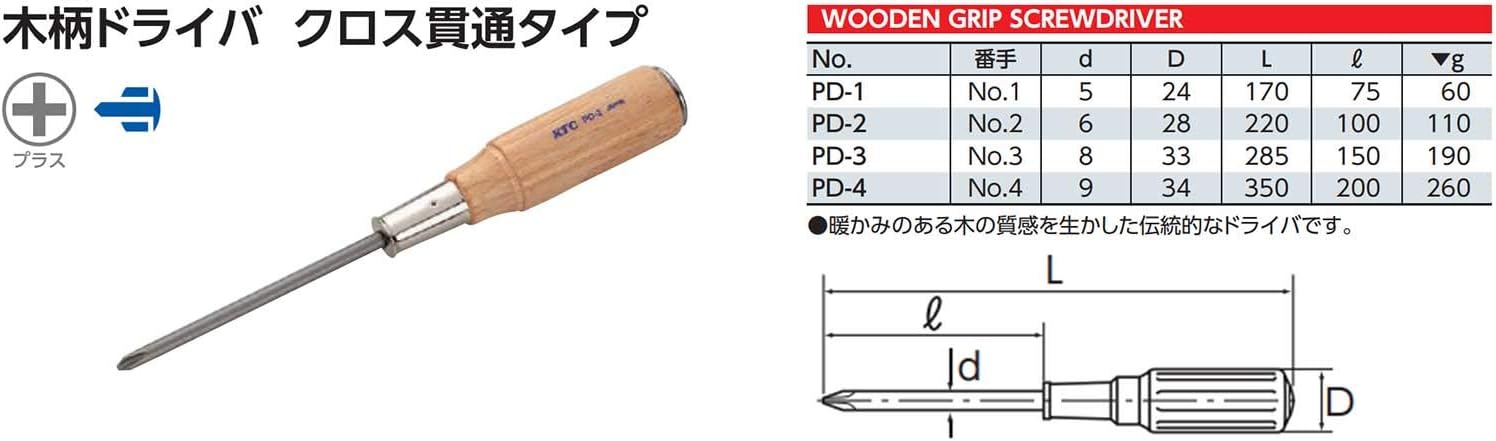
Image: Diagram illustrating the dimensions (L, l, d, D) for various KTC PD series screwdrivers, including PD-2.
| Model No. | Tip Size (No.) | Shaft Diameter (d) | Overall Length (L) | Shaft Length (l) | Weight (g) |
|---|---|---|---|---|---|
| PD-1 | No.1 | 5 | 170 | 75 | 60 |
| PD-2 | No.2 | 6 | 220 | 100 | 110 |
| PD-3 | No.3 | 8 | 285 | 150 | 190 |
| PD-4 | No.4 | 9 | 350 | 200 | 260 |
- Shaft Material: S55C (for PD-1, PD-2, PD-3), S45C (for PD-4)
- Handle Material: Wood
- Head Style: Phillips (Cross Penetrating Type)
- Usage: Penetration (designed for loosening tight screws by striking the end of the handle)
3. Setup
The KTC PD-2 screwdriver is ready for use out of the box. No assembly is required. Ensure the screwdriver tip matches the screw head size for optimal performance and to prevent damage to both the screw and the tool.

Image: Illustration of a screwdriver's basic components: tip, shaft, bolster, and grip.
Key Components:
- Tip: The working end that engages with the screw head.
- Shaft: The metal rod connecting the tip to the handle.
- Bolster: A hexagonal section at the base of the shaft, allowing a wrench to be used for additional torque if needed.
- Grip (Handle): The wooden part designed for comfortable and secure holding.
4. Operating Instructions
Using the KTC PD-2 screwdriver effectively involves applying the correct technique and selecting the appropriate size.
4.1. Basic Operation
The fundamental method for using a screwdriver is to apply pressure while turning. For Phillips head screws, it is crucial to apply significant downward force to prevent cam-out (where the screwdriver slips out of the screw head). The ideal ratio of pushing force to turning force is approximately 7:3. When loosening a tightly fastened screw, increase the pushing force.

Image: Diagram illustrating the importance of matching screwdriver tip size to the screw head and the proper force application.
4.2. Selecting the Correct Size
It is essential to select a screwdriver size that perfectly matches the screw head. The best practice is to start with a screwdriver that appears slightly larger than the screw head and then try a smaller size if it does not fit. If the screwdriver tip is too large, it will not fit into the screw head. If it is too small, there will be excessive play, which can damage the screw head. The KTC PD-2 is a No.2 Phillips head screwdriver, suitable for common No.2 Phillips screws.
4.3. Penetrating Type Feature
The PD-2 is a "Cross Penetrating Type" screwdriver. This design allows for the application of impact force (e.g., by striking the end of the handle with a hammer) to loosen extremely tight or rusted screws. While this feature is useful, repeated heavy impacts can shorten the tool's lifespan. Use this feature judiciously.
5. Maintenance
Proper maintenance ensures the longevity and performance of your KTC PD-2 screwdriver.
- Cleaning: Wipe the shaft and tip clean after each use to remove dirt, grease, or debris. The wooden handle can be wiped with a dry or slightly damp cloth. Avoid harsh chemicals that may damage the wood.
- Storage: Store the screwdriver in a dry place to prevent rust on the metal parts and to protect the wooden handle from moisture damage.
- Inspection: Regularly inspect the tip for wear, chipping, or bending. A damaged tip can strip screw heads. If the tip is significantly worn, consider replacing the screwdriver.
- Handle Care: The wooden handle offers a warm feel and good grip. While durable, avoid exposing it to extreme temperatures or prolonged moisture to prevent cracking or warping.
6. Safety Precautions
Always observe the following safety precautions when using the KTC PD-2 screwdriver to prevent injury or damage to the tool or workpiece.

Image: Visual warnings for safe screwdriver use, including avoiding electrical currents, unstable work, hammering, and using damaged tools.
- ⚠
WARNING: Do not use this screwdriver on live electrical circuits. The handle is not insulated for electrical work.
- ⓘ
CAUTION: Do not work in an unstable position while holding the workpiece with one hand and the screwdriver with the other. Ensure a stable work environment.
- ⓘ
CAUTION: Do not strike the screwdriver with a hammer unless it is a penetrating type designed for impact (like the PD-2, but use judiciously). Do not use it as a pry bar or chisel.
- ⓘ
CAUTION: Always use a screwdriver that matches the size of the screw head. Using the wrong size can damage the screw or the tool.
- ⓘ
CAUTION: Wear appropriate eye protection (safety glasses) when using hand tools to protect against flying debris.
- ⓘ
CAUTION: Do not use screwdrivers with worn, chipped, or bent tips. This can lead to cam-out and potential injury.
7. Troubleshooting
Screwdrivers are simple tools, but issues can arise from improper use or tool condition.
- Screwdriver slips out of screw head (Cam-out):
- Ensure you are using the correct size Phillips head screwdriver (PD-2 is No.2).
- Apply sufficient downward pressure while turning.
- Check if the screw head is stripped or damaged.
- Inspect the screwdriver tip for wear; a worn tip will not grip properly.
- Screw is too tight to turn:
- Apply more downward pressure.
- For extremely tight screws, utilize the penetrating feature by gently striking the end of the handle with a hammer while applying turning force.
- Consider using a penetrating oil on rusted screws.
- Screwdriver tip is damaged:
- Avoid using the screwdriver as a pry bar or chisel.
- Ensure the tip size matches the screw head to prevent excessive stress.
- If the tip is significantly damaged, the screwdriver should be replaced.
8. Warranty and Support
Specific warranty information for KTC products may vary by region and retailer. Please refer to the documentation provided at the time of purchase or contact your point of sale for details regarding warranty coverage and claims.
For product support or inquiries, please visit the official KTC website or contact their customer service department. Keep your purchase receipt as proof of purchase.
Related documentsPD-2

Ask a question about this manual
Ask about setup, troubleshooting, compatibility, parts, safety, or missing instructions. Manuals+ will review the question and use this page’s manual context to help answer it.