
Introduction
This manual provides detailed instructions for the installation, operation, maintenance, and troubleshooting of your Renogy 400 Watt 12 Volt Solar Panel Starter Kit. This kit is designed to provide off-grid solar power for various applications, including RVs, boats, trailers, campers, and marine systems. Please read this manual thoroughly before installation and operation to ensure safe and efficient use of the product.
Product Overview
The Renogy 400 Watt 12 Volt Solar Panel Starter Kit includes four 100W Monocrystalline Solar Panels and a 30A Wanderer PWM Charge Controller. This system is engineered for reliable power generation and battery charging.
Key Components:
- 4 x 100 Watt Monocrystalline Solar Panels
- 1 x 30 Amp Wanderer PWM Charge Controller
- Necessary cabling and mounting hardware
Features:
- High Efficiency: Solar panels feature 22% efficiency with Grade A+ cells.
- Durable Construction: Panels are built with a sturdy 1.1-1.2mm aluminum alloy frame and 20 pre-drilled mounting holes for secure installation.
- Weather Resistance: IP65 rated junction box and IP67 rated solar connectors ensure protection against environmental elements. Panels are designed to withstand 5400Pa snow load and 2400Pa wind load.
- Safety Certified: UL61730-listed solar panels.
- Advanced Charging: The 30A Wanderer PWM charge controller utilizes a 4-stage charging algorithm (Bulk, Boost, Float, and Equalization) to optimize battery health and lifespan.
- Expandable Monitoring: Compatible with optional BT-1 Bluetooth Modules for real-time monitoring via the Renogy DC Home app and Renogy ONE M1.
- Temperature Compensation: Supports an optional temperature sensor for accurate charging voltage adjustment based on battery temperature, maximizing lead-acid battery performance.

Image: Overview of the Renogy 400 Watt Solar Panel Starter Kit, showing four solar panels and the charge controller.

Image: Illustration highlighting the 400W panels, 2000Wh daily power output, Grade A+ cells, and 22.5% high efficiency.

Image: Details on the IP65 Junction Box, IP67 Solar Connectors, 5400Pa Snow Load, 2400Pa Wind Load, and UL61730 listing for the solar panels.
Safety Information
Always observe the following safety precautions during installation and operation of the solar kit:
- Read all instructions in this manual before beginning installation.
- Do not disassemble or attempt to repair any components of the solar kit.
- Ensure all wiring is correctly polarized and securely connected to prevent electrical hazards.
- Wear appropriate personal protective equipment (PPE), including gloves and eye protection, during installation.
- Avoid touching live electrical connections.
- Disconnect all power sources before performing any maintenance or troubleshooting.
- Install the solar panels and charge controller in well-ventilated areas, away from flammable materials.
- Ensure the battery bank is properly sized and compatible with the charge controller.
- Do not expose the charge controller to water or excessive humidity.
Setup and Installation
Follow these steps for a proper 12V solar system setup. An inverter and battery are not included in this kit and must be acquired separately.
Installation Steps:
- Step 1: Connect Solar Panels to a 12V (4P) Array. Connect the four 100W solar panels in parallel to form a 12V array. Use appropriate Solar Y Branch connectors for this configuration. Ensure all connections are secure and weatherproof.
- Step 2: Set Up a 12V Battery Bank. Install your 12V battery bank (not included). Ensure the battery bank is properly charged and maintained according to its manufacturer's instructions.
- Step 3: Link the Charge Controller to the Battery Bank. Connect the 30A Wanderer PWM Charge Controller to your 12V battery bank. Ensure the battery connections are made first to the charge controller before connecting the solar panels.
- Step 4: Plug the Solar Panel Array Output into the Controller's PV Port. Connect the output from your solar panel array to the PV input terminals on the charge controller. The controller's terminals are compatible with solar cables up to 8 AWG. Ensure proper spacing and use pre-stripped cables for easy and quick connection.
Image: A detailed wiring diagram for a 12V solar system, showing the connection of four 100W solar panels, solar Y branch connectors, charge controller, and battery. Inverter is shown as an optional component.
Image: Visual representation of the 4-step installation process for the 12V solar system, from panel connection to charge controller and battery.
Image: Illustration showing the easy and quick installation of the charge controller with appropriate terminal spacing and pre-stripped cables, supporting up to 10mm 8 AWG wires.
Official Installation Guide Video
Video: A comprehensive guide demonstrating the installation process of a Renogy solar panel system. This video covers key steps for setting up your solar kit.
Operating Instructions
Once the solar kit is installed, the 30A Wanderer PWM Charge Controller will automatically manage the charging process of your battery bank.
4-Stage Charging Process:
The charge controller employs a 4-stage charging algorithm to ensure efficient and safe battery charging, extending battery life:
- Bulk Charge: This initial stage delivers the maximum current to rapidly charge the battery.
- Boost Charge: Once the battery reaches a set voltage, the controller enters the absorption stage, maintaining a constant voltage to prevent overcharging and gassing. The default time for this stage is 120 minutes.
- Float Charge: After the boost charge, the voltage is reduced to a lower level to maintain the battery at full charge without overcharging.
- Equalization: This stage is an intentional overcharging for a controlled period, typically every 28 days. It helps to balance battery cell voltages and prevent sulfation, particularly beneficial for certain types of lead-acid batteries. During equalization, it is recommended to have no load on the batteries.

Image: Visual representation of the 4-stage charging process: Bulk, Boost, Float, and Equalization.
Monitoring and Adjustment (Optional):
- Bluetooth Module (BT-1): An optional BT-1 Bluetooth Module (not included) can be connected to the charge controller for real-time monitoring of system performance via the Renogy DC Home app. This allows for voltage tracking and tailoring of Boost Charge Voltage for Li batteries (from 12.6V to 16V).
- Temperature Sensor: An optional temperature sensor (not included) can be added to the charge controller to adjust charging voltage based on battery temperature, optimizing performance and extending the lifespan of lead-acid batteries.
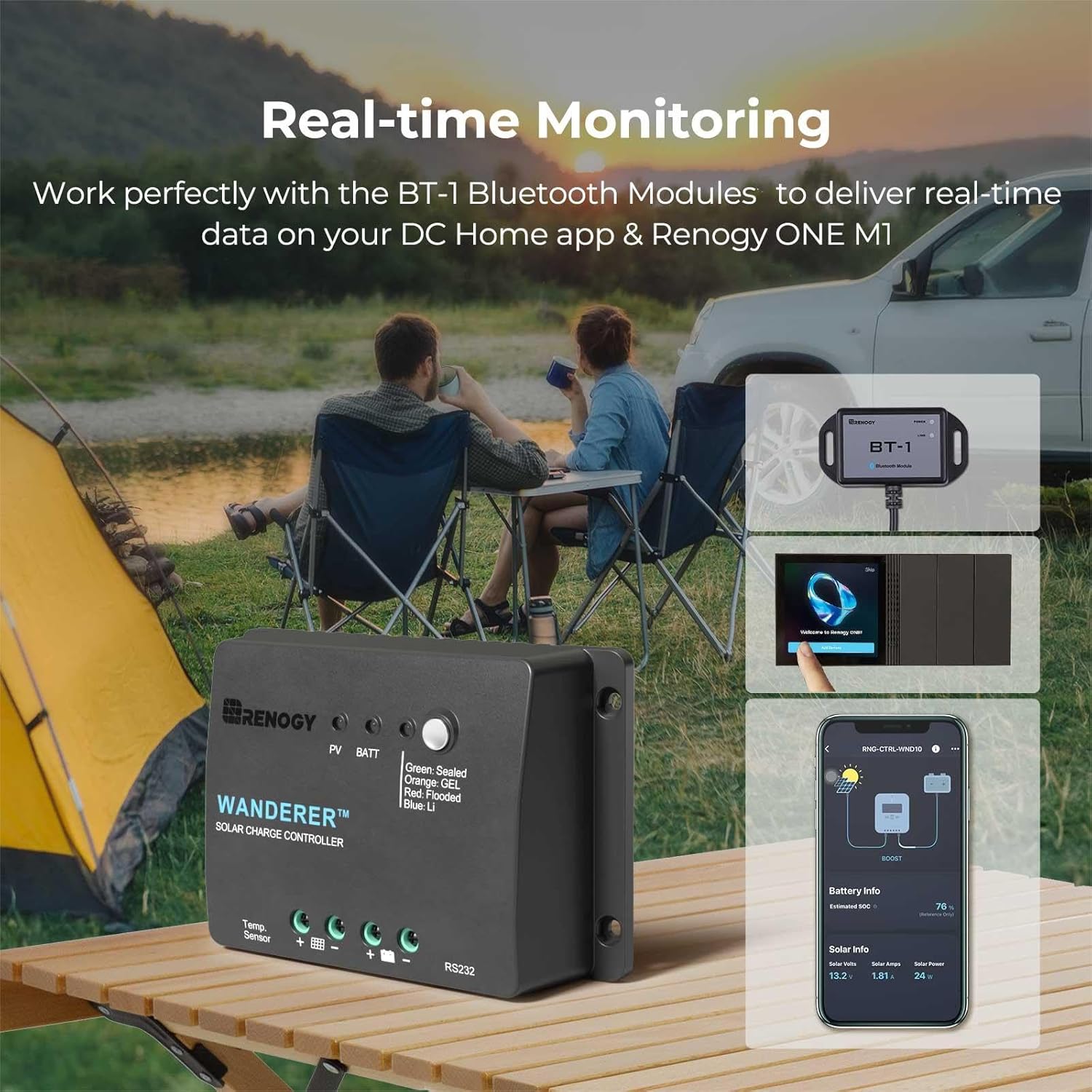
Image: The Renogy Wanderer charge controller connected to an optional BT-1 Bluetooth module, enabling real-time monitoring and voltage tracking.

Image: The Renogy Wanderer charge controller with an optional temperature sensor connected, illustrating its use for real-time temperature adjustment of charging voltage.
Maintenance
Regular maintenance ensures optimal performance and longevity of your solar power system.
- Solar Panels: Periodically clean the surface of the solar panels with a soft cloth and mild, non-abrasive cleaner to remove dirt, dust, and debris. Ensure panels are dry before reconnecting to the system if disconnected for cleaning.
- Connections: Regularly inspect all electrical connections for tightness and corrosion. Loose or corroded connections can lead to power loss or safety hazards.
- Charge Controller: Keep the charge controller free from dust and ensure adequate ventilation around the unit.
- Battery Bank: Follow the battery manufacturer's maintenance guidelines for your specific battery type. This may include checking electrolyte levels for flooded lead-acid batteries or monitoring voltage for sealed batteries.
Troubleshooting
This section addresses common issues you might encounter with your Renogy solar kit.
Common Issues and Solutions:
- No Power Output from Solar Panels:
- Check for shading on the solar panels.
- Verify all connections from the panels to the charge controller are secure and correctly wired.
- Ensure there is sufficient sunlight.
- Battery Not Charging or Charging Slowly:
- Confirm the charge controller is correctly connected to both the solar panels and the battery.
- Check battery voltage; if it's too low, the controller might not initiate charging.
- Inspect for any loose or corroded battery terminals.
- Ensure the battery type setting on the charge controller matches your battery.
- Charge Controller Displaying Warnings:
- Over-Voltage Warning: Indicates the input voltage from the solar panels or battery voltage is too high. Check panel configuration or battery health.
- Under-Voltage Warning: Indicates battery voltage is too low. Charge the battery or check for excessive load.
- Over-Discharge Warning: Indicates the battery has been discharged too deeply. Reduce load or increase charging capacity.
- Equalization Mode Concerns:
- The equalization process is an intentional overcharge. It is crucial to ensure there is no load on the batteries when this stage is active to prevent damage to connected appliances or the battery itself.
- If charging current falls during equalization, the device may pause this mode and resume when adequate charging current is available.
Specifications
| Feature | Specification |
|---|---|
| Brand | Renogy |
| Model Number | 400W 12V Solar Panel Starter Kit |
| Total Power Output | 400 Watts (4 x 100W panels) |
| System Voltage | 12 Volt |
| Solar Panel Type | Monocrystalline Silicon |
| Solar Panel Efficiency | 22% |
| Charge Controller Type | 30A Wanderer PWM Charge Controller |
| Product Dimensions (each panel) | 41.8"L x 20.9"W x 1.38"H |
| Item Weight (each panel) | 14.1 Pounds |
| Junction Box Rating | IP65 |
| Solar Connector Rating | IP67 |
| Max Snow Load | 5400 Pa |
| Max Wind Load | 2400 Pa |
| Certifications | UL61730-listed (Solar Panels) |
| Date First Available | April 14, 2013 |
Warranty and Support
Renogy provides comprehensive support and warranty coverage for its products.
Warranty Information:
- Solar Panels: 10-year warranty.
- Charge Controller: 2-year warranty.
- Power Output: 25-year warranty on power output.
For detailed warranty terms and conditions, please refer to the official Renogy website or contact customer support.
Customer Support:
Renogy is committed to providing excellent customer service:
- Prompt Response: Expect a 24-hour response time for inquiries.
- Local Warehouses: Local warehouses in the US for efficient service.
- Technical Guidance: Professional technical guidance is available to assist with any questions or issues.

Image: Information on Renogy's service plan, including 10 years for solar panels, 2 years for charge controllers, and 25 years for power output.


