1. Introduction
This manual provides essential information for the safe and efficient operation of your Hitachi CP-DX300 DLP Projector. Please read this manual thoroughly before using the projector and retain it for future reference. The Hitachi CP-DX300 is designed to deliver bright, clear, and detailed images for various applications, including business presentations and home entertainment.
3. Package Contents
Verify that all items listed below are included in your package:
- Hitachi CP-DX300 DLP Projector
- Power Cable
- Remote Control
- HDMI Cable
- VGA Cable (if included with specific models)
- User Manual (this document)
Note: Additional accessories may vary by region or retailer.
4. Product Overview
The Hitachi CP-DX300 is a compact and powerful DLP projector designed for versatility. Below are key physical features and connection ports.
Front View
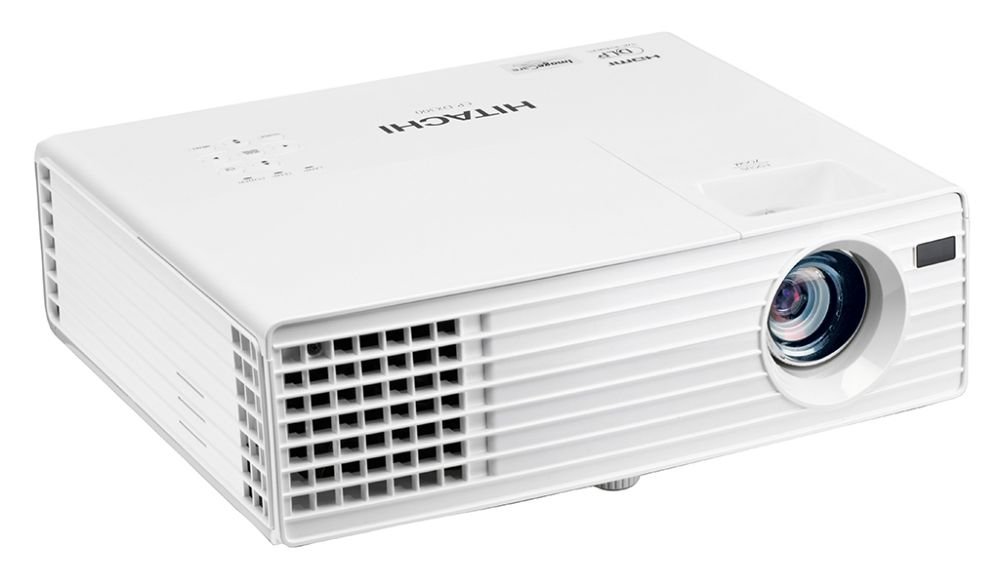
This image displays the front of the Hitachi CP-DX300 projector, highlighting the main projection lens and the front ventilation grille. The lens is centrally located, and the Hitachi brand logo is visible on the right side of the front panel.
Side View (Ports)

This image shows the side panel of the Hitachi CP-DX300 projector, detailing the various input and output ports. These include HDMI, VGA, S-Video, Composite Video, Component Video, and audio input/output jacks, providing comprehensive connectivity options.
Key Features:
- Projection Technology: 0.55" single chip DLP
- Resolution: XGA - 1024 x 768
- Light Output: 3,000 ANSI lumens
- Colors: 1.07 billion colors
- Aspect Ratio: Native 4:3 / 16:9 compatible
- Contrast Ratio: 2500 : 1
- Lamp Life: Approximately 4,500 hours (standard mode), 6,000 hours (Eco mode)
- Speaker Output: 2W x 1
- Connectivity: HDMI x 1 (HDCP compliant), Computer Input (15-pin mini D-sub) x 2, Computer Monitor Output (15-pin mini D-sub) x 1, S-Video Mini DIN 4-pin x 1, Composite Video RCA jack x 1, Component Video (shared with computer inputs), Audio Input (3.5 mm stereo mini jack) x 1, Audio Output (3.5 mm stereo mini jack) x 1.
6. Operating Instructions
6.1 Power On/Off
- Power On: Press the Power button on the projector or the remote control. The lamp will warm up, and the image will appear shortly.
- Power Off: Press the Power button again. A confirmation message may appear; press Power again to confirm shutdown. The projector will enter a cooling cycle before completely powering off.
6.2 Focus and Keystone Adjustment
- Focus: Rotate the focus ring on the projector lens until the image appears sharp and clear on the screen.
- Keystone Correction: Use the keystone adjustment feature (typically found in the projector's menu or via dedicated buttons on the remote) to correct trapezoidal distortion, ensuring a rectangular image. The CP-DX300 supports +/- 30 Degree vertical keystone correction.
6.3 Source Selection
Press the "Source" button on the projector or remote control to cycle through available input sources (HDMI, VGA, S-Video, Composite, etc.) until your desired source is displayed.
6.4 Audio Output
The projector has a built-in 2W speaker. For enhanced audio, connect external speakers or a sound system to the 3.5 mm stereo mini Audio Output jack.
6.5 3D Viewing
The Hitachi CP-DX300 is 3D capable. To enjoy 3D content, you will need compatible 3D glasses and a special graphic card (sold separately) connected to a 3D-enabled source device.
6.6 Wall Color Correction
This feature allows the projector to automatically adjust color output when projecting onto colored walls, ensuring accurate color reproduction without needing a white screen.
7. Maintenance
7.1 Cleaning the Projector
- Exterior: Wipe the projector's exterior with a soft, dry cloth. Do not use abrasive cleaners or solvents.
- Lens: Gently clean the lens with a lens cleaning cloth or lens paper. Avoid touching the lens directly with your fingers.
- Ventilation: Regularly check and clean the ventilation grilles to ensure proper airflow and prevent dust buildup.
7.2 Lamp Replacement
The lamp door is conveniently located on top of the model for easy maintenance. Refer to the detailed instructions in the full user manual for safe lamp replacement procedures. Always use genuine Hitachi replacement lamps.
Expected Lamp Life: Approximately 4,500 hours (standard mode), 6,000 hours (Eco mode).
7.3 Power Saving Standby Mode
The projector features a power-saving standby mode that reduces power consumption to less than 0.5W, contributing to energy efficiency.
7.4 Image Care Technology
Image Care is a lamp power control function that optimizes picture performance with maximum energy savings by decreasing energy usage, improving contrast ratio, and lengthening lamp life. This results in a lower total cost of ownership and decreased maintenance cost.
7.5 Intelligent Eco Mode
This mode automatically adjusts the lamp's brightness according to the screen's brightness level, further enhancing energy efficiency and lamp longevity.
8. Troubleshooting
If you encounter issues with your projector, refer to the following common problems and solutions:
- No Image:
- Ensure the power cable is securely connected and the projector is powered on.
- Verify the input source is correctly selected and the source device is active.
- Check the connection cable (HDMI, VGA) for damage or loose connections.
- Blurred Image:
- Adjust the focus ring on the lens.
- Ensure the projection surface is flat and the projector is stable.
- Image is Trapezoidal:
- Use the keystone correction feature to adjust the image shape.
- No Audio:
- Check the projector's volume settings.
- Ensure external audio devices are properly connected and powered on if used.
- Verify the audio source is playing.
- Overheating Warning:
- Ensure ventilation grilles are not blocked.
- Clean any dust from the grilles.
- Operate the projector in a well-ventilated area.
For more complex issues, please contact Hitachi customer support.
10. Warranty & Support
For warranty information and customer support, please refer to the documentation included with your product or visit the official Hitachi website. Keep your purchase receipt for warranty claims.
Note: Returns may be subject to specific terms and conditions, especially for brand new items, as indicated by the seller. Technical issues are typically covered.


