
1. Introduction
This manual provides essential information for the proper assembly, installation, operation, and maintenance of your Sirio Tornado 50-60 MHz Omni-Directional 6M Vertical Base Station Antenna. Please read these instructions carefully before proceeding with installation to ensure optimal performance and safety.
The Sirio Tornado is a high-quality, mono-band, low-gain, omnidirectional antenna designed for the 6-meter (50 MHz) band. It is constructed from anti-corodal aluminum tubes, ensuring durability and reliable performance.
2. Safety Information
- Always exercise caution when working at heights. Use appropriate safety equipment.
- Avoid installing the antenna near power lines or other electrical hazards.
- Ensure proper grounding of the antenna system to protect against lightning and static discharge.
- Do not operate the antenna with damaged components.
- Consult local regulations and codes for antenna installation requirements.
3. Package Contents
Before beginning assembly, verify that all components are present and undamaged. Refer to the included parts list for a complete inventory. Typical components include:
- Antenna radiating elements (aluminum tubes)
- Mounting hardware (clamps, screws, bolts)
- Radial elements
- UHF-female connector assembly
- Tuning diagram/chart
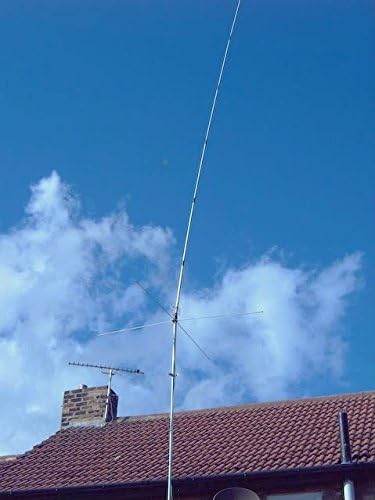
Image 1: Assembled Sirio Tornado 50-60 MHz Vertical Base Station Antenna. This image shows the complete antenna structure, including the vertical radiating element and horizontal radial elements, mounted against a sky background.
4. Setup and Assembly
The Sirio Tornado antenna is designed for straightforward assembly. Follow these general steps, referring to the specific tuning diagram and parts list provided with your antenna for detailed instructions.
4.1. Component Identification
Identify the main radiating elements, which typically consist of multiple telescopic aluminum sections. Also, locate the radial elements and the base mounting bracket.
4.2. Radiating Element Assembly
- Begin by connecting the largest section of the radiating element to the base assembly. Ensure proper alignment of pre-drilled holes for securing with screws.
- Progressively assemble the smaller telescopic sections, sliding them into the larger ones. Secure each section using the provided screws or clamps. Note: Some users have reported needing additional screws or minor drilling for optimal securement. Ensure all connections are firm and stable.
- Attach the radial elements to the designated points on the base or lower section of the antenna. These typically extend horizontally.
4.3. Tuning
The antenna is tunable for the 50-60 MHz range by adjusting the length of the whip. Use the enclosed tuning diagram to determine the correct length for your desired operating frequency. Adjustments are typically made on the uppermost section, often secured with a hose clamp for fine-tuning.
- Consult the tuning chart to find the recommended length for your target frequency (e.g., 50 MHz, 52 MHz, 54 MHz).
- Adjust the top section of the antenna to the specified length.
- Secure the adjustable section firmly.
- Verify the Standing Wave Ratio (SWR) using an antenna analyzer or SWR meter. Fine-tune the length for the lowest SWR at your desired operating frequency.
4.4. Mounting
The Sirio Tornado is a vertical base station antenna. It should be mounted on a sturdy mast or pole. The mounting hardware is designed to accommodate standard mast diameters.
- Select a mounting location that is as high as possible and clear of obstructions for optimal performance.
- Attach the antenna's mounting bracket to your mast using the provided U-bolts and clamps. Ensure the antenna is vertical and securely fastened to withstand wind loads.
- Connect your 50 Ohm coaxial cable to the UHF-female connector at the base of the antenna. Ensure the connection is tight and weatherproofed.
5. Operating Instructions
Once assembled, tuned, and mounted, the Sirio Tornado antenna is ready for operation.
- Connect the antenna to your radio transceiver via a 50 Ohm coaxial cable.
- Ensure your radio is set to the 6-meter band (50-60 MHz).
- The antenna is omni-directional, meaning it transmits and receives signals equally well in all horizontal directions.
- Observe the maximum power rating of 1000 Watts (CW) at 30°C to prevent damage to the antenna.
6. Maintenance
Regular maintenance will prolong the life and ensure consistent performance of your antenna.
- Periodic Inspection: Annually inspect all mechanical connections, including screws, clamps, and mounting hardware, for tightness and corrosion.
- Cable Inspection: Check the coaxial cable and connector for signs of wear, damage, or moisture ingress. Re-weatherproof connections as needed.
- Cleaning: Clean the antenna elements periodically to remove dirt, grime, and salt deposits, especially in coastal areas. Use a mild detergent and water, then rinse thoroughly.
- Material Care: The antenna is made of aluminum, brass, and nylon. These materials are generally resistant to corrosion, but regular inspection is still recommended.
7. Troubleshooting
If you experience issues with your antenna, consider the following troubleshooting steps:
7.1. High SWR (Standing Wave Ratio)
- Check Tuning: Re-verify the length of the adjustable whip section against the tuning chart for your desired frequency.
- Inspect Connections: Ensure all antenna elements are securely assembled and all screws/clamps are tight. Check the coaxial cable connection at the antenna and radio for proper seating and absence of shorts or open circuits.
- Cable Condition: A damaged or incorrect length of coaxial cable can cause high SWR. Test with a known good cable if possible.
- Proximity to Objects: Ensure the antenna is not too close to metal objects, buildings, or other antennas, which can detune it.
7.2. Poor Signal Reception/Transmission
- Antenna Height: Ensure the antenna is mounted as high as practically possible and clear of obstructions.
- SWR: High SWR will reduce effective radiated power and reception sensitivity. Address SWR issues first.
- Radio Settings: Confirm your radio is functioning correctly and set to the appropriate frequency and mode.
- Coaxial Cable: Check for excessive cable length or poor quality cable, which can lead to signal loss.
8. Specifications
| Feature | Specification |
|---|---|
| Antenna Type | Base station antenna, mono-band, omnidirectional |
| Frequency Range | 50-60 MHz (6 Meter Band) |
| Tunability | Tunable by whip length adjustment |
| Gain | 1.2 dBd - 3.35 dBi |
| Bandwidth @ SWR 2 | 3.1 MHz @ 50 MHz |
| SWR @ Resonant Frequency | 1.2 |
| Maximum Power (CW) @ 30°C | 1000 Watts |
| Impedance | 50 Ohms |
| Connector | UHF-female |
| Materials | Aluminum alloy 6063 T-832, Brass, Nylon |
| Wind Load / Resistance | 146 N @ 150 Km/h / 150 Km/h |
| Wind Surface | 0.13 m² |
| Product Dimensions | 47 x 4 x 5 inches (approximate, packaged) |
| Item Weight | 6 pounds |
| Model Number | tornado5060 |
| UPC | 670541232965 |
9. Warranty and Support
For warranty information, please refer to the documentation included with your purchase or contact the authorized Sirio dealer or manufacturer directly. Specific warranty terms and conditions may vary by region and seller.
For technical support or assistance with parts, please contact your point of purchase or the official Sirio customer service channels. Keep your purchase receipt and product model number (tornado5060) readily available when seeking support.


