1. Product Overview
The ASUS TUF SABERTOOTH 990FX R2.0 is an ATX motherboard designed for AMD Socket AM3+ processors, supporting up to 8-core AMD FX Series CPUs and compatible with previous generation AM3 processors. This motherboard emphasizes stability, compatibility, and durability, ensuring reliable operation under various conditions.
Key features include CeraM!X premium ceramic-coating technology for enhanced heat dissipation, TUF Thermal Radar with 10 hardware sensors for real-time thermal detection, and DIGI+ Power Control for precise CPU and DRAM voltage regulation. It also incorporates ASUS E.S.P. for efficient power switching, MemOK! for memory boot compatibility, and ESD Guards for component protection. The board supports Quad-GPU SLI and Quad-GPU CrossFireX for multi-GPU configurations and utilizes military-standard TUF capacitors, chokes, and MOSFETs for extended lifespan.
2. Setup and Installation
2.1. CPU Installation (Socket AM3+)
Carefully align your AMD AM3+ processor with the motherboard socket. Ensure the CPU is correctly oriented before gently lowering it into place. Close the retention lever to secure the CPU.
2.2. RAM Installation (DDR3)
This motherboard supports DDR3 memory. Open the clips on the DIMM slots. Align the memory module's notch with the slot's key and press down firmly on both ends until the clips snap into place. Refer to the motherboard layout for recommended dual-channel configurations.
2.3. Storage Device Installation (SATA 6Gb/s)
Connect your SATA 6Gb/s storage devices (HDDs, SSDs) to the available SATA ports on the motherboard using SATA data cables. Ensure power cables from your power supply are also connected to the devices.
2.4. Expansion Card Installation (PCIe)
Insert your PCI Express expansion cards (e.g., graphics cards, sound cards) into the appropriate PCIe slots. Press down firmly until the card is seated correctly and secure it with a screw to the chassis.
2.5. Power Connections
Connect the 24-pin ATX main power connector and the 8-pin ATX 12V power connector from your power supply to the corresponding sockets on the motherboard.
2.6. Front Panel Connections
Connect the front panel headers (power button, reset button, HDD LED, power LED, USB ports, audio jacks) from your chassis to the corresponding pins on the motherboard. Refer to the motherboard manual for exact pin assignments.
3. Operating Instructions
3.1. BIOS/UEFI Configuration
Upon initial boot, press the designated key (usually DEL or F2) to enter the BIOS/UEFI setup utility. Here you can configure boot order, system time, and various hardware settings. The DIGI+ Power Control allows for advanced power management and tuning.
3.2. Driver Installation
After installing your operating system, install all necessary drivers from the provided support DVD or the ASUS website. This includes chipset drivers, audio drivers, LAN drivers, and any other peripheral drivers to ensure optimal system performance.
3.3. System Monitoring
Utilize the TUF Thermal Radar software to monitor real-time thermal conditions across 10 hardware sensors on the motherboard. This allows for customized cooling settings and proactive thermal management.
4. Maintenance
4.1. Dust Cleaning
Regularly clean dust from the motherboard and cooling components using compressed air. Ensure the system is powered off and unplugged before cleaning.
4.2. BIOS Updates
Periodically check the ASUS support website for BIOS/UEFI updates. Updating the BIOS can improve system stability, compatibility, and performance. Follow the instructions provided by ASUS carefully during the update process.
4.3. Component Checks
Ensure all cables and components are securely seated. Loose connections can lead to system instability or non-functionality.
5. Troubleshooting
5.1. System Not Booting
- Verify all power connections to the motherboard and components are secure.
- Check that the CPU and RAM are correctly installed.
- Utilize the MemOK! button on the motherboard to resolve memory compatibility issues if the system fails to boot due to RAM.
- Ensure the graphics card is properly seated and connected to power, if applicable.
5.2. Peripheral Recognition Issues
- Ensure all drivers are correctly installed and up to date.
- Check USB and SATA connections for proper seating.
- Test peripherals on different ports to rule out faulty ports.
5.3. System Instability/Crashes
- Monitor system temperatures using TUF Thermal Radar to check for overheating.
- Ensure adequate cooling and airflow within the PC case.
- Verify RAM stability using diagnostic tools.
- Check for the latest BIOS/UEFI firmware and update if necessary.
The motherboard features ESD Guards to protect components from electrostatic discharge, which can help prevent certain types of hardware failures.
6. Specifications
| Feature | Detail |
|---|---|
| Brand | ASUS |
| Series | SABERTOOTH 990FX R2.0 |
| Model Number | SABERTOOTH 990FX R2.0 |
| CPU Socket | Socket AM3+ |
| Compatible Processors | AMD FX Series (up to 8-core), AMD Athlon, AMD Sempron |
| Chipset Type | AMD 990FX |
| RAM Memory Technology | DDR3 SDRAM |
| Max RAM Supported | 32 GB DDR3 |
| Memory Speed | Up to 2666 MHz |
| SATA Ports | SATA 6Gb/s |
| USB 2.0 Ports | 2 (rear panel) + internal headers |
| USB 3.0 Ports | 2 (rear panel) + internal headers |
| Product Dimensions (LxWxH) | 10.47 x 2.99 x 13.03 inches |
| Item Weight | 4.45 pounds |
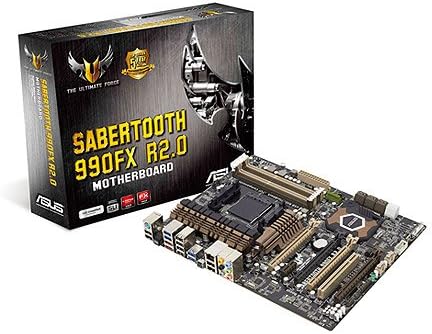
7. Product Visuals
7.1. Product Images




7.2. Official Product Videos
This video provides a general overview of the product, highlighting its design and features. It is an official product video from the seller.
8. Warranty and Support
For detailed warranty information, please refer to the official ASUS website or the documentation included with your purchase. Product support, including driver downloads and further troubleshooting guides, can also be found on the official ASUS support portal.
Please note the legal disclaimer: "Item is nonrefundable once purchased. Still has original packaging." This information is provided by the seller and may pertain to specific purchase conditions.


