
Introduction
This manual provides essential information for the proper setup, operation, and maintenance of your Fender '65 Princeton Reverb Guitar Amplifier. The '65 Princeton Reverb is a 15-watt all-tube amplifier designed for versatile use in various settings, from home practice to recording studios and small live performances. It features classic Fender tube tone, dynamic clean and overdriven sounds, and integrated long-spring reverb and tube vibrato effects.
Key features include:
- 15-watt all-tube amplification with tube rectification.
- Equipped with a 1-10" Jensen C-10R, 8 Ohm, 40 Watt Speaker with Ceramic Magnet.
- Integrated long-spring Fender reverb and tube vibrato effects.
- Includes an amplifier cover and a 2-button footswitch for remote control of reverb and vibrato.

Figure 1: Front view of the Fender '65 Princeton Reverb Guitar Amplifier, showcasing its classic black Tolex finish and silver grille cloth.
Setup
- Unpacking: Carefully remove the amplifier from its packaging. Retain all packing materials for future transport or storage.
- Placement: Position the amplifier on a stable, level surface. Ensure adequate ventilation around the unit to prevent overheating. Avoid placing the amplifier near heat sources or in direct sunlight.
- Power Connection: Ensure the amplifier's power switch is in the 'OFF' position. Connect the supplied power cord to the amplifier's AC inlet and then to a grounded electrical outlet. Verify that the outlet provides the correct voltage for your region.
- Instrument Connection: Connect your guitar or other instrument to one of the 'INSTRUMENTS' input jacks (Input 1 or Input 2) using a high-quality instrument cable. Input 1 typically offers higher sensitivity than Input 2.
- Footswitch Connection (Optional): If using the included 2-button footswitch, connect it to the 'FOOTSWITCH' jack on the amplifier's rear panel. This allows remote activation of the Reverb and Vibrato effects.
Operating Instructions
Familiarize yourself with the amplifier's front panel controls:
- Power Switch: Turns the amplifier ON or OFF. Allow a brief warm-up period after turning on.
- Volume: Controls the overall output level of the amplifier.
- Treble: Adjusts the high-frequency response. Turn clockwise for brighter tones, counter-clockwise for warmer tones.
- Bass: Adjusts the low-frequency response. Turn clockwise for more bass, counter-clockwise for less.
- Reverb: Controls the intensity of the built-in spring reverb effect.
- Speed: Adjusts the rate of the vibrato effect.
- Intensity: Adjusts the depth or prominence of the vibrato effect.
Initial Power-Up:
- Ensure all volume and effect controls are set to their minimum positions.
- Flip the power switch to the 'ON' position. The pilot light will illuminate.
- Allow approximately 30-60 seconds for the tubes to warm up.
- Slowly increase the 'Volume' control to your desired listening level. Adjust 'Treble' and 'Bass' for tonal preference.
- Experiment with the 'Reverb', 'Speed', and 'Intensity' controls to achieve desired effects.
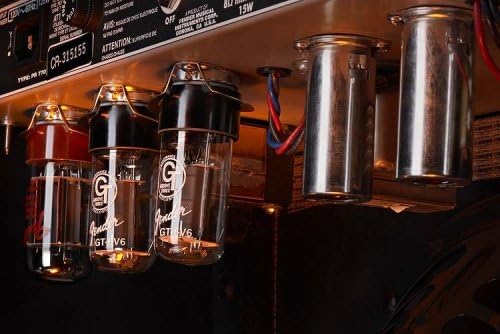
Figure 2: Internal view of the amplifier, highlighting the vacuum tubes which are crucial for its tonal characteristics.
Maintenance
- Cleaning: Use a soft, dry cloth to clean the amplifier's exterior. Avoid abrasive cleaners or solvents.
- Tube Care: Vacuum tubes have a finite lifespan. If you notice a decrease in performance, unusual noise, or a change in tone, tubes may need replacement. Consult a qualified technician for tube replacement.
- Storage: When not in use, store the amplifier in a dry, temperature-controlled environment. Use the included amplifier cover to protect it from dust and minor impacts.
- Transportation: Always power off and unplug the amplifier before moving it. Use proper lifting techniques due to its weight.
Troubleshooting
| Problem | Possible Cause | Solution |
|---|---|---|
| No sound output | Power cord disconnected, instrument cable faulty, volume set to zero, speaker disconnected. | Check power and instrument cables. Ensure volume is up. Verify speaker connection. |
| Humming or buzzing noise | Ground loop, faulty instrument cable, proximity to other electronics, worn tubes. | Try a different outlet. Use shielded cables. Move away from other devices. Consult technician for tube inspection. |
| Weak or distorted sound | Worn tubes, incorrect instrument input, speaker damage. | Check instrument input. Consult technician for tube or speaker inspection. |
| Reverb or Vibrato not working | Footswitch disconnected or faulty, effect controls set to zero, internal component failure. | Check footswitch connection and functionality. Ensure effect controls are adjusted. Consult technician. |
If troubleshooting steps do not resolve the issue, contact Fender customer support or a qualified service technician.
Specifications
- Brand: Fender
- Model: '65 Princeton Reverb
- Item Model Number: 2172000000
- Output Wattage: 15 Watts
- Speaker: 1-10" Jensen C-10R, 8 Ohm, 40 Watt Speaker with Ceramic Magnet
- Product Dimensions: 28.25 x 22.5 x 12.25 inches (Length x Height x Depth)
- Item Weight: 34 pounds
- Color: Black
- Material: Metal, Wood
- Compatible Devices: Guitar
- Manufacturer: Fender Musical Instruments Corp.

Figure 3: Dimensional diagram of the amplifier, indicating its length, height, and depth.
Warranty and Support
Fender products are designed for reliability and performance. For specific warranty information, please refer to the warranty card included with your amplifier or visit the official Fender website. For technical support, service, or replacement parts, please contact Fender customer service through their official channels. Always provide your model number (2172000000) and serial number when seeking support.
Online Resources: For additional information, product registration, and support, visit the official Fender website.


