
Introduction
This manual provides essential information for the installation, operation, and maintenance of your Walbro GSL392-400-939 Universal 255 LPH Inline Fuel Pump Kit. Walbro electric fuel pumps are designed with a proven gerotor mechanism, offering compact dimensions suitable for various hanger assemblies without extensive modifications. This kit includes the fuel pump, all necessary drop parts, accessories, and detailed installation instructions to ensure proper function and longevity.
An inlet filter, meeting or exceeding original equipment specifications, is also included to provide improved filtration and durability for your fuel system.
Product Overview
The Walbro GSL392-400-939 is a high-performance inline fuel pump designed for universal applications. Key features include:
- Universal 255 LPH Kit (Inline Pump): Provides a flow rate of 255 Liters Per Hour, suitable for various high-performance applications.
- Complete Fuel Pump and Install Kit: Includes the fuel pump, mounting hardware, electrical connectors, and an inlet filter for a comprehensive installation solution.
- Gerotor Design: Utilizes a reliable and efficient gerotor pumping mechanism.
- Compact Size: Engineered to fit into existing fuel system configurations with minimal or no modification.

Figure 1: Walbro GSL392-400-939 Fuel Pump and Installation Kit. This image displays the fuel pump unit along with various components included in the kit, such as mounting brackets, electrical connectors, and hose barb fittings.
Specifications
| Specification | Detail |
|---|---|
| Brand | Walbro |
| Model Number | GSL392-400-939 |
| Fit Type | Universal Fit |
| Vehicle Service Type | Car |
| Material | Alloy Steel (Body), Metal |
| Style | Rotary Vane |
| Auto Part Position | Front Inside |
| Outlet Connection Type | Hose fitting |
| Inlet Connection Type | Threaded |
| Gas Type | Gasoline |
| Mounting Type | Threaded |
| Operation Mode | Automatic |
| Product Grade | Performance Part |
| OEM Equivalent Part Number | GSL-392, GSL392, 400-939 |
| Connector Type | Threaded, Hose-barb fitting |
| Outlet Connection Size | 0.39 inches |
| Inlet Connection Size | 0.39 inches |
Installation
Proper installation is crucial for the performance and longevity of your fuel pump. It is highly recommended that installation be performed by a qualified automotive technician. Refer to the detailed installation instructions included with your kit for specific steps and diagrams.
General Guidelines:
- Safety First: Disconnect the vehicle's battery and relieve fuel system pressure before beginning any work. Ensure adequate ventilation and have a fire extinguisher readily available.
- Mounting Location: The fuel pump should be mounted securely, ideally at or below the level of the fuel tank to prevent cavitation and ensure proper fuel delivery.
- Fuel Lines: Use fuel lines rated for fuel injection systems. Ensure all connections are tight and leak-free. Consider using AN fittings for enhanced security and performance.
- Electrical Connections: Upgrade fuel pump wiring if necessary, as this pump may draw significant power. Ensure all electrical connections are secure and properly insulated.
- Inlet Filter: Install the included inlet filter to protect the pump from contaminants.
- Return Line: For fuel-injected systems, ensure a properly sized return line is in place to manage excess fuel flow and maintain consistent pressure.
Operation
Once installed, the Walbro GSL392-400-939 fuel pump operates automatically to supply fuel to your engine. It is designed to maintain consistent fuel pressure under various operating conditions.
- Initial Start-up: After installation, cycle the ignition key several times without starting the engine to allow the pump to prime the fuel system and build pressure. Check for any leaks before starting the engine.
- Noise Level: A properly installed Walbro GSL392-400-939 pump should operate quietly, emitting only a slight hum or whirr. Excessive noise may indicate an issue such as cavitation (due to improper mounting or restricted inlet) or a faulty component.
- Fuel Pressure Monitoring: For performance applications, monitoring fuel pressure with a gauge is recommended to ensure the pump is delivering the required pressure.
Maintenance
The Walbro GSL392-400-939 fuel pump is designed for durability and requires minimal routine maintenance. However, periodic checks can help ensure optimal performance:
- Fuel Filter Replacement: Regularly inspect and replace your fuel filter(s) according to your vehicle manufacturer's recommendations or more frequently in dusty or contaminated environments. A clogged fuel filter can restrict flow and put undue strain on the pump.
- System Inspection: Periodically check fuel lines, connections, and electrical wiring for any signs of wear, leaks, or corrosion.
- Fuel Quality: Use clean, high-quality gasoline to prevent contaminants from entering the fuel system and damaging the pump.
Troubleshooting
If you experience issues with your fuel pump, consider the following common troubleshooting steps:
- No Fuel Pressure / Engine Cranks but Won't Start:
- Check electrical connections to the pump for power and ground.
- Verify the fuel pump fuse and relay are functional.
- Ensure there is sufficient fuel in the tank.
- Inspect for severely clogged fuel filters or lines.
- Excessive Noise / Whining:
- Check if the pump is mounted at or below the fuel tank level. Improper mounting can lead to cavitation.
- Inspect the inlet filter and fuel lines for restrictions.
- Ensure the pump is securely mounted and not vibrating against other components.
- Low Fuel Pressure:
- Check for clogged fuel filters.
- Inspect for leaks in the fuel lines or connections.
- Verify the fuel pressure regulator is functioning correctly.
- Ensure adequate voltage supply to the pump.
If troubleshooting steps do not resolve the issue, consult a qualified automotive technician.
Performance Data
The following chart illustrates the typical performance characteristics of the Walbro GSL392 fuel pump, showing flow rate versus pressure at different voltages (12V and 13.5V DC) and current draw.

Figure 2: Pump #GSL392 - Typical Performance. This graph shows the relationship between fuel flow (GPH), pressure (PSI), and current draw (Amps) at 12V and 13.5V DC, measured in Stoddard Solvent.
Dimensions
Refer to the diagram below for the physical dimensions of the Walbro GSL392 fuel pump. All measurements are provided in millimeters unless otherwise specified.
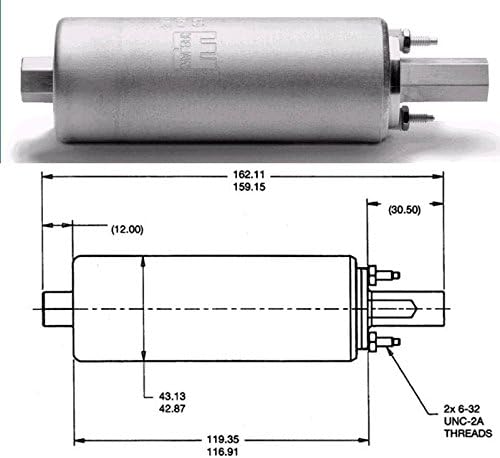
Figure 3: Walbro GSL392 Fuel Pump Dimensional Drawing. This technical drawing provides precise measurements of the fuel pump's length, diameter, and connection points, including thread specifications for electrical terminals.
Warranty and Support
For warranty information, please refer to the documentation included with your purchase or contact Walbro customer support directly. Keep your proof of purchase for any warranty claims.
For technical assistance or further inquiries, please visit the official Walbro website or contact their customer service department. When contacting support, please have your product model number (GSL392-400-939) and purchase details readily available.