
ISO 14230-4:2000
Contents
ISO 14230-4:2000 Instruction Manual
Road vehicles — Diagnostic systems — Keyword Protocol 2000 — Part 4: Requirements for emission-related systems
1. Introduction
This document serves as an instruction manual for understanding and applying the ISO 14230-4:2000 standard. This part of ISO 14230 specifies the requirements for the Keyword Protocol 2000 (KWP 2000) data link and connected vehicle and scan tool when used to comply with on-board diagnostic (OBD) requirements for emission-related test data.
It is important to note that this part of ISO 14230 only specifies requirements relative to the Keyword Protocol 2000 for OBD purposes. For a complete specification, refer to ISO 14230 parts 1 to 3 and ISO 14229. ISO 14230-1, ISO 14230-2, and ISO 14230-3 are applicable for OBD purposes only as explicitly referenced within this document.
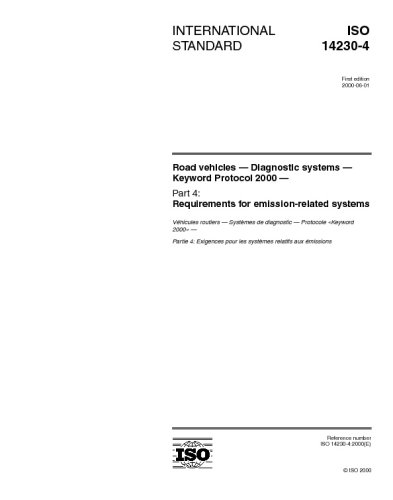
Figure 1: Cover page of the ISO 14230-4:2000 standard. This image displays the cover page of the ISO 14230-4:2000 standard. It features the title 'Road vehicles — Diagnostic systems — Keyword Protocol 2000 — Part 4: Requirements for emission-related systems' along with the ISO logo and publication details.
2. Document Setup and Access
This standard is typically provided in a digital format (PDF) or as a physical paperback. To effectively utilize this document, ensure you have appropriate software for viewing PDF files, such as Adobe Acrobat Reader, if accessing a digital copy.
For physical copies, ensure the document is stored in a clean, dry environment to preserve its integrity. No specific setup is required beyond standard document handling practices.
3. Operating and Application Guidelines
To effectively apply the ISO 14230-4:2000 standard, follow these guidelines:
- Understand the Scope: This part focuses specifically on emission-related systems and the KWP 2000 data link for On-Board Diagnostic (OBD) purposes. Do not apply its requirements to non-emission related systems unless explicitly referenced by other standards.
- Reference Related Standards: As mentioned, this document is part of a series. Always refer to ISO 14230 parts 1, 2, and 3, and ISO 14229 for comprehensive understanding of the Keyword Protocol 2000 and diagnostic services. Links to these related standards can often be found through the International Organization for Standardization (ISO) website or your standard distributor.
- Interpret Requirements: Carefully read each requirement. Pay attention to keywords such as "shall" (mandatory), "should" (recommended), and "may" (optional).
- Data Link Communication: The standard details the communication protocols for the KWP 2000 data link. Ensure your diagnostic tools and vehicle systems comply with these specifications for proper data exchange.
- Emission-Related Data: Focus on the specific data parameters and diagnostic trouble codes (DTCs) related to emission control systems as defined within the standard.
For practical implementation, it is recommended that personnel involved in vehicle diagnostics and system development have a strong background in automotive electronics and communication protocols.
4. Document Maintenance and Updates
As a published standard, ISO 14230-4:2000 is a static document. However, standards are periodically reviewed and may be revised or superseded by newer versions. To ensure you are always working with the most current and applicable information:
- Check for Revisions: Regularly consult the official ISO website (www.iso.org) or your standard purchasing platform for any updates, amendments, or newer editions of ISO 14230 or related standards.
- Subscribe to Updates: Many standards organizations offer subscription services to notify users of changes to specific standards.
- Archiving: Keep records of the version of the standard used for specific projects or vehicle models for historical reference and compliance auditing.
5. Troubleshooting Common Application Issues
While this document is a technical specification, common issues can arise during its application:
- Incomplete Understanding: If diagnostic systems are not behaving as expected, verify that all relevant parts of ISO 14230 (1-4) and ISO 14229 have been thoroughly reviewed and understood. Often, a requirement in one part relies on definitions or procedures in another.
- Tool Compatibility: Ensure that any scan tools or diagnostic equipment used are certified or explicitly designed to comply with KWP 2000 as defined by this standard. Incompatibility can lead to communication errors.
- Vehicle Implementation Variations: While standards aim for uniformity, vehicle manufacturers may have specific interpretations or additional proprietary diagnostic routines. Consult vehicle-specific service manuals in conjunction with this standard.
- Data Interpretation Errors: Double-check the interpretation of diagnostic trouble codes (DTCs) and data parameters against the standard's definitions. Misinterpretation can lead to incorrect diagnoses.
For complex issues, consider consulting with experts in automotive diagnostics or contacting the technical support channels of your diagnostic equipment provider.
6. Document Specifications
| Attribute | Detail |
|---|---|
| ASIN | B00186ZJXI |
| Publisher | Multiple. Distributed through American National Standards Institute (ANSI) |
| Publication Date | August 23, 2007 |
| Language | English |
| Print Length | 24 pages |
| Item Weight | 3.84 ounces |
| Dimensions | 8.25 x 0.06 x 10.5 inches |
7. Warranty and Support
As a technical standard document, ISO 14230-4:2000 does not come with a traditional product warranty. Its accuracy and applicability are maintained by the International Organization for Standardization (ISO) through their rigorous development and review processes.
For support regarding the content or interpretation of this standard, it is recommended to:
- Consult ISO Resources: Visit the official ISO website (www.iso.org) for FAQs, errata, or contact information for technical committees.
- Contact Distributor: If purchased through a distributor like ANSI, they may offer support or direct you to appropriate resources.
- Professional Organizations: Industry-specific professional organizations or forums often provide platforms for discussing and clarifying standard interpretations.
Please note that the publisher and distributor are not responsible for the direct application or consequences of using this standard in specific implementations.
Documents and downloads
Ask a question about this manual
Ask about setup, troubleshooting, compatibility, parts, safety, or missing instructions. Manuals+ will review the question and use this page’s manual context to help answer it.