
1. Introduction to the HP 48SX
This document serves as Volume II of the comprehensive user manual for the HP 48SX Scientific Expandable Calculator. It is designed to guide users through the advanced functionalities, programming capabilities, and intricate operations of this powerful scientific instrument. Familiarity with basic calculator operations, as covered in Volume I, is recommended for optimal use of this manual.
The HP 48SX is renowned for its Reverse Polish Notation (RPN) entry system, extensive graphing capabilities, and expandability via memory cards. This volume delves deeper into these features, enabling users to unlock the full potential of their calculator for complex scientific, engineering, and mathematical tasks.
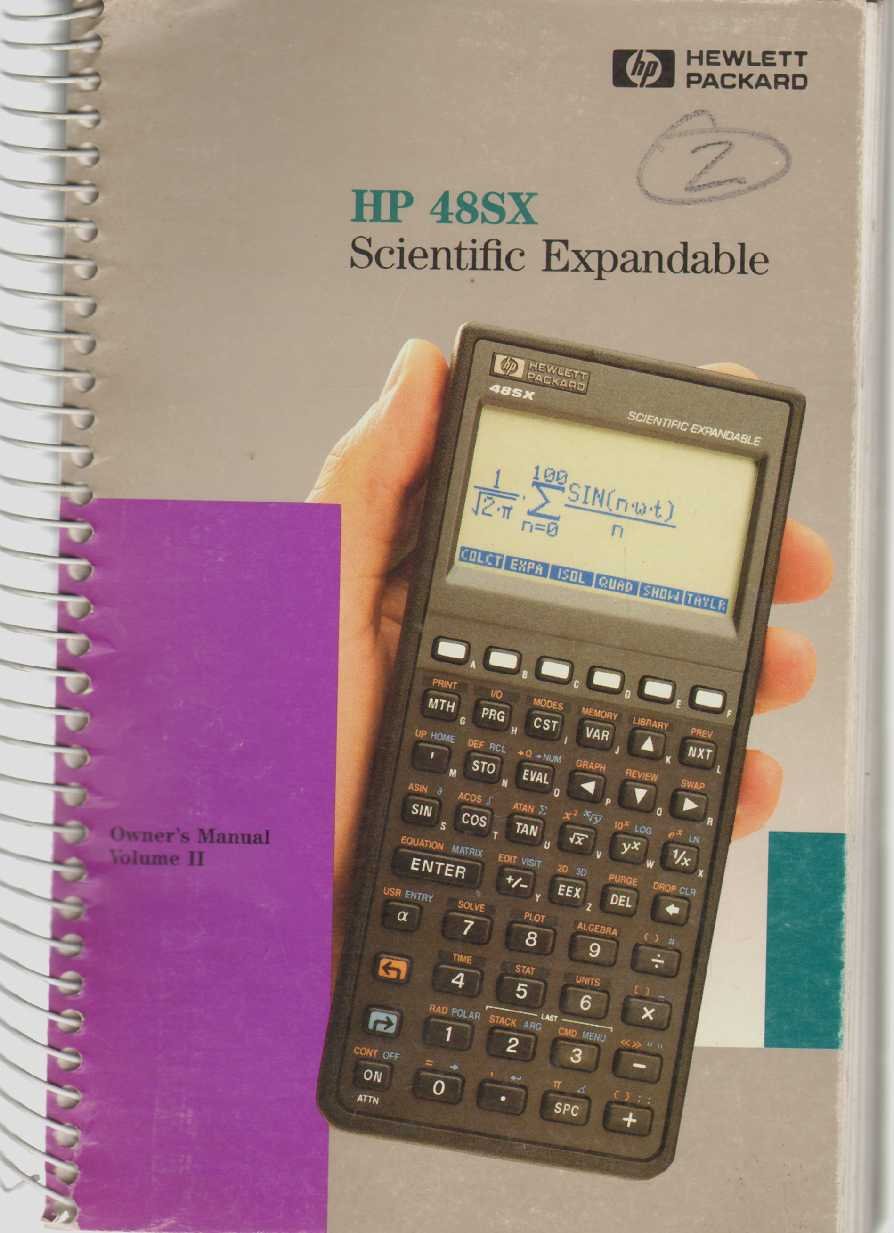
Figure 1: The HP 48SX Scientific Expandable Calculator. This image displays the calculator's physical layout, including its keypad, display, and expansion slots.
2. Setup and Initial Configuration
2.1 Battery Installation
The HP 48SX operates on three AAA batteries. Proper installation is crucial for functionality.
- Locate the battery compartment cover on the back of the calculator.
- Slide the cover off in the direction indicated by the arrow.
- Insert three fresh AAA batteries, ensuring correct polarity (+/-) as marked inside the compartment.
- Replace the battery compartment cover, ensuring it clicks securely into place.
2.2 Initial Power-On and Display Adjustment
After battery installation, press the ON key to power on the calculator. The display contrast can be adjusted for optimal viewing.
- To increase contrast: Press and hold the ON key, then press the + key.
- To decrease contrast: Press and hold the ON key, then press the - key.
2.3 Memory Card Installation (Optional)
The HP 48SX features two expansion slots for memory cards, allowing for increased storage and specialized applications.
- Ensure the calculator is powered off.
- Locate the expansion slots on the top edge of the calculator.
- Carefully insert the memory card into an available slot, ensuring the correct orientation. Do not force the card.
- Press firmly until the card is seated securely.
- Power on the calculator. The system should detect the new memory card.
3. Operating the HP 48SX: Advanced Functions
This section covers advanced operations, building upon the basic functions detailed in Volume I.
3.1 Understanding the RPN Stack
The HP 48SX utilizes Reverse Polish Notation (RPN), where operands are entered before the operator. The stack is a fundamental concept in RPN, holding intermediate results.
- Entering Numbers: Type the number, then press ENTER. This pushes the number onto the stack.
- Performing Operations: Enter the operands, then press the desired operator key (e.g., +, -, *, /). The operation is performed on the top two stack levels, and the result replaces them.
- Stack Manipulation: Keys like DROP, SWAP, ROLL, and DUP are used to manage stack contents.
3.2 Advanced Mathematical Functions
Access advanced functions via the SHIFT keys (left-shift LS and right-shift RS) and menus.
- Trigonometric Functions: SIN, COS, TAN and their inverses are directly accessible or via shifted keys. Ensure the correct angle mode (degrees, radians, grads) is selected using the MODES menu.
- Logarithmic Functions: LN (natural logarithm) and LOG (base 10 logarithm) are available.
- Complex Numbers: The HP 48SX supports complex number arithmetic. Enter complex numbers as (real, imaginary).
- Matrix Operations: Create and manipulate matrices using the MATRIX menu. Operations include addition, subtraction, multiplication, inversion, and determinants.
3.3 Graphing Functions
The calculator can plot various types of graphs.
- Press PLOT to access the plotting menu.
- Select the desired plot type (e.g., FUNCTION, PARAMETRIC, POLAR, CONIC).
- Enter the function(s) to be plotted.
- Adjust the viewing window (X-RANGE, Y-RANGE) as needed.
- Press DRAW to display the graph.
3.4 Programming with RPL
The HP 48SX uses RPL (Reverse Polish Lisp) for programming. Programs are stored as objects.
- To create a new program, enter << (left-shift ALPHA [) followed by the program commands, and then >> (right-shift ALPHA ]).
- Store the program by typing its name (e.g., 'MYPROG') and pressing STO.
- To execute a program, type its name and press EVAL, or press the corresponding softkey if assigned.
- Common programming constructs include IF...THEN...ELSE...END, FOR...NEXT, and DO...UNTIL...END.
4. Maintenance and Care
4.1 Cleaning the Calculator
To ensure longevity and proper function, keep your HP 48SX clean.
- Use a soft, lint-free cloth slightly dampened with water or a mild, non-abrasive cleaner.
- Avoid harsh chemicals, solvents, or abrasive materials, as these can damage the display or casing.
- Do not spray cleaning solutions directly onto the calculator.
4.2 Battery Replacement
Replace batteries promptly when the low battery indicator appears on the display to prevent data loss.
- Follow the battery installation steps outlined in Section 2.1.
- It is recommended to replace all three AAA batteries simultaneously.
- Dispose of old batteries according to local regulations.
4.3 Storage
When not in use for extended periods, store the calculator in a cool, dry place, away from direct sunlight and extreme temperatures. Consider removing batteries if storing for several months to prevent leakage.
5. Troubleshooting Common Issues
This section addresses common problems and their solutions.
5.1 Calculator Does Not Turn On
- Check Batteries: Ensure batteries are correctly installed and not depleted. Replace if necessary.
- Battery Contacts: Verify that battery contacts are clean and free of corrosion.
- Hard Reset: If the calculator is unresponsive, perform a hard reset by removing all batteries for a few minutes, then reinserting them. Note that this may clear user data.
5.2 Display Issues
- Adjust Contrast: Use the ON + and ON - key combinations to adjust display contrast (refer to Section 2.2).
- Faint Display: This often indicates low battery power. Replace batteries.
- Garbled Display: A hard reset (see 5.1) may resolve temporary display glitches.
5.3 Incorrect Calculation Results
- Angle Mode: For trigonometric functions, ensure the calculator is in the correct angle mode (degrees, radians, or grads). Check the MODES menu.
- RPN Stack: Verify the order of operations and contents of the RPN stack. Incorrect stack manipulation is a common source of errors.
- Units: Confirm that units are consistent for physical calculations.
- Program Errors: If using a program, review the program code for logical or syntax errors.
6. Specifications
The following specifications pertain to the HP 48SX Scientific Expandable Calculator.
| Feature | Detail |
|---|---|
| Model | HP 48SX |
| Type | Scientific Expandable Graphing Calculator |
| Entry System | Reverse Polish Notation (RPN) |
| Display | LCD, 8 lines x 22 characters (approx. 131 x 64 pixels) |
| Memory | 32 KB RAM (expandable via memory cards) |
| Expansion Slots | 2 (for RAM or ROM cards) |
| Power Source | 3 x AAA batteries |
| Connectivity | Serial port (for data transfer to computers or other HP calculators) |
| Dimensions (Approx.) | 180 x 80 x 25 mm (7.1 x 3.1 x 1.0 inches) |
| Weight (Approx.) | 200 g (7.1 oz) |
Note: Specifications are subject to change without notice.


