
Introduction
The PetSafe Stubborn Dog In-Ground Fence System provides a reliable and customizable solution for containing your pet within a defined boundary. Designed for dogs with a strong desire to roam, this system utilizes a buried wire to create an invisible fence, offering a safe and effective way to keep your dog secure in your yard. This manual provides detailed instructions for installation, operation, maintenance, and troubleshooting to ensure optimal performance and the safety of your pet.
What's Included

This image displays the complete PetSafe Stubborn Dog In-Ground Fence System kit. It includes the main transmitter unit, a red receiver collar, a spool of yellow boundary wire, and a set of white training flags. These are the primary components required for setting up your pet containment system.
- Transmitter with Power Adaptor: The central unit that sends the signal through the boundary wire.
- Stubborn Dog In-Ground Fence™ Receiver Collar: A waterproof, battery-operated collar designed for dogs 8 lbs and up, with adjustable static correction levels.
- 500 feet of 20 Gauge Wire: Enough wire to cover up to 1/3 acre, expandable with additional wire.
- 50 Training Flags: Visual cues to help train your dog to the boundary.
- 1 9-Volt Alkaline Battery: For the receiver collar.
- Surge Protector: For the transmitter unit.

This image provides a closer look at the individual components of the PetSafe In-Ground Fence system. It highlights the compact transmitter unit, the durable red receiver collar with its contact points, the yellow boundary wire, and the white training flags, each essential for the system's functionality.
Setup and Installation
Proper installation is crucial for the effectiveness and safety of your in-ground fence system. This process typically takes a weekend for two people.
1. Planning Your Layout
Before installing, plan the exact layout of your boundary wire. Consider areas you want your dog to access and areas to restrict. The wire must form a continuous loop back to the transmitter. Avoid sharp 90-degree corners; instead, use gentle curves (at least 3-foot radius) to prevent signal distortion and create a consistent correction zone.

This diagram illustrates the concept of the in-ground fence system. It shows the buried wire forming the boundary, an outer "warning zone" where the collar emits a tone and vibration, and an inner "correction zone" where static correction is applied if the dog proceeds further. This visual helps in understanding how the system guides your pet.
This image depicts a typical in-ground fence layout around a house. It clearly shows the transmitter unit, the path of the buried wire forming a loop, and the placement of boundary flags to mark the warning zone. This visual guide is helpful for planning your own yard's fence configuration.
2. Installing the Transmitter
The transmitter should be installed in a dry, protected area, such as a garage, basement, or utility room. It must not be exposed to rain or freezing temperatures. Plug the transmitter into a standard electrical outlet, preferably through the included surge protector.
3. Burying or Securing the Wire
The boundary wire can be buried 1-3 inches deep using a lawn edger or trencher, or it can be secured above ground along existing fences, walls, or other structures using staples or zip ties. Ensure the wire is not cut or damaged during installation. If crossing a driveway or sidewalk, the wire can be placed in a shallow groove and sealed with caulk, or run through a PVC pipe for protection.

This image shows a person actively installing the boundary wire for the in-ground fence system. The wire is being laid along the ground, demonstrating the hands-on nature of the installation process. A dog is present in the background, emphasizing the product's purpose.
4. Setting Up the Collar
Insert the 9-volt battery into the receiver collar. Adjust the collar strap to ensure a snug but comfortable fit on your dog's neck. The contact points should touch your dog's skin. You may need to trim your dog's fur if it is very thick to ensure proper contact. The collar features 4 adjustable static correction levels, plus a tone-only and vibration mode. Start with the lowest correction level and increase as needed during training.
This image shows a woman adjusting the PetSafe receiver collar on a dog. This highlights the importance of proper collar fit for effective and humane operation of the in-ground fence system. The dog appears comfortable and attentive during the adjustment.
Operating the System
Once installed, the system operates by emitting a radio signal through the boundary wire. When your dog approaches the wire with the receiver collar on, the collar will first emit an audible tone and vibration (warning zone). If the dog continues, it will receive a static correction (correction zone).
Dog Training
Effective training is essential for your dog to understand the new boundary. This process typically takes about two weeks.
- Introduce the Flags: Place the training flags along the boundary wire to create a visual cue.
- Leash Training: On a leash, walk your dog around the boundary, allowing them to hear the warning tone. Gently guide them away from the boundary when the tone sounds.
- Introduce Correction: Gradually allow your dog to experience the static correction at a low level. Immediately reinforce positive behavior (turning away from the boundary) with praise and treats.
- Supervised Off-Leash Training: Once your dog consistently responds to the warning tone, begin supervised off-leash training within the boundary.
- Remove Flags: After your dog reliably understands the boundary, you can gradually remove the training flags.

This image shows a woman and a child training a dog with the help of boundary flags. The flags serve as visual markers for the dog to learn the perimeter of the invisible fence, emphasizing the importance of visual cues during the training phase.

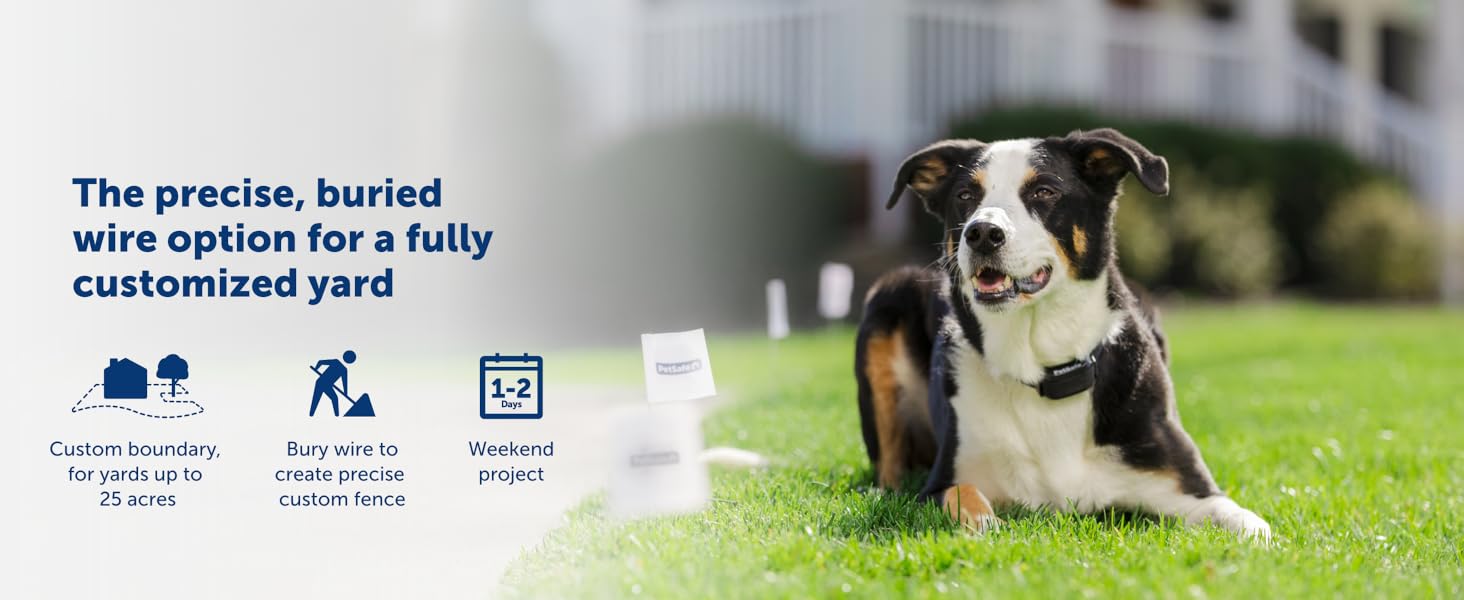
This image features a happy Akita dog running freely in a green yard, illustrating the benefit of the PetSafe Stubborn Dog In-Ground Fence System for active and determined dogs. The system allows pets to enjoy their outdoor space safely within defined boundaries.
Adjusting Correction Levels
The receiver collar has 4 static correction levels. Start with the lowest level and observe your dog's reaction. Increase the level only if your dog does not respond to the warning tone or low correction. The goal is to get your dog's attention, not to cause distress. The tone-only and vibration mode is ideal for initial training or for hearing-impaired dogs.
Maintenance
- Battery Replacement: The receiver collar uses one 9-volt alkaline battery. Replace the battery every 3-4 months, or when the low battery indicator on the collar activates. Always use fresh, high-quality batteries.
- Collar Cleaning: Regularly clean the collar and contact points with a damp cloth to ensure proper contact with your dog's skin and prevent irritation.
- Wire Inspection: Periodically inspect the boundary wire for any visible damage, especially after extreme weather conditions or landscaping activities. A damaged wire can lead to system malfunction. The transmitter includes an audible alarm if there is a wire break.
- Transmitter Placement: Ensure the transmitter remains in a dry, protected environment.
Troubleshooting
| Problem | Possible Cause | Solution |
|---|---|---|
| Collar not correcting. | Dead battery; collar not fitted correctly; correction level too low; wire break. | Replace battery; adjust collar for snug fit; increase correction level; check for wire breaks. |
| Dog crosses boundary. | Insufficient training; correction level too low; dog's temperament. | Reinforce training; increase correction level; consult a professional trainer if needed. |
| Transmitter alarm sounds. | Wire break in the boundary loop. | Locate and repair the wire break. |
| Correction zone is inconsistent. | Sharp corners in wire layout; interference from other electronics. | Ensure smooth curves (3ft radius minimum); move transmitter away from large metal objects or appliances. |
Specifications
- Model Number: PIG00-10777
- Coverage Area: Up to 1/3 acre with included wire, expandable to 25 acres with additional wire.
- Wire Gauge: 20 Gauge
- Collar Fit: Adjustable neck sizes from 6-28 inches.
- Dog Weight: For dogs 8 lbs and up.
- Dog Age: Older than 6 months.
- Correction Levels: 4 adjustable static correction levels, plus tone and vibration mode.
- Collar Battery: 1 x 9-Volt alkaline battery (included).
- Collar Features: Waterproof.
- Item Weight: 2.2 Pounds (entire kit).
- Dimensions: 12 x 12 x 3 inches (package).
- Country of Origin: China.
Warranty and Support
The PetSafe Stubborn Dog In-Ground Fence System comes with a Limited Lifetime Warranty when purchased from a PetSafe Authorized Retailer. For detailed warranty information and to register your product, please visit the official PetSafe website or refer to the documentation included in your product packaging.
For customer support, troubleshooting assistance, or to purchase additional components, please contact PetSafe customer service. Contact information can typically be found on the product packaging or the official PetSafe website.
Important Note: Always follow the instructions in this manual and any accompanying DVDs or guides for safe and effective use of the product.


