

1. Introduction
This manual provides essential information for the proper installation, operation, and maintenance of your First Alert SCO501CN-3ST Wireless Interconnected Combination Smoke and Carbon Monoxide Alarm. This device is designed to detect both smoke and carbon monoxide (CO) hazards, offering enhanced safety for your home. It features wireless interconnection capabilities, allowing multiple alarms to communicate and activate simultaneously throughout your residence.
2. Safety Information
Carbon monoxide is an invisible, odorless, and deadly gas that can be produced by any fuel-burning appliance. CO alarms detect this poisonous gas and provide early warning. For maximum protection, it is recommended to use both ionization and photoelectric sensing technologies. This alarm incorporates a photoelectric smoke sensor, designed to reduce false alarms from cooking smoke or shower steam, and an advanced electrochemical CO sensor.

Common Sources of Carbon Monoxide
Carbon monoxide can originate from various household appliances and systems. Be aware of potential sources such as:
- Furnaces
- Dryer Vents
- Chimneys
- Water heaters
- Gas stoves and ovens
- Fireplaces
- Automobiles in attached garages


Recommended Placement
Install smoke alarms on every level of your home and in every bedroom. Carbon monoxide alarms should also be placed on every level and in every bedroom. Avoid placing alarms in 'dead zones' where walls and ceilings meet, as smoke detectors are less effective in these areas.

3. Product Features
- Combination Detection: Detects both smoke and carbon monoxide.
- Wireless Interconnection: Connects with up to 18 other compatible First Alert alarms for a synchronized safety network.
- Voice Location: Announces the type of threat and its location (e.g., "Fire in the Kitchen!"). Features 11 programmable locations.
- Photoelectric Smoke Sensor: Designed to minimize false alarms from cooking or steam while effectively detecting smoldering fires.
- Electrochemical CO Sensor: Provides accurate detection of carbon monoxide.
- Battery Operated: Easy installation without hardwiring.
- One-Button Operation: A single button for testing the unit and silencing false alarms.
- Loud Alarm: Emits an 85-decibel siren to alert occupants.
- EZ Access Battery Drawer: Allows for easy battery replacement without removing the alarm from the ceiling.

Front view of the First Alert SCO501CN-3ST Combination Alarm.
4. Setup
4.1. Installation
The alarm is battery-operated for easy installation. Mount the alarm securely to the ceiling or wall in accordance with local codes and the recommended placement guidelines. Ensure the mounting plate is firmly attached before twisting the alarm onto it.
4.2. Battery Installation
Your alarm requires two (2) AA batteries (included). To install or replace batteries:
- Locate the EZ access battery drawer on the side of the alarm.
- Open the battery drawer.
- Insert the two AA batteries, ensuring correct polarity (+ and -).
- Close the battery drawer until it clicks securely into place.
4.3. Wireless Interconnection
To create a wireless safety network, follow the pairing instructions provided in the full user manual to interconnect this alarm with other compatible First Alert alarms. This allows all interconnected alarms to sound when one detects a hazard.
Video: Product Summary - Demonstrates key features and ease of use for the First Alert Combination Alarm.
5. Operating
5.1. Testing the Alarm
Test your alarm weekly to ensure proper function. Press and hold the 'Test/Silence' button on the alarm until it sounds. The alarm will emit a loud 85-decibel sound and announce its status. If interconnected, all alarms should sound.
5.2. Silence Feature
In case of a nuisance alarm (e.g., from cooking smoke), press the 'Test/Silence' button to temporarily silence the alarm. The alarm will reset after a few minutes if the smoke or CO levels return to normal.
5.3. Alarm Signals
The alarm provides distinct audible and voice alerts for different conditions:
- Smoke Alarm: Three loud beeps followed by a voice announcement like "Fire! Fire!" and the location.
- Carbon Monoxide Alarm: Four loud beeps followed by a voice announcement like "Warning! Carbon Monoxide!" and the location.
- Low Battery Warning: One chirp every minute.
- Malfunction: Three chirps every minute.
- End of Life: Five chirps every minute.


6. Maintenance
6.1. Cleaning
Gently vacuum or use clean compressed air to remove accumulated dust monthly. Never use water, cleaners, or solvents, as these can damage the unit. If the alarm becomes excessively dirty, it may need to be replaced.
6.2. Battery Replacement
Replace the two (2) AA batteries once a year, or immediately when the low battery warning (one chirp per minute) sounds. Refer to section 4.2 for battery installation instructions.
7. Troubleshooting
If your alarm sounds, identify the type of alert based on the beeping pattern and voice announcement. Take appropriate action:
- Smoke Alarm (3 beeps + voice): Immediately evacuate the premises and call emergency services (Fire Department or 911).
- CO Alarm (4 beeps + voice): Immediately move to fresh air outdoors or by an open door/window. Call emergency services if symptoms persist.
- Low Battery (1 chirp/minute): Replace batteries immediately.
- Malfunction (3 chirps/minute): Replace the alarm unit.
- End of Life (5 chirps/minute): Replace the alarm unit.
8. Specifications
| Brand | First Alert |
| Model Number | SCO500 |
| Power Source | Battery Powered (2 AA batteries included) |
| Product Dimensions | 2"D x 5"W x 5"H |
| Item Weight | 3.2 ounces |
| Alarm Type | Audible (85 dB) with Voice Location |
| Sensor Type | Photoelectric (Smoke), Electrochemical (CO) |
| Interconnection | Wireless, up to 18 compatible alarms |
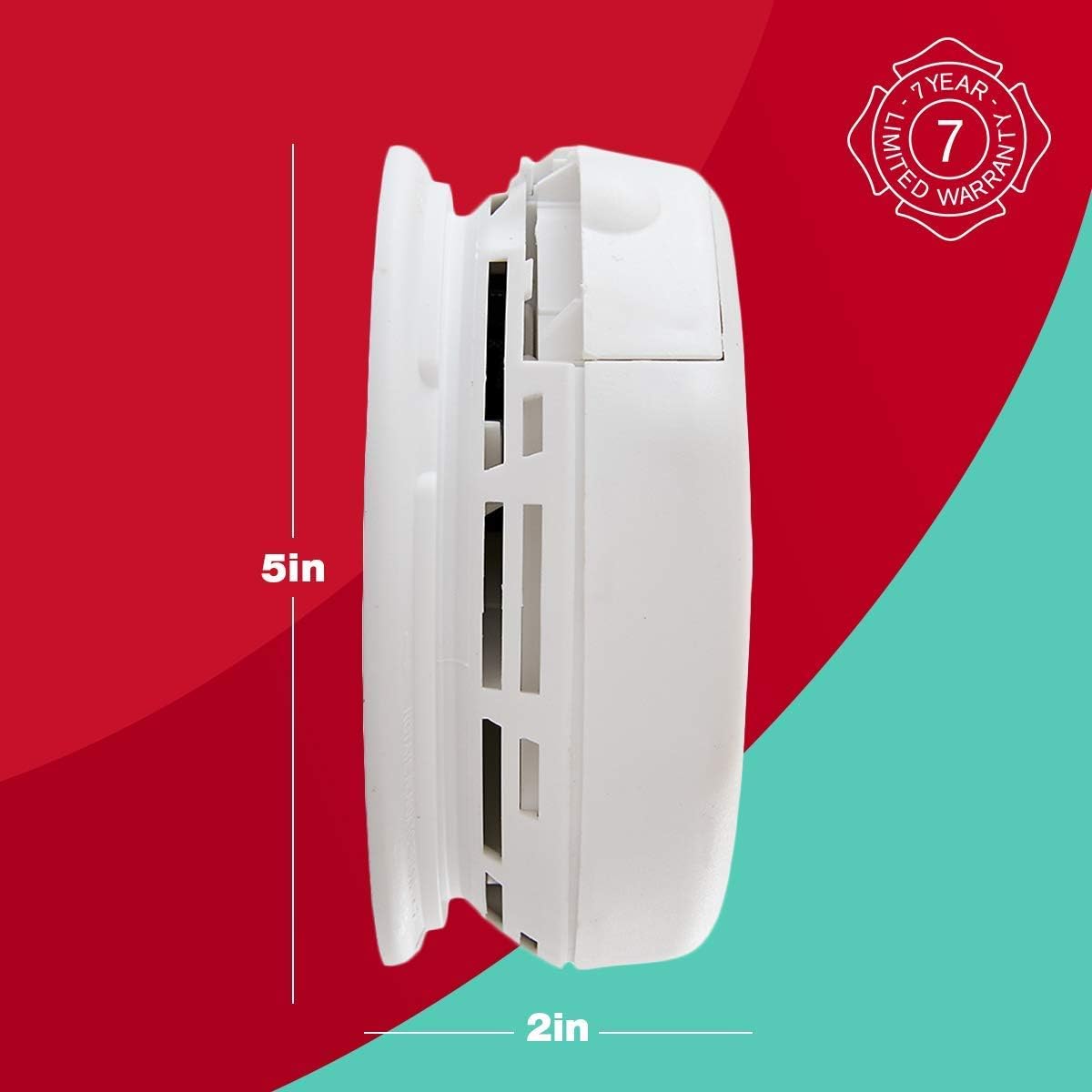
Side view with approximate dimensions.
9. Warranty and Support
This First Alert alarm comes with a 7-year limited warranty. For warranty claims, technical support, or further assistance, please refer to the contact information provided in the original product packaging or visit the official First Alert website.


