Introduction
This manual provides essential information for the proper setup, operation, and maintenance of your Polk Audio PSW303 8-Inch 100-Watt Powered Subwoofer. Please read this manual thoroughly before using your subwoofer to ensure optimal performance and safety.
The Polk Audio PSW303 is designed to enhance your audio experience by providing deep, impactful bass, making it ideal for both stereo and home theater systems. Its integrated amplifier and advanced features ensure powerful and precise low-frequency reproduction.
Safety Information
Please observe the following safety precautions to prevent damage to the unit and ensure your safety:
- Power Source: Connect the subwoofer only to the type of power source indicated on the unit.
- Ventilation: Ensure adequate ventilation. Do not block ventilation openings.
- Water and Moisture: Do not expose the unit to rain or moisture. Do not place objects filled with liquids, such as vases, on the unit.
- Heat: Do not place the unit near heat sources such as radiators, heat registers, stoves, or other apparatus (including amplifiers) that produce heat.
- Cleaning: Unplug the unit from the wall outlet before cleaning. Use a dry cloth for cleaning.
- Servicing: Do not attempt to service this product yourself. Refer all servicing to qualified service personnel.
- Placement: Place the subwoofer on a stable, level surface to prevent it from falling.
Features
The Polk Audio PSW303 Powered Subwoofer includes the following key features:
- A single powered subwoofer for use with stereo or home theater speaker systems.
- Equipped with one magnetically shielded 8-inch long-throw woofer.
- Frequency Response: 28Hz - 200Hz.
- Peak power handling: 260 watts (100 watts continuous).
- Slot-load venting minimizes turbulence, noise, and distortion.
- Integrated 100 Watt Amplifier for powerful bass.
- Automatic On and Off function for convenience.
- Adjustable Crossover for seamless integration with main speakers.
Product Overview

This image displays the main aesthetic of the subwoofer, highlighting its sleek black cabinet and front-firing design. The grille is in place, protecting the woofer.

The rear panel features various controls and connection options, including volume, low pass filter, phase switch, line-level inputs, and speaker-level inputs/outputs. This is where all audio and power connections are made.
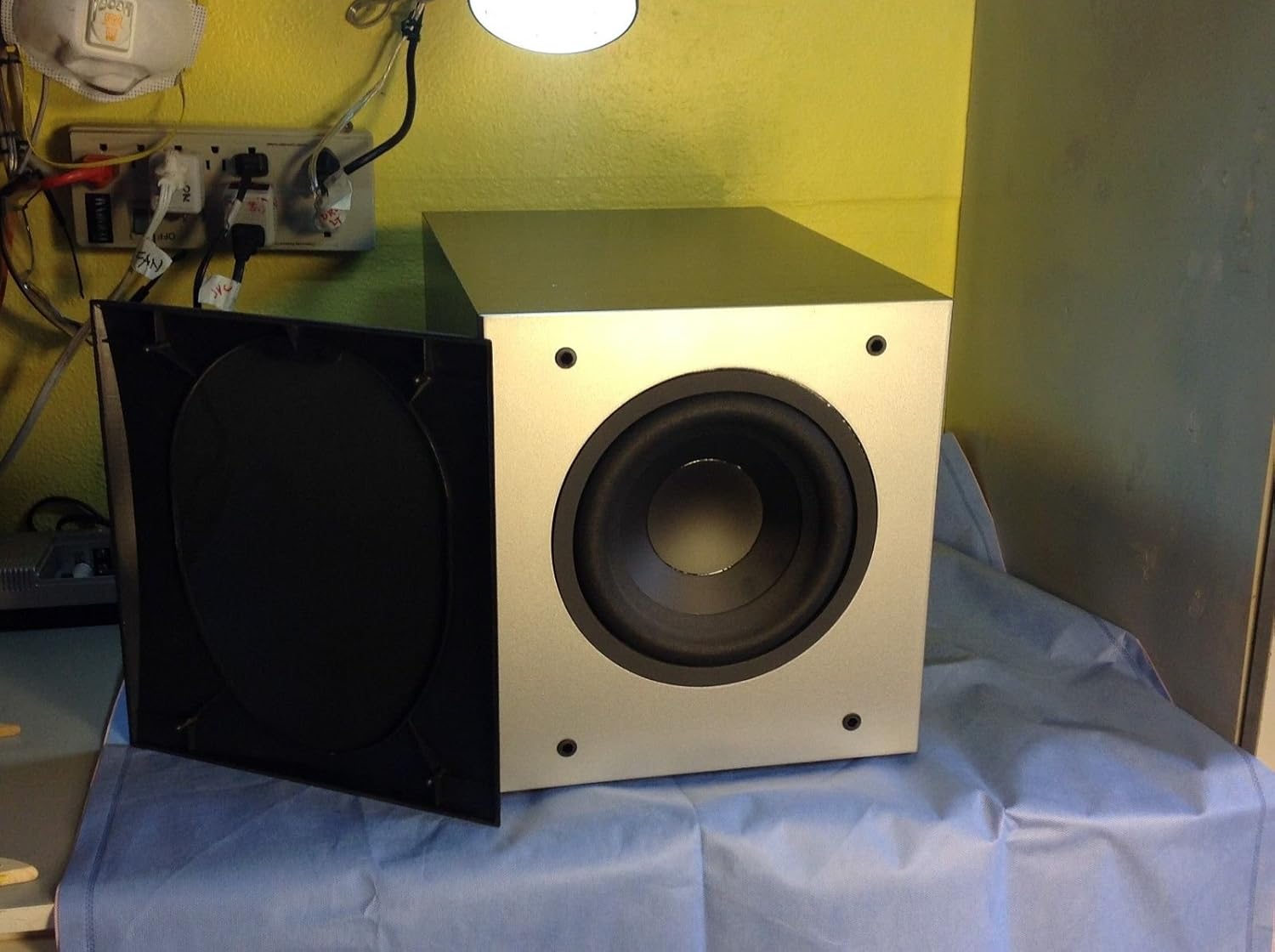
This image provides a view of the subwoofer's driver without the protective grille. It shows the 8-inch long-throw woofer, which is responsible for producing the deep bass frequencies.
Setup
1. Placement
The placement of your subwoofer significantly impacts its performance. Experiment with different locations to find the best sound for your room. Generally, corner placement can enhance bass output, but may also lead to a 'boomy' sound. Placing it along a wall often provides a good balance.
- Avoid placing the subwoofer directly against a wall or in a corner if the bass becomes overwhelming or indistinct.
- Keep the subwoofer away from direct heat sources and areas of high moisture.
- Ensure there is enough space around the unit for proper ventilation.
2. Connections
Refer to Figure 2 (Rear Panel) for connection points.
- Line Level Connection (Recommended): If your receiver or pre-amplifier has a dedicated subwoofer output (LFE or Sub Out), connect a single RCA cable from this output to the LFE input on the subwoofer.
- Stereo Line Level Connection: If your receiver does not have a dedicated subwoofer output, connect RCA cables from your receiver's pre-out (left and right) to the L/R Line In inputs on the subwoofer.
- Speaker Level Connection: If your receiver does not have line-level outputs, connect speaker wires from your receiver's main speaker outputs to the Speaker Level Inputs on the subwoofer. Then, connect speaker wires from the Speaker Level Outputs on the subwoofer to your main left and right speakers. Ensure correct polarity (+ to + and - to -).
- Power Connection: Once all audio connections are made, plug the subwoofer's power cord into a suitable wall outlet.
Operating Instructions
1. Power On/Off
The PSW303 features an automatic on/off circuit. When the power switch is set to 'AUTO', the subwoofer will automatically turn on when it detects an audio signal and enter standby mode after a period of no signal. You can also manually turn the subwoofer on or off using the power switch.
2. Adjusting Controls
- Volume Control: Adjust the volume knob to balance the subwoofer's output with your main speakers. Start with a low setting and gradually increase until the bass sounds natural and integrated with your system.
- Low Pass Filter (Crossover): This control determines the highest frequency the subwoofer will reproduce. Set it to blend smoothly with your main speakers. A common starting point is 80Hz-100Hz, but adjust based on your main speakers' low-frequency capabilities. If using the LFE input, this control is often bypassed as the receiver manages the crossover.
- Phase Switch (0°/180°): This switch helps to ensure that the subwoofer's output is in phase with your main speakers. Listen to music with strong bass and flip the switch between 0° and 180°. Choose the setting that provides the most impactful and coherent bass.
Maintenance
Proper care will ensure the longevity and performance of your subwoofer.
- Cleaning: Dust the cabinet with a soft, dry cloth. For stubborn marks, lightly dampen the cloth with water. Avoid using harsh chemicals or abrasive cleaners.
- Grille: The grille can be removed for cleaning or if you prefer the look of the exposed driver. Handle with care to avoid damaging the grille pegs or the cabinet.
- Storage: If storing the subwoofer for an extended period, disconnect it from power and store it in a cool, dry place, ideally in its original packaging.
Troubleshooting
If you encounter issues with your subwoofer, refer to the table below for common problems and solutions.
| Problem | Possible Cause | Solution |
|---|---|---|
| No sound from subwoofer | Power not connected; Volume too low; Incorrect input selected on receiver; Cables loose or faulty. | Check power cord and outlet; Increase subwoofer volume; Ensure receiver's subwoofer output is enabled; Check all audio cables for secure connection. |
| Bass is weak or distorted | Volume too low; Crossover set too low; Phase incorrect; Subwoofer placement. | Increase volume; Adjust crossover frequency higher; Flip phase switch (0°/180°); Experiment with subwoofer placement. |
| Subwoofer hums or buzzes | Ground loop; Loose connections; Nearby electrical interference. | Try plugging into a different outlet; Ensure all cables are securely connected; Move subwoofer away from other electronic devices. |
| Subwoofer does not turn on automatically | Power switch not in 'AUTO' mode; Input signal too low. | Ensure power switch is set to 'AUTO'; Increase the volume output from your receiver's subwoofer channel. |
Specifications
Key technical specifications for the Polk Audio PSW303 Powered Subwoofer:
| Feature | Specification |
|---|---|
| Model Number | AM3030-C |
| Subwoofer Diameter | 8 Inches |
| Amplifier Power (Continuous) | 100 Watts |
| Amplifier Power (Peak) | 260 Watts |
| Frequency Response | 28Hz - 200Hz |
| Dimensions (H x W x D) | 52.71 x 40.01 x 38.1 cm |
| Item Weight | 15.9 kg (35 Pounds) |
| Color | Black |
| Audio Output Mode | Stereo |
| Mounting Type | Tabletop |
Warranty and Support
Polk Audio products are manufactured to the highest quality standards. For specific warranty details, please refer to the warranty card included with your product or visit the official Polk Audio website. Keep your purchase receipt as proof of purchase for warranty claims.
For technical support, troubleshooting assistance, or service inquiries, please contact Polk Audio customer support through their official website or the contact information provided in your product documentation. You can also visit the Polk Audio Store on Amazon for additional product information and resources.


