Product Overview
This book is a straightforward, no-fuss introduction to Calculus. Little formal reliance is made on the reader's previous mathematical background and great care has been taken to make the book as self contained as possible. The topics are presented in a logical sequence with continuity of flow of ideas, with definitions given as succinctly as possible. Examples are given after definitions and theorems, and the more difficult proofs of these are relegated to the end of the chapter so as to allow for continuity of flow of ideas. The book includes an elementary treatment of ordinary differential equations with emphasis on first and second order differential equations. Exercises with complete solutions have also been carefully selected to supplement the text as well as to provide guidance to the correct way of writing mathematics.
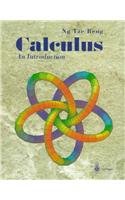
Image: Front cover of the "Calculus: An Introduction" textbook, featuring the title, author, and a colorful abstract mathematical knot design.
Setup and Preparation
To maximize your learning experience with "Calculus: An Introduction," consider the following preparatory steps:
- Environment: Find a quiet, well-lit space free from distractions where you can concentrate on the material.
- Materials: Have essential study tools readily available, such as pens, pencils, paper for notes and working problems, and a calculator if permitted or necessary for certain exercises.
- Prerequisites: While the book aims to be self-contained, a basic understanding of algebra and pre-calculus concepts will be beneficial. Reviewing these fundamentals before diving into calculus can enhance comprehension.
Operating and Studying Guidelines
Effective engagement with the textbook involves a systematic approach:
- Read Definitions Carefully: Pay close attention to all definitions. Calculus builds upon precise definitions, and a clear understanding of these is crucial.
- Follow Examples: Work through the provided examples step-by-step. Understand the logic and methods applied before attempting similar problems.
- Attempt Exercises: The book includes exercises with complete solutions. Actively attempt these problems to solidify your understanding. Do not simply read the solutions; try to solve them independently first.
- Review Proofs: More difficult proofs are relegated to the end of chapters. Review these to gain a deeper theoretical understanding once you are comfortable with the core concepts.
- Take Notes: Summarize key concepts, formulas, and problem-solving strategies in your own words.
- Connect Concepts: Identify how different topics relate to each other to build a holistic understanding of calculus.
Maintenance and Care
To ensure the longevity and usability of your textbook, follow these maintenance guidelines:
- Storage: Store the book in a dry place away from direct sunlight and extreme temperatures to prevent warping or fading.
- Handling: Handle the book with clean hands. Avoid folding pages or placing heavy objects on top of it, which can damage the binding.
- Protection: Consider using a book cover to protect the exterior from spills and wear.
- Marking: If you must mark in the book, use a pencil for notes that can be erased, or use non-permanent highlighters.
Troubleshooting Common Learning Challenges
Encountering difficulties is a normal part of learning calculus. Here are some strategies to overcome common challenges:
- Concept Unclear: If a concept is difficult to grasp, re-read the relevant section slowly. Try to explain it aloud to yourself or to someone else. Sometimes, looking at alternative explanations online or in other textbooks can provide a different perspective.
- Stuck on a Problem: If you're unable to solve an exercise, review the examples that precede it. Break the problem down into smaller steps. If solutions are provided, review the solution for the specific problem you are stuck on, then try to solve a similar problem without looking at the solution.
- Feeling Overwhelmed: Calculus can be challenging. Take short breaks, review foundational topics, and remember that consistent effort is key. Do not hesitate to seek help from instructors, tutors, or study groups if available.
Specifications
| Title | Calculus: An Introduction |
| Author | Tze Beng Ng |
| Publisher | Springer |
| Publication Date | January 1, 1998 |
| Edition | 1st |
| Language | English |
| Print Length | 338 pages |
| ISBN-10 | 9813083069 |
| ISBN-13 | 978-9813083066 |
| Item Weight | 1.45 pounds |
| Dimensions | 7 x 0.75 x 9.25 inches |
Warranty and Support
As a textbook, "Calculus: An Introduction" does not typically come with a manufacturer's warranty in the traditional sense for electronic devices or appliances. However, support for academic content or errata may be available:
- Publisher Support: For inquiries regarding the publication, printing quality, or potential errata, you may contact the publisher, Springer. Their official website typically provides contact information.
- Academic Support: For questions related to the mathematical content, it is recommended to consult with your instructor, academic advisors, or utilize university/college tutoring services.
- Author Information: Information about the author, Tze Beng Ng, may be available through academic institutions or the publisher for further academic engagement.


