1. Overview
This monograph, "Coronary Circulation: Basic Mechanism and Clinical Relevance," addresses the critical importance of coronary heart disease as a major health concern in industrialized nations. It highlights the advancements in both medical and surgical treatments, emphasizing the need for accurate diagnostic methods to assess disease severity, identify treatment alternatives, and evaluate treatment outcomes.
The book integrates recent breakthroughs in basic research concerning coronary circulation, including its intricate interactions with myocardial contraction, relaxation, and neural and humoral control mechanisms. It compiles papers that delve into fundamental mechanisms of coronary circulation and their direct clinical relevance.
The content is designed for a multidisciplinary audience, fostering collaboration between basic scientists and clinicians.
2. Key Topics Covered
This volume is structured into nine comprehensive chapters, covering a wide range of topics essential for understanding coronary circulation:
- Chapter 1: Coronary Vascular Anatomy
Provides macroscopic and microscopic descriptions of the coronary vascular anatomy, detailing its close relationship to the functions of coronary circulation. - Chapter 2: Evaluation Methods for Coronary Blood Velocity
Presents two contemporary methods used to evaluate phasic coronary blood velocity waveforms: the laser Doppler method and the ultrasound Doppler method. - Chapter 3: Mechanical Properties of Coronary Circulation
Describes the mechanical properties of coronary circulation, which are crucial for comprehending coronary arterial and venous blood flow velocity waveforms in relation to cardiac contraction and relaxation. - Further chapters delve into additional aspects of coronary circulation, its regulation, and clinical implications.
3. Target Audience
This book is primarily directed towards a diverse group of professionals and researchers in the medical and scientific fields, including:
- Physicians, including cardiologists, cardiac surgeons, cardiac radiologists, and anesthesiologists.
- Basic scientists, such as physiologists and bioengineers.
- Researchers and students interested in cardiovascular physiology and pathology.
4. Product Specifications
General Details
- Title: Coronary Circulation: Basic Mechanism and Clinical Relevance
- Format: Paperback
- Language: English
- Print Length: 347 pages
Publication Information
- Publisher: Springer
- Publication Date: December 14, 2011
- Edition: Softcover reprint of the original 1st ed. 1990
- ISBN-10: 4431680896
- ISBN-13: 978-4431680895
Physical Characteristics
- Item Weight: 1.24 pounds
- Dimensions: 6.69 x 0.83 x 9.61 inches
5. About the Authors and Editors
This comprehensive volume is the result of collaborative efforts by a distinguished group of experts:
- Editors: Fumihiko Kajiya, Gerald A. Klassen, Jos A.E. Spaan, Julien I.E. Hoffman
- Co-editors: K. Onodera, Y. Maruyama, H. Tomoike, K. Tsujioka
Their collective expertise ensures the accuracy and depth of the information presented, making this a valuable resource for the study of coronary circulation.
6. Product Image
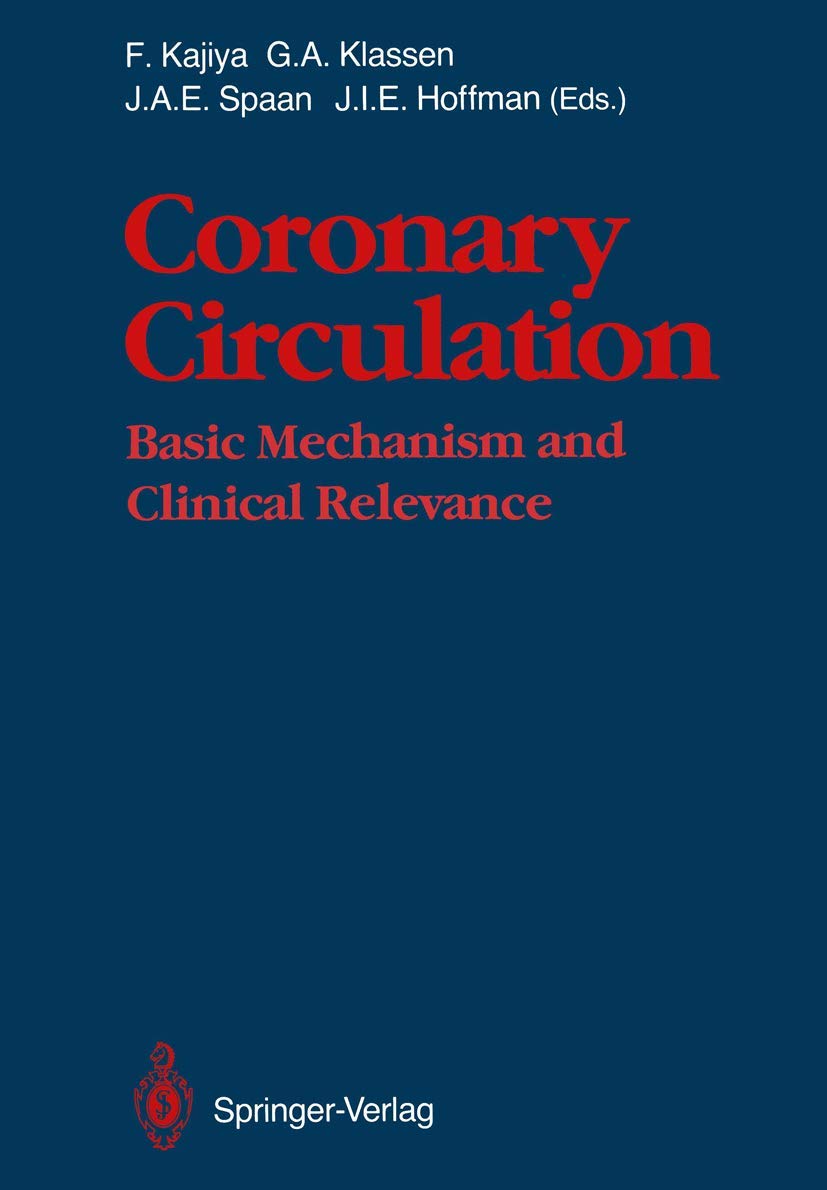
Image: Front cover of the book "Coronary Circulation: Basic Mechanism and Clinical Relevance". The cover features the title in large red font on a dark blue background, with the names of the editors and the publisher "Springer-Verlag" at the bottom.
7. Publisher Information
This book is published by Springer, a leading global scientific, technical and medical portfolio, providing researchers in academia, scientific institutions and corporate R&D departments with quality content and innovative solutions.
For more information about Springer publications, please visit their official website.


