1. Introduction to "Ölwechsel!"
The book "Ölwechsel! Das Ende des Erdölzeitalters und die Weichenstellung für die Zukunft" (Oil Change! The End of the Oil Age and the Setting of the Course for the Future) by Colin J. Campbell, published by Dtv, serves as a critical examination of global oil reserves and the implications of their depletion. This manual provides an overview of the book's structure, key arguments, and its relevance in understanding future energy landscapes.
It is designed for readers seeking to comprehend the complex topic of peak oil and the transition to alternative energy sources, offering a structured approach to the book's content.
2. Understanding the Premise (Setup)
The book establishes its foundation by detailing the history of oil exploration and production, introducing the concept of "Peak Oil" – the point at which the maximum rate of petroleum extraction is reached, after which production declines. Campbell emphasizes that oil reservoirs experience a decline in their extraction rate long before complete exhaustion, a phenomenon known as the Hubbert Peak.
Key Concepts Introduced:
- Conventional vs. Non-Conventional Oil: Distinction between easily accessible oil and sources like deep-sea oil or oil sands.
- Global Oil Regions: A systematic overview of identified oil regions, their quantities, and production history.
- Hubbert Peak Theory: Explanation of the predictive model for oil production rates.
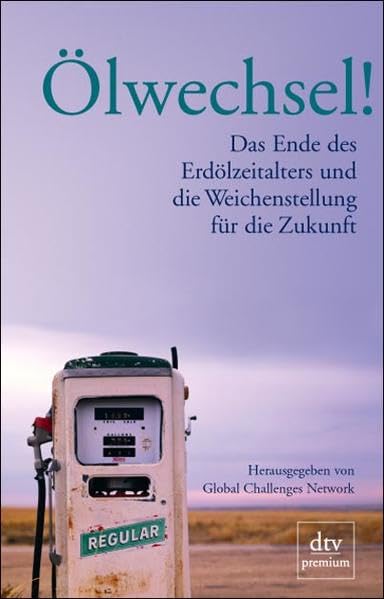
This image displays the cover of the book 'Ölwechsel!', featuring an antique 'REGULAR' labeled gas pump in the foreground with a vast, open sky behind it. The title 'Ölwechsel!' is prominently displayed at the top, with the subtitle 'Das Ende des Erdölzeitalters und die Weichenstellung für die Zukunft' (The End of the Oil Age and the Setting of the Course for the Future) below it. The publisher's logo, 'dtv premium', and 'Herausgegeben von Global Challenges Network' (Published by Global Challenges Network) are also visible.
3. Navigating the Content (Operating)
The book is structured into distinct parts, with the first chapter providing a highly factual and systematic overview of oil regions and production data. This section serves as a crucial reference for the subsequent political and economic discussions.
Book Structure:
- Part 1 (Chapter 1): Detailed statistical analysis of global oil reserves, production history, and the concept of Hubbert Peak. This part is rich in data and serves as an informative reference work.
- Part 2 (Chapters 2-4): Explores the geopolitical history surrounding oil, discussing the economic and political implications of oil dependency and the challenges faced by oil-producing nations.
Readers are encouraged to pay close attention to the statistical data presented in the first part, as it forms the factual basis for the broader discussions on energy policy and future strategies.
4. Applying the Knowledge (Maintenance)
Beyond theoretical understanding, "Ölwechsel!" aims to equip readers with insights into potential solutions for the energy crisis. The book concludes not with doomsday scenarios but by highlighting pathways out of the crisis through more efficient resource management and the expansion of renewable energies.
Practical Applications:
- Resource Efficiency: Understanding the importance of optimizing energy consumption.
- Renewable Energy Development: Recognizing the role of solar, wind, and other sustainable sources.
- Policy Awareness: Gaining perspective on the political and economic factors influencing global energy decisions.
The book encourages a proactive approach to energy challenges, advocating for sustainable practices and informed decision-making.
5. Addressing Critical Perspectives (Troubleshooting)
While highly informative, some readers note that the book's second part, focusing on geopolitical history, may not be as rigorously factual as the first. It offers a good overview for beginners but might lack the depth found in other specialized works on the subject.
Points for Consideration:
- Economic Context: The book may not fully illuminate the macroeconomic connections, such as the reasons for oil price fluctuations in the 1980s.
- Geopolitical Depth: For a more comprehensive understanding of geopolitical dynamics, supplementary reading (e.g., Daniel Yergin's "The Prize") may be beneficial.
- Author's Stance: Be aware of the author's underlying critique regarding industrialized nations' responsibility for global issues.
Readers are advised to approach the geopolitical sections with a critical eye and consider cross-referencing information with other reputable sources for a balanced perspective.
6. Book Specifications
| Attribute | Detail |
|---|---|
| Title | Ölwechsel! Das Ende des Erdölzeitalters und die Weichenstellung für die Zukunft |
| Author | Colin J. Campbell |
| Publisher | Dtv |
| Publication Date | December 1, 2002 |
| Language | German |
| Print Length | 260 pages |
| ISBN-10 | 342324321X |
| ISBN-13 | 978-3423243216 |
| Item Weight | 14 ounces |
| Dimensions | 8.66 x 5.91 x 1.06 inches |
7. Publisher and Author Information
For further inquiries regarding the book or its content, please refer to the publisher's official channels. The publisher of "Ölwechsel!" is Dtv.
- Publisher: Dtv (dtv.de)
- Author: Colin J. Campbell (Amazon Author Page)
This section serves as the primary point of contact for support or additional information related to the publication.


