Introduction to the Guide
This guide provides an overview of the book "Monte Carlo Methods for Radiation Transport: Fundamentals and Advanced Topics," a comprehensive resource for understanding and applying Monte Carlo techniques in radiation transport. It is particularly relevant for medical physicists and researchers seeking to deepen their knowledge in this critical area.
The book serves as a foundational text, explaining basic concepts while also delving into advanced topics and recent advancements in the field. It is designed to assist both those new to the technique and experienced users of standard Monte Carlo codes who wish to gain deeper insight into the underlying mathematics.
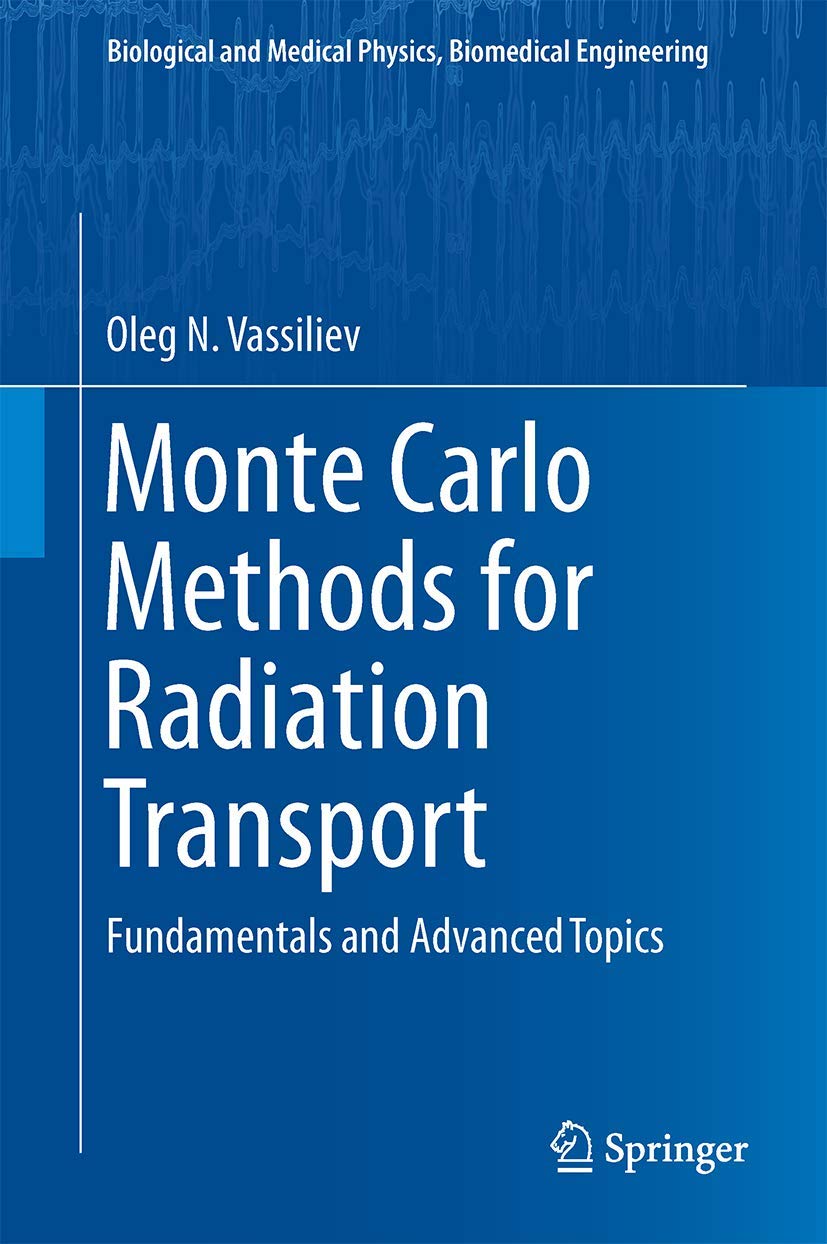
Image: Front cover of "Monte Carlo Methods for Radiation Transport" by Oleg N. Vassiliev. The cover features the title in large white text on a blue background, with the author's name and the series title "Biological and Medical Physics, Biomedical Engineering" also visible. The Springer logo is at the bottom right.
Core Concepts and Fundamentals
The initial sections of the book are dedicated to establishing a strong understanding of the fundamental principles of Monte Carlo techniques. This includes detailed explanations of the basic concepts that form the backbone of radiation transport simulations.
- Introduction to Monte Carlo simulation methods.
- Principles of radiation transport and interaction with matter.
- Mathematical foundations of Monte Carlo algorithms.
- Basic implementation strategies for transport codes.
Emphasis is placed on clarity and thoroughness, ensuring readers grasp the essential elements before progressing to more complex topics.
Advanced Topics and Recent Advances
Beyond the fundamentals, the book explores advanced subjects and cutting-edge developments in Monte Carlo methods for radiation transport. This includes specialized applications and theoretical advancements.
- Transport of charged particles in magnetic fields.
- Grid-based solvers of the Boltzmann equation.
- Techniques for accurate radiotherapy dose calculations.
- Discussions on the latest research and methodologies.
These sections are designed to provide readers with insights into the current state of the art and future directions of Monte Carlo simulations in medical physics.
Applications in Medical Physics
The primary focus of the book's application is within medical physics, particularly in radiotherapy dose calculations. Monte Carlo methods are highlighted as a "gold standard" for their accuracy in this domain.
The text details how these techniques are applied to various problems in the field, reflecting the high level of research activity and the thousands of papers published on this subject in recent years.
About the Author
The book is authored by Oleg N. Vassiliev, a distinguished expert in medical physics, radiation transport, and Monte Carlo methods. He has contributed significantly to the field with over 70 published papers, including highly cited works on Monte Carlo methods in radiation therapy.
Mr. Vassiliev's extensive experience includes applying Monte Carlo techniques to a wide array of problems and playing a leading role in the development of grid-based solvers for the Boltzmann equation in radiotherapy dose calculations.
Product Specifications
| Title | Monte Carlo Methods for Radiation Transport: Fundamentals and Advanced Topics |
| Author | Oleg N. Vassiliev |
| Publisher | Springer |
| Publication Date | October 26, 2016 |
| Edition | 1st ed. 2017 |
| Language | English |
| Print Length | 298 pages |
| ISBN-10 | 331944140X |
| ISBN-13 | 978-3319441405 |
| Item Weight | 1.31 pounds |
| Dimensions | 6.14 x 0.69 x 9.21 inches |
| Series | Biological and Medical Physics, Biomedical Engineering |
Support and Resources
For additional support, inquiries, or to explore other publications by Springer, please refer to the publisher's official website or contact their customer service department.
- Publisher Website: www.springer.com
- For academic inquiries or errata, please consult the publisher's contact information provided within the book or on their website.
- Further reading on related topics can be found within the "Biological and Medical Physics, Biomedical Engineering" series.


