Introduction
This manual provides a comprehensive guide to the use of oscilloscopes in both laboratory and field environments. It details procedures for measuring and displaying waveforms, illustrates how this data can be applied to repair malfunctioning equipment, develop new designs, and debug pre-production prototypes.
The book commences with an examination of how oscilloscopes represent electrical energy as traces on X and Y coordinates, explaining the seamless transition between time and frequency domains, consistent with the Fourier Transform and its modern counterpart, the Fast Fourier Transform.
Further sections delve into practical applications and case studies, demonstrating oscilloscope usage in diagnosing Pulse Width Modulation (PWM) issues, analyzing serial data streaming, and investigating power supply noise and premises power quality. Emphasis is placed on the advanced functionality of mixed-signal oscilloscopes compared to mixed-domain instruments and earlier models. The manual also features numerous applications in applied science and physics.
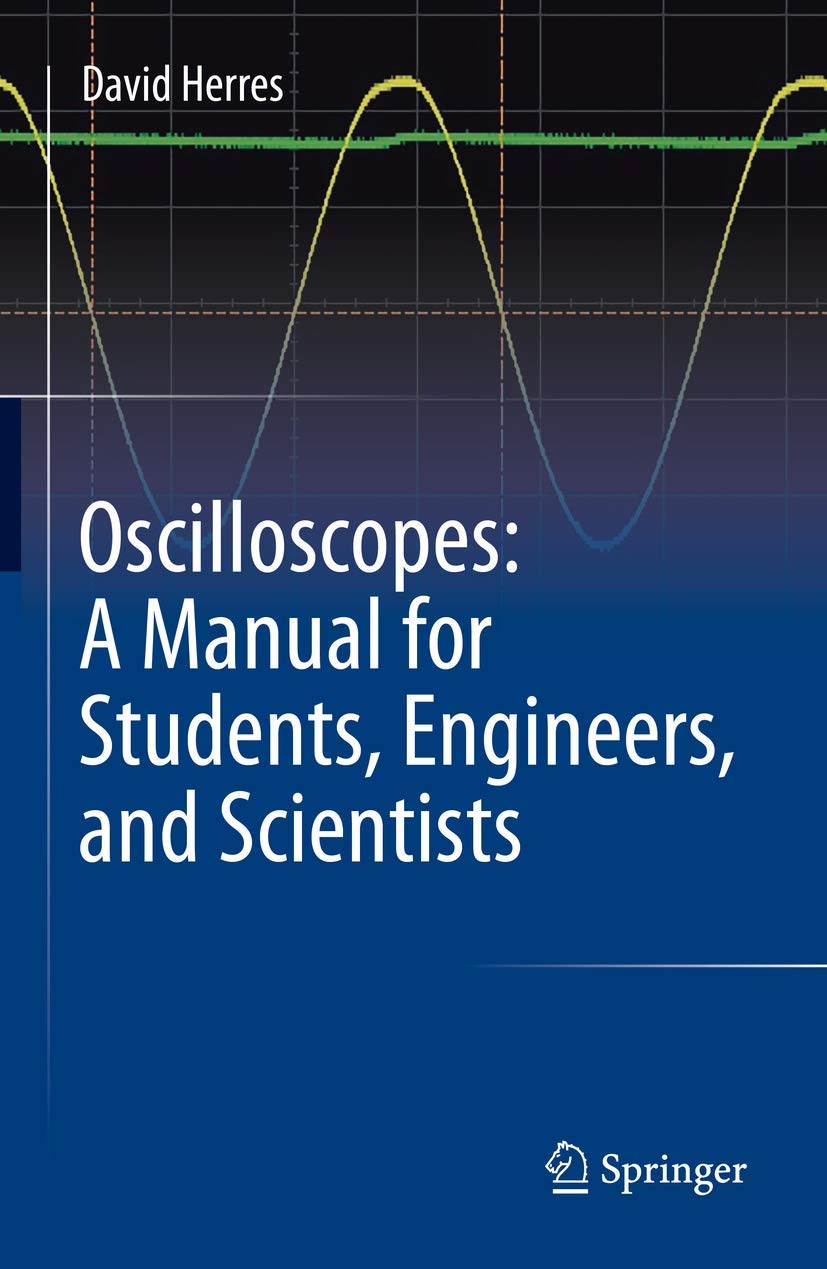
This image displays the front cover of the manual, featuring the title 'Oscilloscopes: A Manual for Students, Engineers, and Scientists' and the author's name, David Herres, against a background showing an oscilloscope waveform.
How to Use This Manual
This manual is designed for students, engineers, and scientists seeking to understand and effectively utilize oscilloscopes. It is structured to guide readers from fundamental concepts to advanced applications.
- Foundational Understanding: Begin with the initial chapters to grasp the core principles of oscilloscope operation and waveform representation.
- Practical Applications: Progress to sections detailing real-world scenarios and case studies to see how theoretical knowledge is applied.
- Specific Problem Solving: Refer to relevant sections when addressing particular issues such as PWM diagnosis, serial data analysis, or power quality assessment.
- Reference: Use the detailed explanations and examples as a reference for laboratory work, equipment design, and prototype debugging.
Key Concepts Covered
The manual covers a range of essential topics for oscilloscope users:
- Measurement and display of electrical waveforms.
- Application of oscilloscope data for equipment repair and new design development.
- Techniques for debugging pre-production prototypes.
- Principles of Fourier Transform and Fast Fourier Transform in waveform analysis.
- Diagnosis of Pulse Width Modulation (PWM) problems.
- Analysis of serial data streaming.
- Investigation of power supply noise and premises power quality issues.
- Comparison and functionality of mixed-signal versus mixed-domain oscilloscopes.
Book Specifications
| Specification | Detail |
|---|---|
| Publisher | Springer |
| Publication Date | October 7, 2020 |
| Edition | 1st ed. 2020 |
| Language | English |
| Print Length | 277 pages |
| ISBN-10 | 3030538842 |
| ISBN-13 | 978-3030538842 |
| Item Weight | 1.32 pounds |
| Dimensions | 7.7 x 0.6 x 9.4 inches |
About the Author
David Herres is a Contributing Editor of DesignWorld/Test & Measurement. He has been writing about electrical work and electronics in professional journals since 2006 and is the author of four books on National Electrical Code and Electronics.
Publisher Information
This manual is published by Springer, a leading global scientific, technical and medical portfolio, providing researchers in academia, scientific institutions and corporate R&D departments with quality content and innovative solutions.
For inquiries regarding this publication or other works by Springer, please visit the official Springer website or contact their customer support channels.


