Introduction
This manual provides detailed instructions and procedures for the maintenance, service, and repair of Volkswagen Golf III and Vento models equipped with Diesel and Turbodiesel engines, manufactured from 1991 onwards. It is designed to assist owners and professional technicians in performing various tasks, from routine servicing to complex overhauls and fault diagnosis.
The information contained herein is based on the original vehicle specifications and common repair practices. Always prioritize safety and consult professional assistance if unsure about any procedure.
Product Overview
This manual covers the Volkswagen Golf III and Vento series, specifically focusing on models equipped with Diesel and Turbodiesel engines produced from 1991. These vehicles are known for their robust design and fuel efficiency. The manual aims to provide comprehensive guidance for their upkeep.
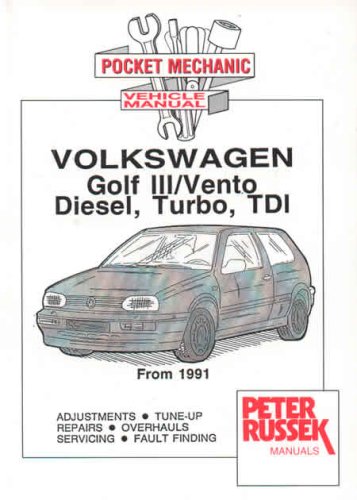
Figure 1: Front cover of the "Pocket Mechanic Vehicle Manual" for Volkswagen Golf III/Vento Diesel, Turbo, TDI models from 1991. The cover displays an illustration of a Volkswagen Golf III/Vento car and lists covered topics such as Adjustments, Tune-Up, Repairs, Overhauls, Servicing, and Fault Finding, published by Peter Russek Manuals.
General Safety Information
Always observe safety precautions when working on a vehicle. This includes wearing appropriate personal protective equipment (PPE) such as safety glasses and gloves, ensuring the vehicle is securely supported on jack stands, disconnecting the battery when working on electrical systems, and allowing hot components to cool before handling.
- Ensure adequate ventilation when working with chemicals or engine fumes.
- Keep a fire extinguisher readily available.
- Never work under a vehicle supported only by a jack.
- Refer to the vehicle's owner's manual for additional safety guidelines.
Maintenance and Servicing
Regular maintenance is crucial for the longevity and optimal performance of your Volkswagen Golf III/Vento. This section outlines routine servicing tasks and recommended intervals.
Routine Checks and Fluid Levels
- Engine Oil: Check level weekly. Refer to specifications for correct oil type and capacity.
- Coolant: Inspect level and condition. Top up with appropriate coolant mixture.
- Brake Fluid: Check level and condition. Do not overfill.
- Power Steering Fluid: Verify level in reservoir.
- Windshield Washer Fluid: Ensure adequate supply.
Scheduled Servicing (Tune-Up)
Follow the manufacturer's recommended service schedule. Typical intervals include:
- Oil and Filter Change: Every 10,000-15,000 km or annually, whichever comes first.
- Fuel Filter Replacement: As per manufacturer's schedule, typically every 30,000-60,000 km.
- Air Filter Replacement: Annually or every 30,000 km, more frequently in dusty conditions.
- Timing Belt Inspection/Replacement: Critical maintenance item; adhere strictly to manufacturer's specified mileage/time.
- Brake System Inspection: Check pads, discs, and lines at every service.
Repairs and Overhauls
This section provides detailed procedures for common repairs and major overhauls. It is recommended to have appropriate tools and a clean working environment before attempting any repair.
Engine System
Procedures for diagnosing and repairing engine components, including:
- Cylinder head removal and installation.
- Piston and connecting rod service.
- Crankshaft and main bearing replacement.
- Fuel injection system component replacement (injectors, fuel pump).
- Turbocharger inspection and replacement.
Transmission and Drivetrain
Guidance on servicing manual and automatic transmissions, clutch replacement, and driveshaft maintenance.
Brake System
Instructions for brake pad and disc replacement, caliper service, brake line inspection, and bleeding the brake system.
Suspension and Steering
Procedures for shock absorber/strut replacement, spring service, control arm replacement, and steering rack maintenance.
Adjustments
Precise adjustments are often necessary after repairs or as part of routine maintenance. This section covers key adjustments.
- Valve Clearance Adjustment: If applicable to your engine type.
- Fuel Injection Timing: Critical for diesel engine performance and emissions.
- Idle Speed Adjustment: For stable engine operation.
- Headlight Aiming: For proper illumination and safety.
- Wheel Alignment: Recommended after suspension component replacement.
Troubleshooting and Fault Finding
This section assists in diagnosing common problems by providing symptoms, possible causes, and recommended solutions.
| Symptom | Possible Cause | Action |
|---|---|---|
| Engine cranks but won't start | Low fuel, faulty glow plugs, air in fuel system, weak battery | Check fuel level, inspect glow plugs, bleed fuel system, test battery |
| Excessive exhaust smoke | Worn injectors, faulty turbo, incorrect fuel timing, oil burning | Inspect injectors, check turbocharger, verify timing, check oil level |
| Brakes feel spongy | Air in brake lines, low brake fluid, worn master cylinder | Bleed brake system, check fluid level, inspect master cylinder |
Specifications
This section provides key technical specifications for the Volkswagen Golf III/Vento Diesel and Turbodiesel models. Always refer to the specific data for your vehicle's engine code and year of manufacture.
| Category | Detail |
|---|---|
| Engine Type | Inline 4-cylinder Diesel / Turbodiesel |
| Fuel Type | Diesel |
| Oil Capacity | Approx. 4.5 - 5.0 Liters (including filter) |
| Coolant Capacity | Approx. 6.0 - 7.0 Liters |
| Tire Pressure (Typical) | 2.0 - 2.2 bar (30-32 psi) - Varies by tire size and load |
| Torque Specifications | Specific values for bolts (e.g., wheel nuts, engine components) are detailed within relevant repair sections. |
Note: All specifications are approximate and may vary based on specific model year, engine variant, and regional differences. Always consult the vehicle's official service data for precise values.
Warranty and Support
This instruction manual is an independent publication and is not affiliated with or endorsed by Volkswagen AG. It provides general guidance for maintenance and repair. Any repairs or modifications performed using the information in this manual are done at the user's own risk.
For official warranty information, support, or authorized service, please refer to your vehicle's original manufacturer documentation or contact an authorized Volkswagen service center. This manual does not provide or imply any warranty for the vehicle or its components.


