Introduction to SAP Plant Maintenance

This guide serves as an essential resource for understanding and utilizing SAP Enterprise Asset Management (SAP EAM) with a focus on SAP Plant Maintenance (SAP PM). It provides detailed explanations and practical advice for structuring functional locations, managing shift notes and reports, and navigating the technical aspects of SAP PM, including material and plant maintenance assemblies and linear asset management.
The 4th edition has been updated and expanded to cover the latest developments and best practices, ensuring users can optimize their daily operations within the SAP PM environment.
Key Features and Functionality
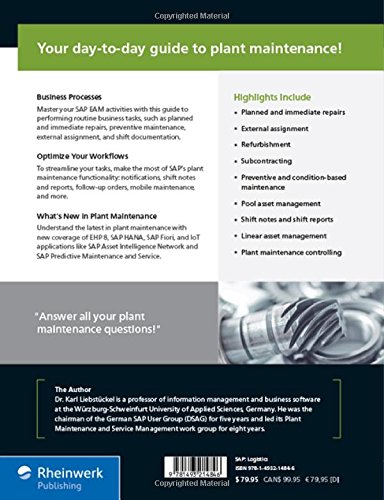
This guide details critical SAP PM functions and business processes, offering insights into:
- Business Processes: Master routine SAP EAM activities including planned and immediate repairs, preventive maintenance, external assignments, and shift documentation.
- Workflow Optimization: Streamline tasks using SAP's plant maintenance functionality, notifications, shift notes, reports, follow-up orders, and mobile maintenance.
- New in Plant Maintenance: Understand recent updates with coverage of EHP 8, SAP HANA, SAP Fiori, and IoT applications such as SAP Asset Intelligence Network and SAP Predictive Maintenance and Service.
- Highlights Include: Planned and immediate repairs, external assignment, refurbishment, subcontracting, preventive and condition-based maintenance, pool asset management, shift notes and shift reports, linear asset management, and plant maintenance controlling.
How to Use This Guide (Getting Started)
To maximize your learning experience with this guide, consider the following approach:
- Understand the Structure: Familiarize yourself with the book's layout. Each chapter focuses on specific SAP PM functionalities or business processes.
- Start with Fundamentals: If new to SAP PM, begin with introductory sections that explain core concepts and organizational structures before diving into advanced topics.
- Apply Practical Tips: The guide includes real-world tips and best practices. Try to relate these to your own operational context or a simulated SAP environment.
- Review Case Studies: Pay attention to any examples or scenarios provided, as these illustrate how concepts are applied in practice.
Navigating the Content (Operating)
The guide is structured to facilitate easy access to information:
- Chapter Headings: Use the main chapter headings to locate broad topics such as 'Business Processes' or 'Specialized Functionality'.
- Subheadings: Within each chapter, subheadings break down complex topics into manageable sections, allowing for focused reading.
- Index: Refer to the comprehensive index at the back of the book to quickly find specific terms, transactions, or functionalities.
- Cross-References: The text may include references to other sections or chapters for related information, aiding in a holistic understanding.
Further Resources (Maintenance)
To stay current with SAP PM and related technologies, consider these recommendations:
- SAP Community Network: Engage with the official SAP Community for forums, blogs, and expert insights on SAP PM and EAM.
- SAP PRESS Website: Visit the SAP PRESS website for updates, new publications, and additional resources related to SAP solutions.
- Official SAP Documentation: Consult SAP's official documentation and help portals for the most up-to-date technical specifications and release notes.
- Training Courses: Explore official SAP training courses or certified partner programs for in-depth learning and skill development.
Common Questions and Clarifications (Troubleshooting)
This section addresses common inquiries and provides clarifications for typical challenges encountered by SAP PM users:
- Understanding Terminology: SAP PM uses specific terminology. If a term is unclear, refer to the book's glossary (if available) or an online SAP dictionary.
- Process Flow Issues: If a business process described in the book does not align with your system's configuration, consult your system administrator or an SAP consultant. The book focuses on standard functionalities.
- Integration Challenges: For issues related to integrating SAP PM with other modules or external systems, review the 'Integration' sections and consider seeking specialized technical support.
- Software Version Differences: While this is the 4th edition, SAP software evolves. Be aware that minor interface or functionality differences may exist between the book's content and newer SAP versions.
Specifications
| ASIN | 1493214845 |
| Publisher | SAP Press |
| Publication Date | April 27, 2017 |
| Edition | 4th |
| Language | English |
| Print Length | 689 pages |
| ISBN-10 | 9781493214846 |
| ISBN-13 | 978-1493214846 |
| Item Weight | 3.16 pounds |
| Dimensions | 7.5 x 2 x 9.25 inches |
About the Author
Dr. Karl Liebstückel is a distinguished professor of information management and business software at the Würzburg-Schweinfurt University of Applied Sciences, Germany. He has served as the chairman of the German SAP User Group (DSAG) for five years and has led its Plant Maintenance and Service Management work group for eight years, bringing extensive expertise to this publication.
Publisher Information and Support
This guide is published by SAP PRESS, a leading publisher of books on SAP technologies. For inquiries regarding this publication, including potential errata or future editions, please refer to the publisher's official channels.
- Publisher: SAP Press
- ISBN-13: 978-1493214846
- Official Website: www.sap-press.com
Please note that specific warranty or return policies for the physical book are typically handled by the retailer from whom it was purchased.


