1. Introduction to LonWorks/EIA 709 Technology
This manual provides an overview of LonWorks/EIA 709 technology, a robust standard for open control networks. These networks are fundamental in various applications, including digital homes, industrial automation, commercial buildings, transportation systems, and security installations. They facilitate communication between smart sensors and actuators, enabling efficient information exchange and control.
The content covers key aspects such as the LonTalk protocol, Neuron chip architecture, programming models, network structures, and network management. It also delves into interoperability, application profiles, development tools, performance analysis, and standardization efforts. This guide serves as a valuable resource for students, engineers, and system designers involved in distributed networks and intelligent systems.
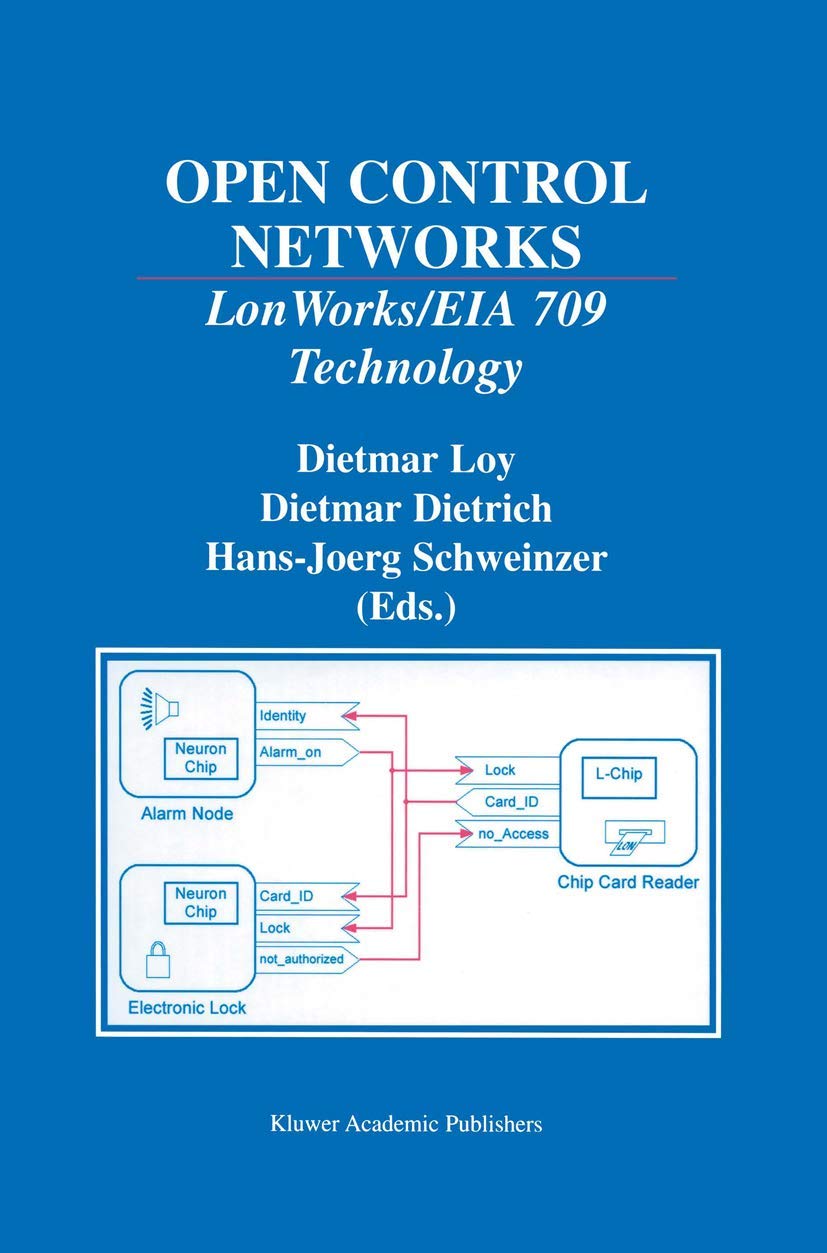
Figure 1.1: Cover of the "Open Control Networks: LonWorks/EIA 709 Technology" book. The cover displays the title, authors (Dietmar Loy, Dietmar Dietrich, Hans-Joerg Schweinzer), and a schematic diagram illustrating an "Alarm Node" and "Chip Card Reader" system, featuring Neuron Chips, an Electronic Lock, and various communication lines for identity, alarm, lock, and card ID signals.
2. Core Concepts and Architecture
LonWorks technology is built upon several foundational concepts that enable its distributed control capabilities.
2.1. LonTalk Protocol
The LonTalk protocol is the communication language used by LonWorks devices. It is a transaction-based, peer-to-peer protocol designed for control applications, offering features like message authentication, error detection, and retransmission. Its efficiency allows for reliable communication over various media.
2.2. Neuron Chip
At the heart of every LonWorks device is the Neuron Chip. This specialized microcontroller integrates communication, processing, and I/O capabilities. It executes the LonTalk protocol in hardware, offloading communication tasks from the application processor and ensuring real-time performance.
2.3. Network Variables (NVs)
Communication between LonWorks devices is primarily achieved through Network Variables (NVs). NVs are abstract data points that represent inputs or outputs of a device. When an output NV changes value, it is automatically transmitted to all connected input NVs, simplifying application development and promoting interoperability.
3. System Setup and Deployment
Deploying a LonWorks network involves several steps, from physical installation to logical configuration.
3.1. Physical Installation
- Device Placement: Strategically position LonWorks devices (sensors, actuators, controllers) within the environment to ensure optimal coverage and functionality.
- Wiring: Connect devices using appropriate LonWorks media (e.g., twisted pair, power line, fiber optic). Adhere to cabling standards and distance limitations for reliable communication.
- Power Supply: Ensure stable and sufficient power is supplied to all network devices.
3.2. Network Configuration
Once physically installed, the network requires logical configuration using network management tools.
- Discovery: Use a network management tool to discover all LonWorks devices on the network.
- Binding: Establish logical connections (bindings) between Network Variables of different devices to enable data exchange. This defines how devices interact.
- Domain and Subnet/Node Addressing: Assign unique addresses to devices within domains, subnets, and nodes for proper network segmentation and routing.
- Application Loading: Load specific application programs onto Neuron Chips to define device behavior.
4. Network Operation and Management
Effective operation of a LonWorks network relies on its distributed intelligence and robust management capabilities.
4.1. Distributed Control
Unlike centralized systems, LonWorks networks operate with distributed control. Each Neuron Chip can make autonomous decisions and communicate directly with other devices, enhancing reliability and scalability. If one device fails, the rest of the network can continue to function.
4.2. Network Management Tools
Specialized network management tools are used to monitor, configure, and maintain LonWorks installations. These tools provide functionalities such as:
- Device commissioning and decommissioning.
- Network diagnostics and performance monitoring.
- Firmware updates and application program changes.
- Security management, including authentication and encryption.
5. Maintenance and Optimization
Regular maintenance and optimization are crucial for ensuring the long-term stability and efficiency of LonWorks systems.
5.1. Routine Checks
- Connectivity Verification: Periodically check physical connections and network cable integrity.
- Device Health Monitoring: Utilize network management tools to monitor device status, error rates, and communication statistics.
- Software Updates: Keep network management software and device firmware updated to the latest versions to benefit from bug fixes and new features.
5.2. Performance Optimization
To optimize network performance:
- Traffic Analysis: Analyze network traffic patterns to identify bottlenecks or excessive communication.
- Network Segmentation: For large networks, consider segmenting into smaller subnets using routers to reduce traffic load and improve response times.
- Binding Optimization: Review and optimize NV bindings to ensure only necessary data is exchanged between devices.
6. Troubleshooting Common Issues
Troubleshooting LonWorks networks often involves systematic diagnosis.
| Problem | Possible Cause | Solution |
|---|---|---|
| Device not responding | Power loss, faulty wiring, device failure, incorrect address. | Check power supply, inspect wiring, replace faulty device, verify network address. |
| Communication errors | Network overload, electromagnetic interference (EMI), incorrect termination, faulty transceiver. | Reduce network traffic, shield cables, check termination resistors, replace transceiver. |
| Application not functioning as expected | Incorrect NV binding, application logic error, outdated firmware. | Verify NV bindings, debug application code, update device firmware. |
Always consult the specific device documentation and utilize network diagnostic tools for detailed troubleshooting.
7. Technical Specifications (EIA 709)
The EIA 709 standard defines the physical and data link layers for LonWorks networks. Key specifications include:
- Protocol: LonTalk Protocol (ISO/IEC 14908-1 compliant).
- Transceiver Types: Supports various transceivers including Free Topology Twisted Pair (FTT), Power Line Carrier (PLC), Fiber Optic, and RF.
- Data Rates: Varies by media, typically ranging from 78 kbps (FTT-10) to 1.25 Mbps (FTT-85).
- Addressing: 48-bit Neuron ID, 7-bit domain ID, 8-bit subnet ID, 8-bit node ID.
- Network Size: Supports large networks with up to 32,385 nodes per domain.
- Interoperability: Achieved through Standard Network Variable Types (SNVTs) and Standard Configuration Property Types (SCPTs).
8. Support and Resources
For ongoing support and to deepen your understanding of LonWorks/EIA 709 technology, consider the following resources:
- Official Standards: Refer to the official EIA 709 and ISO/IEC 14908 series standards documents for definitive technical specifications.
- Industry Associations: Organizations like the LonMark International provide certification, resources, and community forums for LonWorks professionals. Visit their official website for more information: www.lonmark.org.
- Development Kits: Explore development kits and software tools offered by various vendors to experiment with and build LonWorks applications.
- Technical Publications: Consult specialized books and academic papers on control networks and embedded systems for advanced topics.
8.1. Warranty Information (Conceptual)
As this manual pertains to a technology standard and a book, there is no direct product warranty. However, LonWorks certified products and components typically come with manufacturer warranties. Always refer to the warranty documentation provided by the specific hardware or software vendor.