1. Introduction
This manual provides essential information for understanding and utilizing the publication "UV Solid-State Light Emitters and Detectors," part of the NATO Science Series II: Mathematics, Physics and Chemistry, Volume 144. This volume explores the advancements and applications of ultraviolet (UV) solid-state light emitters and detectors, covering topics from fundamental principles to cutting-edge technologies. It is intended for researchers, engineers, and students in the fields of physics, materials science, electrical engineering, and related disciplines.
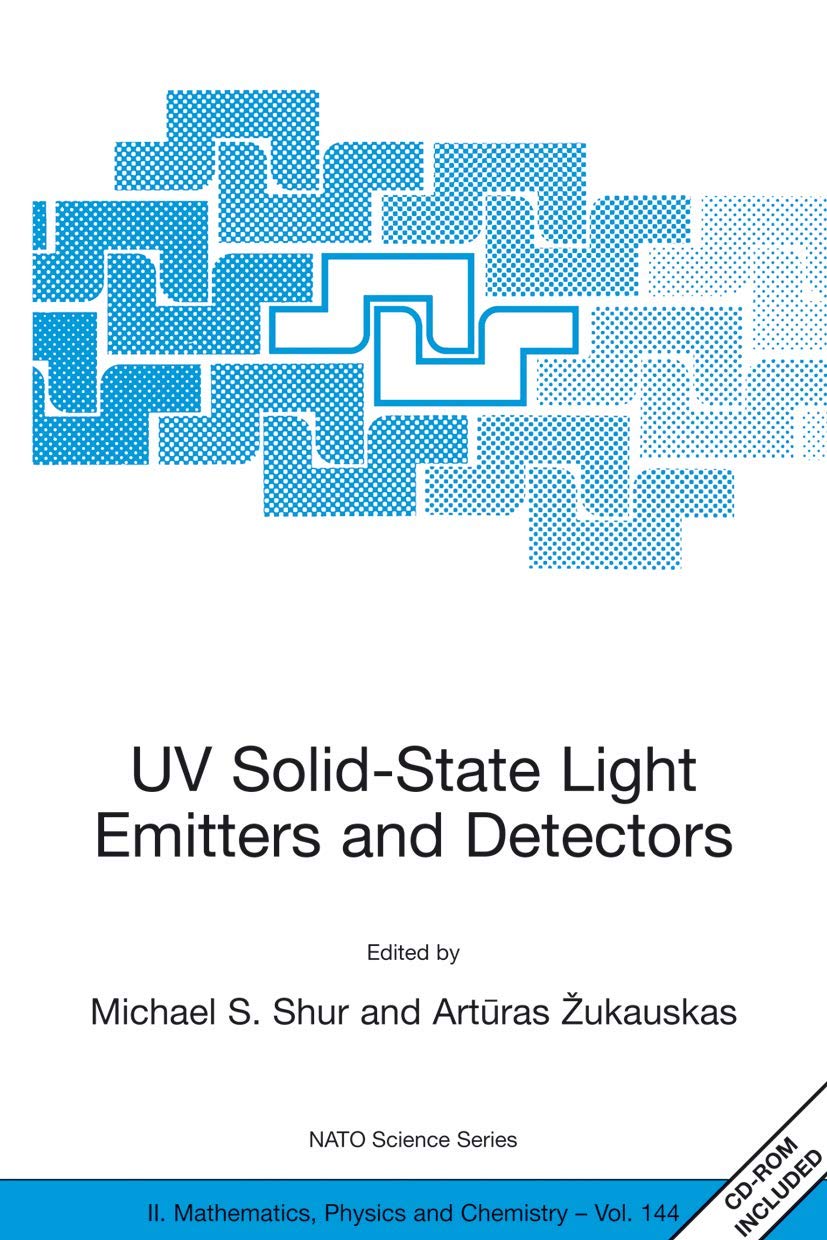
Figure 1: Front cover of the "UV Solid-State Light Emitters and Detectors" book. The cover features a blue abstract pattern at the top and the title in black text, along with the editors' names and series information. A "CD-ROM INCLUDED" label is visible in the bottom right corner.
2. Content Overview
The book delves into the critical role of infrared and visible light LEDs and photodetectors, highlighting their numerous applications and enabling technologies. A significant focus is placed on the emerging field of ultraviolet LEDs and solar-blind photodetectors, which are poised to revolutionize various sectors including biology, medicine, dentistry, solid-state lighting, displays, dense data storage, and semiconductor manufacturing. The text emphasizes the advantages of UV LEDs over traditional UV lamps, such as lower power consumption, extended lifespan, compact design, and sharper spectral lines. It also discusses the potential for generating white light with high Color Rendering Index (CRI) and efficiency using conventional phosphors, and the future prospects with quantum cutter phosphors.
3. Utilizing the Publication
3.1. Reading Strategies
To maximize your learning experience, consider the following approaches:
- Sequential Reading: For a foundational understanding, read chapters in the order presented.
- Targeted Reading: If you have specific interests, refer to the chapter titles and introductory sections to identify relevant content.
- Reviewing Concepts: Utilize the detailed explanations and theoretical frameworks to reinforce your knowledge of solid-state physics and optoelectronics.
3.2. CD-ROM Usage
This publication includes a supplementary CD-ROM. Please follow these general guidelines for its use:
- Insert CD-ROM: Carefully insert the CD-ROM into your computer's optical drive.
- Access Content: Navigate to the CD-ROM drive in your file explorer. The content may include supplementary data, figures, or software related to the book's topics.
- System Requirements: Ensure your computer meets the minimum system requirements for viewing or running the CD-ROM content. Refer to any README files on the disc for specific instructions.
4. Maintenance and Care
To ensure the longevity of your publication and its supplementary materials, observe the following care instructions:
- Storage: Store the book in a cool, dry place away from direct sunlight and extreme temperatures to prevent page yellowing or binding damage.
- Handling: Handle pages carefully to avoid tears. Avoid bending the cover excessively.
- CD-ROM Care: Keep the CD-ROM in its protective sleeve when not in use. Clean with a soft, lint-free cloth if smudges occur. Avoid scratching the disc surface.
5. Troubleshooting
5.1. Content Comprehension
If you encounter difficulties understanding certain concepts:
- Review Prerequisites: Ensure you have a solid understanding of the foundational physics and chemistry concepts typically required for advanced topics in solid-state devices.
- Consult References: Refer to the bibliography or suggested readings within the book for additional context and deeper explanations.
- Seek Clarification: Discuss challenging topics with peers, instructors, or academic resources.
5.2. CD-ROM Issues
If the CD-ROM is not functioning correctly:
- Check Drive: Ensure the CD-ROM is inserted correctly into a functional optical drive.
- Clean Disc: Gently clean the disc surface with a soft cloth to remove any dust or smudges.
- Try Another Computer: Test the CD-ROM on a different computer to rule out a drive-specific issue.
- Contact Publisher: If issues persist, contact the publisher for assistance (see Section 7. Support).
6. Specifications
| Attribute | Detail |
|---|---|
| Title | UV Solid-State Light Emitters and Detectors |
| Series | NATO Science Series II: Mathematics, Physics and Chemistry, Volume 144 |
| Editors | Michael S. Shur, Arturas Zukauskas |
| Publisher | Springer |
| Publication Date | May 31, 2004 |
| Edition | Softcover reprint of the original 1st ed. 2004 |
| Language | English |
| Print Length | 322 pages |
| ISBN-10 | 140202035X |
| ISBN-13 | 978-1402020353 |
| Item Weight | 1 pounds |
| Dimensions | 6.1 x 0.73 x 9.25 inches |
7. Warranty and Support
7.1. Product Warranty
As a published academic work, this book does not typically come with an explicit product warranty in the traditional sense. However, publishers generally guarantee the quality of the physical product (e.g., binding, print quality) at the time of purchase. If you receive a damaged or defective copy, please contact your retailer or the publisher directly within a reasonable timeframe after purchase.
7.2. Technical Support and Inquiries
For questions regarding the content of this publication, or for issues related to the supplementary CD-ROM, please contact the publisher:
Publisher: Springer
www.springer.com
Please refer to the publisher's website for specific contact information for customer service or technical support departments.


