Introduction
This guide serves as an informational companion to The Zen of Business, a book designed to help modern leaders integrate ancient Eastern wisdom into their professional and personal lives. It outlines the core concepts and practical applications presented within the book to foster intention, clarity, and purpose.
The content herein is strictly informational and aims to provide a structured overview of the book's teachings, enabling readers to better understand and apply its principles.
Core Principles (Setup)
The foundation of The Zen of Business lies in several key philosophical concepts. Understanding these principles is crucial for effectively applying the book's guidance.
- Ikigai: A Japanese concept meaning "a reason for being." The book guides readers through exercises to uncover their own life's purpose and vision, which serves as the starting point for intentional leadership.
- Karma: The principle of cause and effect, emphasizing that actions, thoughts, and words influence future outcomes. Applying this in business encourages ethical decision-making and responsibility.
- The Eightfold Path: A framework from Buddhist philosophy offering guidelines for right understanding, thought, speech, action, livelihood, effort, mindfulness, and concentration. These are adapted for modern business contexts to promote holistic success.
These principles provide the mental and ethical framework upon which the practical strategies are built.
Practical Application (Operating)
This section details how to integrate the book's wisdom into daily business operations and personal conduct. The book provides tools and techniques for practical implementation.
- Cultivating Mindfulness: Techniques to enhance present-moment awareness, reduce stress, and improve focus in decision-making. This involves practices like mindful breathing and observation.
- Enhancing Focus: Strategies to minimize distractions and maintain concentration on key objectives, leading to increased productivity and clarity.
- Promoting Ethical Decision-Making: Guidance on making choices that align with long-term values and positive impact, considering the broader implications of actions.
- Integrating Zen Tools: Application of specific Zen practices, adapted for the business environment, to foster inner peace and effective leadership.
The book emphasizes that consistent application of these practices leads to tangible improvements in leadership effectiveness and overall well-being.
Sustaining Practice (Maintenance)
Maintaining the benefits derived from the book's teachings requires ongoing commitment and adaptation. This section highlights aspects related to sustaining personal and professional growth.
- Continuous Reflection: Regularly reviewing personal and business practices against the principles of intention, clarity, and purpose.
- Adaptive Application: Adjusting the techniques to suit evolving challenges and opportunities in the business landscape.
- Community Engagement: While not explicitly detailed in the provided text, the spirit of Zen often involves shared learning. Readers are encouraged to seek out like-minded individuals or groups for continued growth.
Addressing Challenges
Even with clear principles, challenges may arise in applying ancient wisdom to modern business. The book implicitly addresses these by providing a robust framework for resilience and ethical conduct.
- Overcoming Obstacles: The principles of mindfulness and ethical decision-making provide a foundation for navigating difficult situations with composure and integrity.
- Managing Stress: Techniques for cultivating inner peace help leaders manage the inherent stresses of business, preventing burnout and promoting sustained performance.
- Ethical Dilemmas: The emphasis on karma and the Eightfold Path offers a moral compass for resolving complex ethical challenges in a way that benefits all stakeholders.
Specifications
Detailed information regarding the physical attributes and publication details of The Zen of Business.
| Attribute | Detail |
|---|---|
| Publisher | Wiley |
| Publication Date | May 6, 2025 |
| Edition | 1st |
| Language | English |
| Print Length | 256 pages |
| ISBN-10 | 1394309961 |
| ISBN-13 | 978-1394309962 |
| Item Weight | 15 ounces |
| Dimensions | 6.2 x 1.1 x 9.1 inches |
Author and Resources (Support)
For further engagement with the concepts presented in The Zen of Business, readers can explore additional resources by the author.
About the Author: Keith Edward Roberts III is a transformational speaker and leadership expert with over 25 years of entrepreneurial experience. He has successfully started and exited multiple businesses, created the OAK Journal, and coauthored The Eternal Flame. He is a sought-after speaker globally.
For more information or to explore other works by Keith Edward Roberts III, please visit his official platforms or the publisher's website. Links are typically found within the book's introductory or concluding pages.
Usage Notes and Disclaimer
This book provides guidance and insights based on ancient wisdom applied to modern business. It is intended for educational and informational purposes only and should not be considered as professional advice for specific business or personal situations. Readers are encouraged to apply the principles thoughtfully and in accordance with their own circumstances.
As this is a published book, traditional product warranties do not apply. For any issues related to the physical book (e.g., printing defects), please refer to the retailer's return policy where the book was purchased.
Product Image
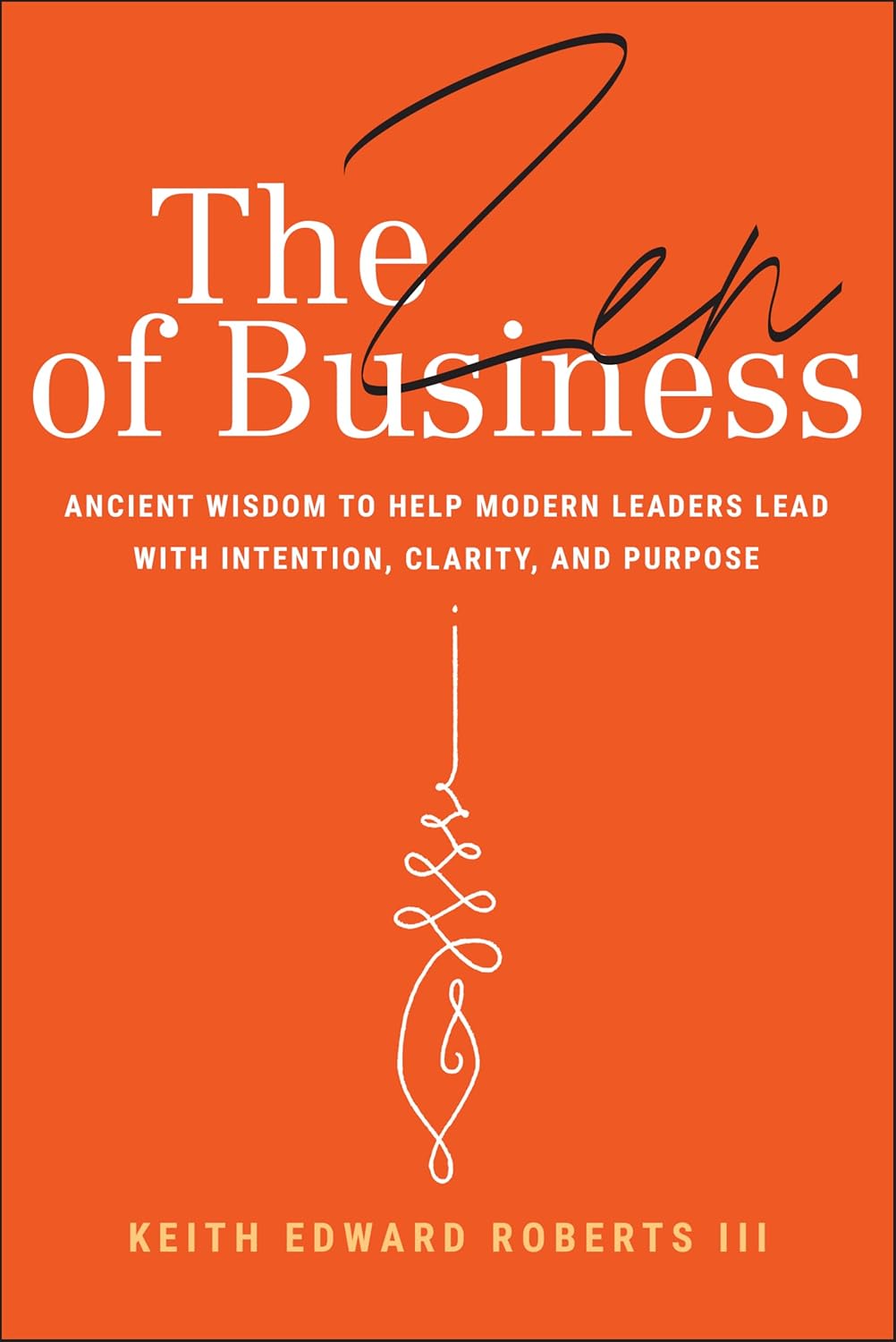
This image displays the front cover of 'The Zen of Business'. The cover is a solid orange color with the title 'The Zen of Business' in large white serif font. Below the main title, in smaller white sans-serif font, is the subtitle: 'ANCIENT WISDOM TO HELP MODERN LEADERS LEAD WITH INTENTION, CLARITY, AND PURPOSE'. A stylized white unalome symbol, representing the path to enlightenment, is prominently featured vertically in the center. At the bottom, the author's name, 'KEITH EDWARD ROBERTS III', is printed in white capital letters.