Introduction to Practical Electronics
This guide provides a comprehensive overview of basic electricity and electronic components, designed for self-paced learning. It addresses fundamental questions such as the nature of semiconductors, methods for laying out circuits to minimize noise and interference, the commonalities between inductors and transformers, and how coaxial cables transmit power to antennas. The content is thoroughly researched and adapted for contemporary understanding, covering the operation of transistors, capacitors, diodes, resistors, and integrated circuits.
The author, Ralph Morrison, introduces concepts starting with simple electronic components and progressively builds towards more complex circuit designs. The guide includes detailed "learning circuits" that can be constructed by the reader, even without prior electronics experience. Its structured format ensures accessibility, offering a clear and comprehensive resource for students, engineers, and hobbyists alike.
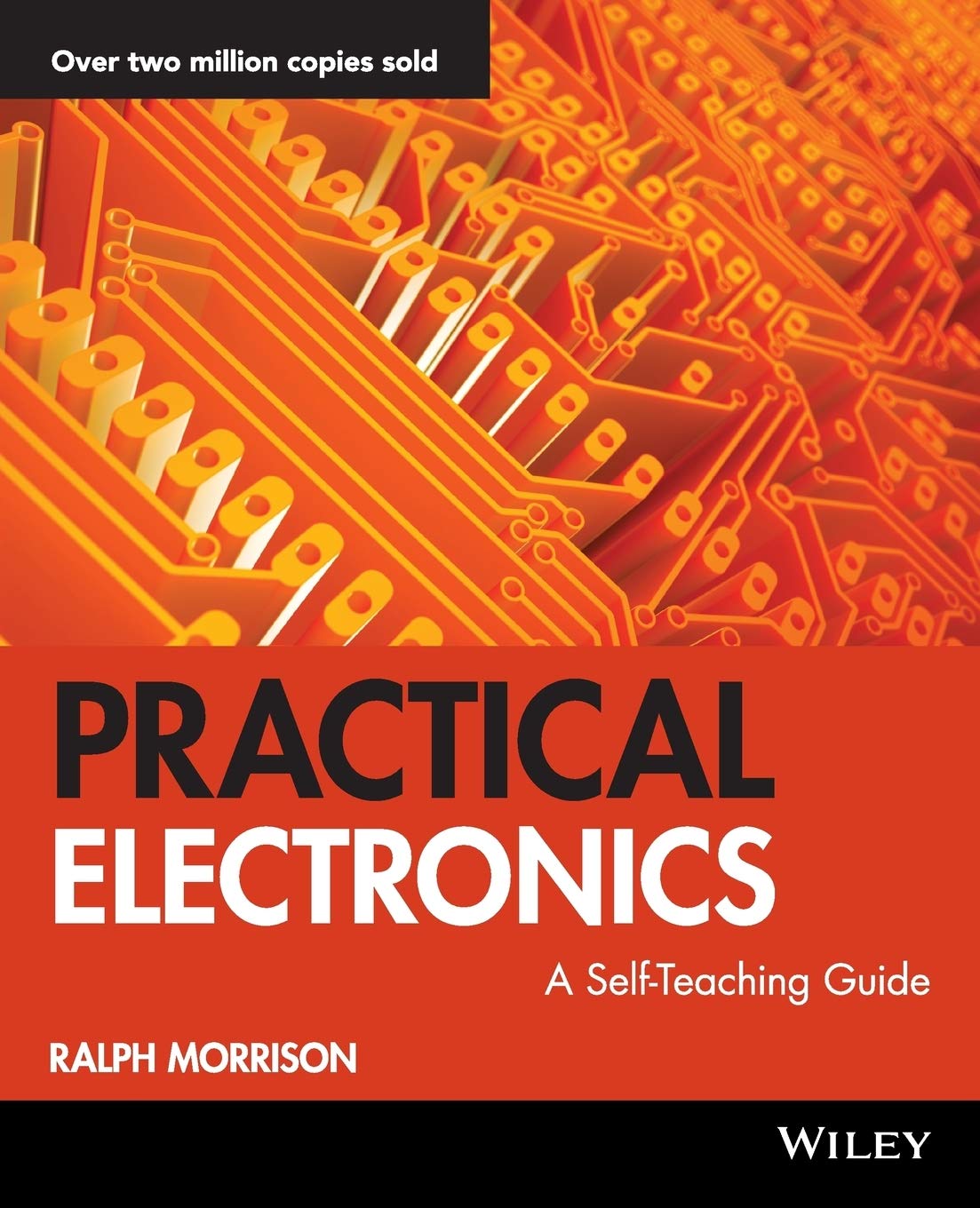
This image displays the front cover of the book 'Practical Electronics: A Self-Teaching Guide'. The cover features an intricate orange circuit board pattern at the top, transitioning into a solid red background. The title 'PRACTICAL ELECTRONICS' is prominently displayed in large white letters, with 'A Self-Teaching Guide' in smaller white text below it. The author's name, 'RALPH MORRISON', is at the bottom left, and the publisher's logo, 'WILEY', is at the bottom right. A small black banner at the top left corner states 'Over two million copies sold'.
Key Concepts Covered
The guide systematically covers a range of essential electronic concepts and components, including:
- Semiconductors: Understanding their properties and applications.
- Circuit Layout: Techniques to minimize noise and interference in electronic circuits.
- Inductors and Transformers: Exploring their functions and shared characteristics.
- Coaxial Cables: How they transmit power and signals.
- Transistors: Principles of operation and common uses.
- Capacitors: Energy storage and filtering applications.
- Diodes: Rectification and signal processing.
- Resistors: Current limitation and voltage division.
- Integrated Circuits: Introduction to complex electronic components.
Learning Circuits
A core feature of this guide is the inclusion of detailed "learning circuits." These are practical electronic circuits designed for hands-on construction. They serve as practical exercises to reinforce theoretical knowledge, allowing readers to apply concepts directly and observe their functionality. No prior electronics experience is required to build and understand these circuits.
Getting Started (Setup)
To maximize your learning experience with "Practical Electronics: A Self-Teaching Guide," consider the following setup recommendations:
- Dedicated Study Area: Establish a quiet space free from distractions.
- Basic Tools: For building learning circuits, you may need a breadboard, jumper wires, a multimeter, and basic hand tools. Refer to specific circuit instructions for exact requirements.
- Component Sourcing: Identify reliable sources for electronic components if you plan to build the learning circuits.
- Note-Taking Materials: Keep a notebook and pen handy for jotting down notes, questions, and circuit diagrams.
Effective Learning Strategies (Operating)
This guide is structured to facilitate gradual learning at your own pace. To operate effectively and gain the most from the material:
- Read Systematically: Progress through chapters in order, as concepts often build upon previous ones.
- Engage with Questions and Self-Tests: Each chapter includes questions and self-tests. Utilize these to reinforce information and assess your understanding before moving forward.
- Build Learning Circuits: Actively constructing the provided circuits will solidify theoretical knowledge through practical application.
- Review and Revisit: If a concept is unclear, revisit earlier sections or specific areas of concern.
- Practice: The more you engage with the material and build circuits, the deeper your understanding will become.
Care and Preservation (Maintenance)
To ensure the longevity and usability of your "Practical Electronics: A Self-Teaching Guide," consider these maintenance tips:
- Store Properly: Keep the book in a dry place, away from direct sunlight and extreme temperatures, to prevent paper degradation.
- Handle with Care: Avoid bending the spine excessively or tearing pages.
- Cleanliness: Keep the book away from liquids and food to prevent stains and damage.
- Component Storage: If you are building circuits, ensure electronic components are stored in an organized manner to prevent loss or damage.
Addressing Learning Challenges (Troubleshooting)
Encountering difficulties is a natural part of the learning process. If you find yourself struggling with a concept or a learning circuit:
- Re-read Sections: Go back and re-read the relevant sections slowly, paying close attention to definitions and examples.
- Break Down Complexities: Try to break down complex topics or circuits into smaller, more manageable parts.
- Verify Circuits: If a learning circuit is not functioning as expected, meticulously re-check all connections and component values against the provided diagrams.
- Seek External Resources: While this guide is comprehensive, supplementary online tutorials or videos on specific topics can sometimes offer alternative explanations.
- Practice Problems: Work through additional practice problems or variations of the learning circuits to solidify understanding.
Product Specifications
| Attribute | Detail |
|---|---|
| Publisher | Wiley |
| Publication Date | November 5, 2003 |
| Edition | 1st |
| Language | English |
| Print Length | 288 pages |
| ISBN-10 | 0471264067 |
| ISBN-13 | 978-0471264064 |
| Item Weight | 1.13 pounds |
| Dimensions | 7.6 x 0.68 x 9.3 inches |
| Part of Series | Wiley Self-Teaching Guides |
Warranty and Support
As a published educational guide, "Practical Electronics: A Self-Teaching Guide" does not typically come with a product warranty in the traditional sense. The quality and accuracy of the content are maintained by the publisher, Wiley.
For any inquiries regarding the book's content, errata, or publishing details, please refer to the publisher's official website or contact their customer service. Specific support for individual learning challenges or circuit building beyond the scope of the book's instructions is not provided by the publisher.


