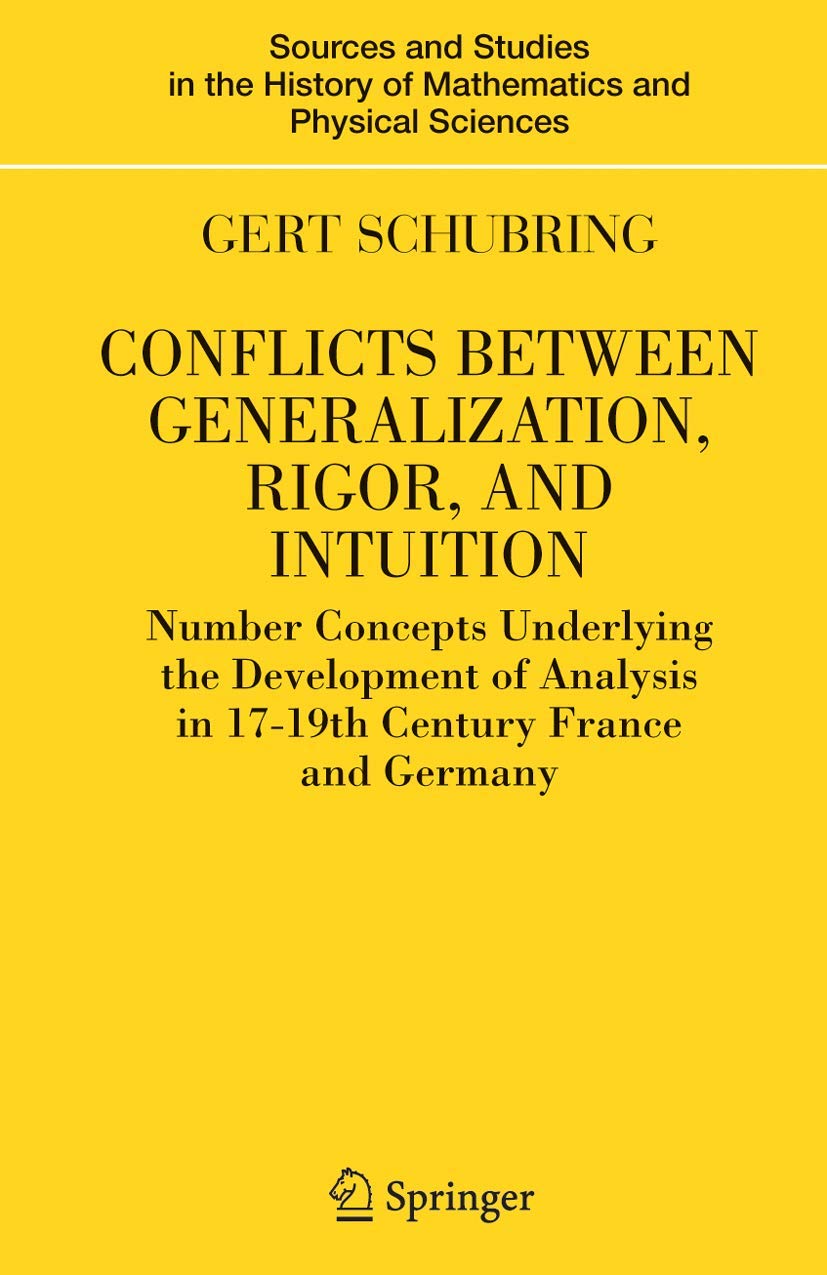
Introduction to the Work
This volume presents a comprehensive historical analysis of the development of mathematical concepts, specifically focusing on negative numbers and infinitely small quantities. Authored by Gert Schubring, the work delves into the intellectual landscape of 17th to 19th century France and Germany, exploring the intricate interplay between generalization, rigor, and intuition in the evolution of mathematical analysis.
The book is the culmination of extensive research in archives and libraries, involving the unearthing of rare texts and systematic comparative analysis of foundational sources. It aims to provide a nuanced understanding of how mathematical ideas were conceived and transformed within their respective cultural and scientific communities.
Key Themes and Conceptual Development
The central focus of this study is the historical evolution of two fundamental mathematical concepts: negative numbers and infinitesimals. The author meticulously traces their development, highlighting the distinct paths taken in different regions, particularly France, Germany, and Britain.
- Generalization: The book examines how mathematical concepts were generalized, with a particular emphasis on algebraization as a driving force for this process.
- Rigor vs. Intuition: A significant theme is the inherent conflict between the desire for intuitive accessibility of concepts and the simultaneous pursuit of mathematical rigor. This tension is shown to have shaped the development of analysis.
- Foundational Ideas: The work provides a detailed analysis of the foundational ideas of key figures such as Lazare Carnot and A. L. Cauchy, illustrating their contributions to the emerging concept of analysis in the 19th century.
- Institutional Context: The study also incorporates the role of educational institutions, such as the École Polytechnique, in shaping the teaching and understanding of analytical methods.
By unifying a large number of historical sources through the lens of negative and infinitely small numbers, the book offers a productive framework for understanding conceptual change in mathematics.
Author Information
The author of this significant work is Gert Schubring. His extensive research and scholarly contributions are evident in the depth and detail of this historical analysis. Schubring's work has been recognized for its rich and detailed account of textbooks, educational institutions, and key historical passages and events in the history of mathematics.
Series Context
This book is part of the distinguished series, Sources and Studies in the History of Mathematics and Physical Sciences. This series is dedicated to publishing scholarly works that contribute to the understanding of the historical development of mathematics and physical sciences.
Product Specifications
| Attribute | Detail |
|---|---|
| Publisher | Springer |
| Publication Date | June 14, 2005 |
| Edition | 2005th |
| Language | English |
| Print Length | 692 pages |
| ISBN-10 | 0387228365 |
| ISBN-13 | 978-0387228365 |
| Item Weight | 7.4 ounces |
| Dimensions | 6.14 x 1.5 x 9.21 inches |
Visual Reference