1. Introduction
This manual provides essential information for effectively utilizing the textbook, Introduction to Mathematical Statistics, Seventh Edition. Designed for students and professionals, this book offers a comprehensive foundation in mathematical statistics. It emphasizes a clear, proven approach to help readers develop a solid understanding of complex statistical concepts through ample examples and exercises.
The content is structured to facilitate learning, from fundamental principles to advanced topics, ensuring a robust grasp of the subject matter. This guide will help you navigate the book's features and maximize your learning experience.
2. Key Features and Benefits
- Comprehensive Coverage: The textbook covers a wide range of topics in mathematical statistics, providing a thorough understanding of the field.
- Clear Explanations: Concepts are presented with clarity, making complex statistical theories accessible.
- Ample Examples: Numerous worked examples illustrate theoretical concepts, aiding in practical application and problem-solving.
- Extensive Exercises: A variety of exercises are included at the end of each section, ranging from foundational problems to more challenging theoretical questions, often with helpful hints for difficult problems.
- Rigorous Proofs: Essential proofs are provided to deepen understanding of the underlying mathematical principles.
- Self-Study Friendly: The book's structure and detailed explanations make it suitable for independent study.
3. Usage Guidelines
To get the most out of Introduction to Mathematical Statistics, consider the following guidelines:
- Sequential Reading: It is recommended to read the chapters and sections in the order presented, as concepts often build upon previous material.
- Engage with Examples: Do not just read the examples; try to work through them yourself before reviewing the provided solutions. This active engagement reinforces learning.
- Practice Exercises: Attempt all exercises at the end of each section. Start with the easier problems to solidify basic understanding, then progress to more challenging ones. Utilize the hints provided for complex problems.
- Understand Proofs: Pay close attention to the proofs of theorems. Understanding why a theorem is true is as important as knowing what it states.
- Review and Summarize: Regularly review previously covered material and summarize key concepts in your own words. This helps in retention and deeper comprehension.
4. Structure and Content Overview
The textbook is organized into chapters, each focusing on a specific area of mathematical statistics. Key topics include probability, distributions, estimation, hypothesis testing, and more advanced statistical methods. The logical progression of topics ensures a coherent learning path.
Book Cover

The front cover of the textbook, featuring the title "Introduction to Mathematical Statistics, Seventh Edition" and the authors' names: Hogg, McKean, and Craig. The design includes a blue background with abstract light patterns.
Back Cover Details

The back cover of the textbook, displaying the ISBN-13 (978-0321795434) and ISBN-10 (0321795431), along with a barcode and the Pearson publisher logo. It also includes the website "www.pearsonhighered.com".
Chapter 6.3: Maximum Likelihood Methods

A sample page from Chapter 6.3, which delves into Maximum Likelihood Methods. This section includes definitions, theorems, and examples related to statistical estimation, such as the likelihood function and its properties.
Chapter 8.4: The Sequential Probability Ratio Test
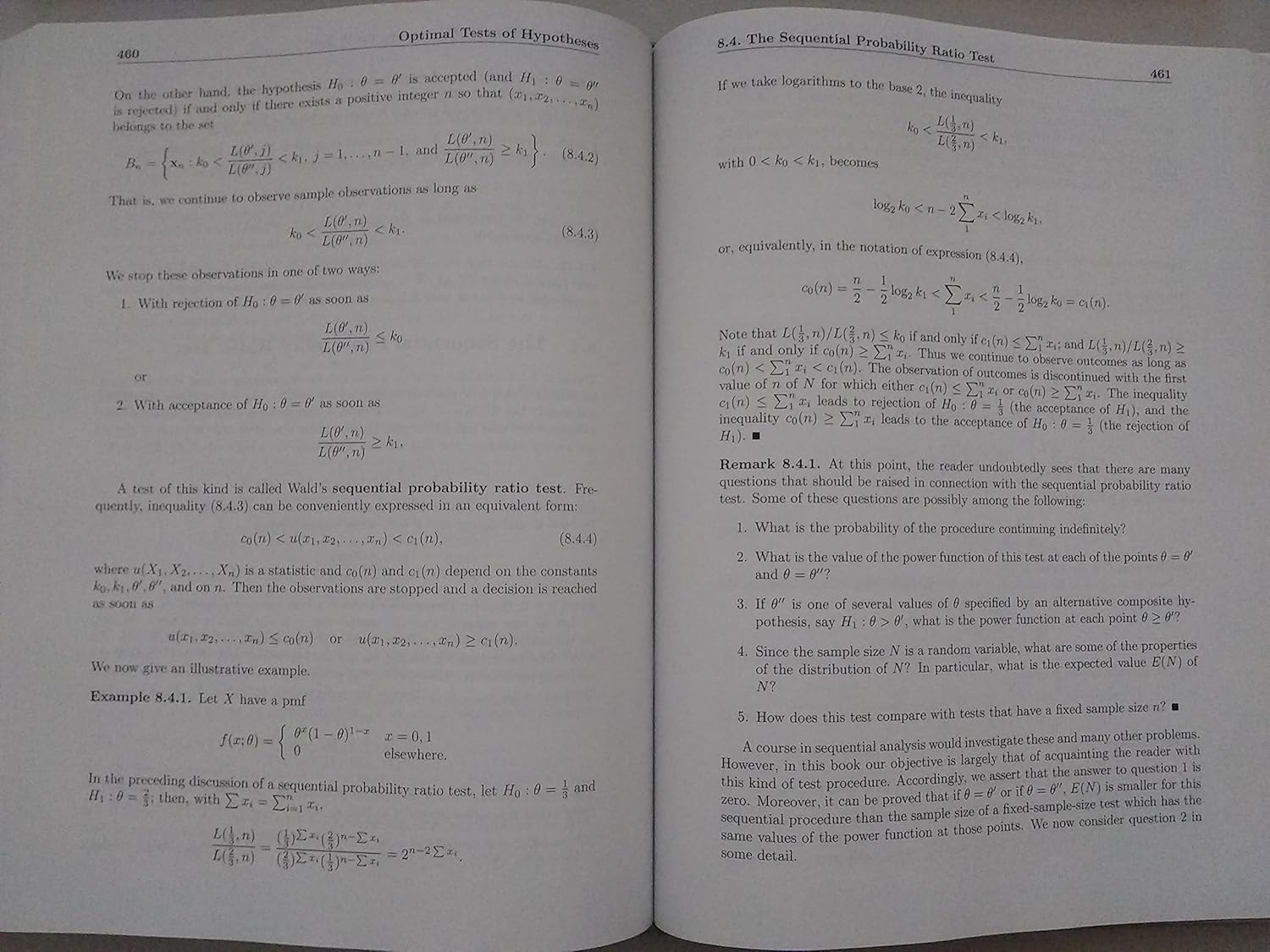
A sample page from Chapter 8.4, focusing on The Sequential Probability Ratio Test. This section illustrates advanced hypothesis testing techniques, including the use of logarithms and sequential sampling methods.
5. Supplemental Resources
While this textbook is a complete resource, additional learning materials may be available from the publisher, Pearson. These might include online appendices, solution manuals, or interactive tools designed to complement the textbook content. Please refer to the publisher's official website for any supplementary resources related to the Seventh Edition of Introduction to Mathematical Statistics.
For direct access to publisher resources, you may visit the Pearson Higher Ed website: www.pearsonhighered.com.
6. Specifications
| Title | Introduction to Mathematical Statistics |
| Edition | 7th Edition |
| Authors | Robert Hogg, Joseph McKean, Allen Craig |
| Publisher | Pearson |
| Publication Date | January 8, 2012 |
| Language | English |
| Print Length | 704 pages |
| ISBN-10 | 0321795431 |
| ISBN-13 | 978-0321795434 |
| Item Weight | 2.22 pounds |
| Dimensions | 7.2 x 1.2 x 9.3 inches |
7. Support and Warranty
For any inquiries regarding the content, errata, or supplementary materials for Introduction to Mathematical Statistics, Seventh Edition, please contact the publisher, Pearson. As a textbook, specific product warranties typically do not apply in the same manner as for electronic devices or physical goods. However, Pearson is committed to providing high-quality educational resources.
Please visit the official Pearson website or contact their customer support for assistance. Contact information can usually be found on the publisher's website or within the initial pages of the textbook.


