
1. Introduction
This manual provides essential information for the assembly, operation, and maintenance of your abay 4D Vector EPP F3P RC Plane. Designed for both indoor and outdoor use, this remote control airplane features an 850mm wingspan and is constructed from durable EPP material, offering excellent flight performance for F3P aerobatics.
2. Features
- Durable Construction: Made from strong EPP material, which is noted to be 20 times harder and lighter, enhancing resilience and flight characteristics.
- Easy Assembly: Designed for straightforward and quick assembly.
- Portable Design: Easy to transport due to its lightweight and potentially modular design.
- Excellent Flight Performance: Optimized for precise control and aerobatic maneuvers, suitable for F3P flying.
- Anti-Collision Board: Integrated design elements to enhance durability against impacts.
- 4D Vector Capability: Allows for advanced flight maneuvers.
3. Specifications
| Attribute | Value |
|---|---|
| Wingspan | 850 mm |
| Length | 880 mm |
| Empty Weight | 70 g |
| Flying Weight | Approximately 170 g (varies based on electronic equipment and assembly) |
| Plate Thickness | 4 mm |
| Material | EPP (Expanded Polypropylene) |
| Electrified | No (for KIT version); Yes (for PNP versions with included electronics) |
| High-concerned chemical | None |
| Compatible Remote Control Brand | DJI (Note: This refers to compatibility with DJI remote control systems, not that the plane is a DJI product.) |
4. Package Contents
The contents of your package will vary depending on the version purchased:
4.1 KIT Version
Includes the empty aircraft airframe, carbon rods, and essential installation accessories. Electronic equipment (motor, ESC, servos, receiver, battery) is NOT included.

4.2 PNP 3D Version
Includes the empty aircraft airframe, carbon rods, installed parts, and the following electronic components:
- Langyu 2206KV Motor
- PTK 7452MG-D12g Digital Metal Gear Servo (1x)
- PTK 7350MG-D5.5g Metal Gear Digital Servo (2x)
- Hobbywing 15A ESC
- 8-inch Propeller (1x)
- 9-inch Propeller (1x)
The motor and ESC are pre-welded. The ESC power supply is typically a JST connector; if an XT30 connector is required, please specify when ordering.

4.3 PNP 4D Version
Includes the empty aircraft airframe, carbon rods, installed parts, and the following electronic components:
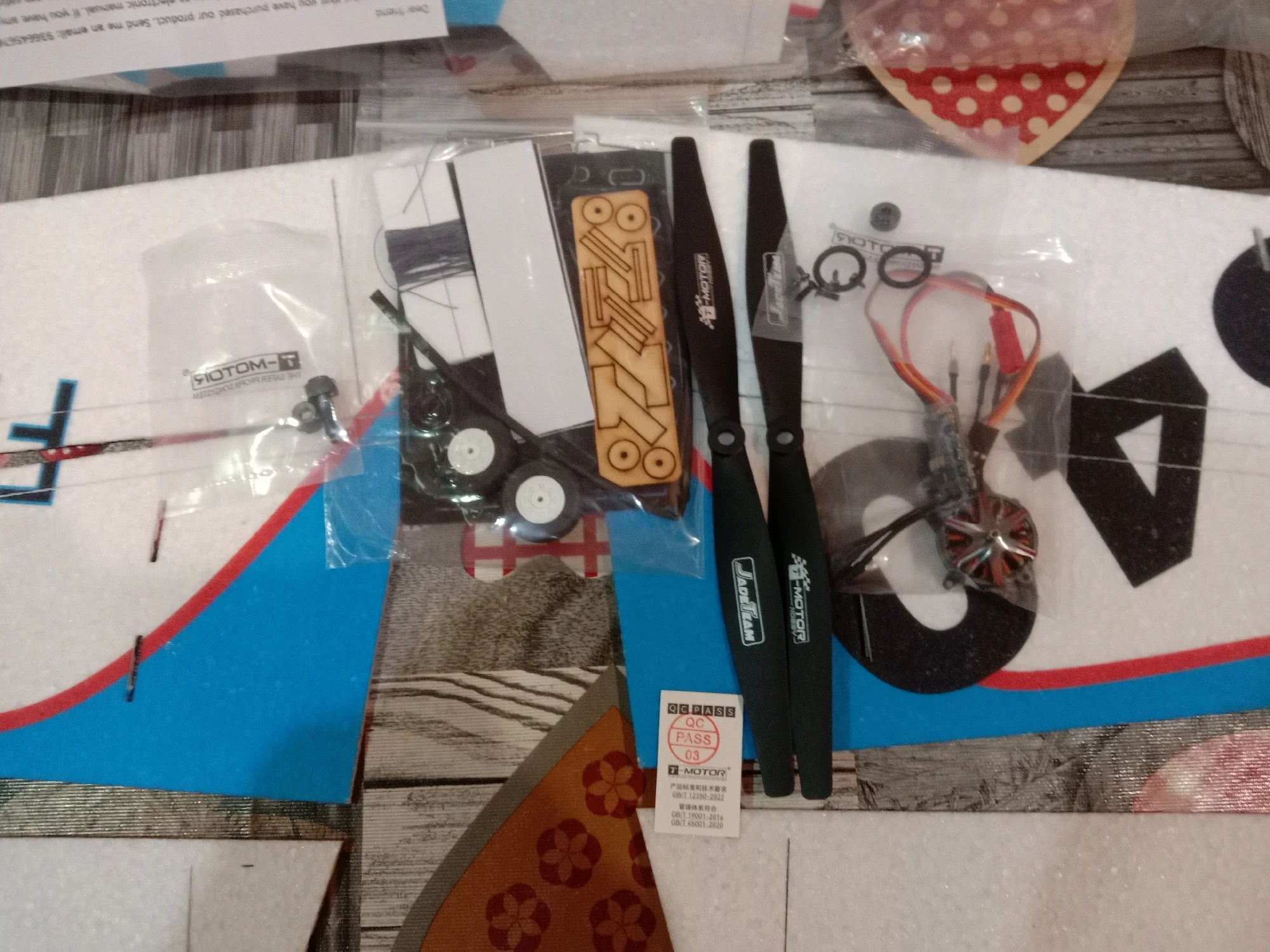
- T-MOTOR AM40 BPP-4D PRO Combo (AM40 Brushless Motor, 4D Vector Motor Mount, AM16A ESC, T8542 Prop with 2 Propellers)
- PTK 7452MG-D12g Digital Metal Gear Servo (1x)
- PTK 7350MG-D5.5g Metal Gear Digital Servo (2x)
The motor and ESC are pre-welded. The ESC power supply is typically a JST connector; if an XT30 connector is required, please specify when ordering.

Note: The packaging does not contain glue. Due to transportation requirements, the fuselage may be cut; the incision is smooth and will not affect appearance or rigidity once glued. If the EPP plate is slightly bent from long-distance transport, place it on a flat surface and press with a heavy object for one day to help restore its flatness. The 4D motor may be packed without its original box to save on transportation costs. The specific brand or model of certain electronic components (e.g., servos) may vary but will be of equivalent quality.
5. Setup and Assembly
Assembly of the RC plane is designed to be straightforward. Follow these general guidelines:
- Inspect Components: Carefully unbox all components and inspect for any damage. If EPP foam parts are bent, follow the tip in Section 4.3 to restore their flatness.
- Fuselage Assembly: If the fuselage parts are separated for shipping, carefully align and glue them together. Ensure a strong and smooth bond.
- Wing and Tail Assembly: Attach the wings and tail sections to the fuselage using appropriate adhesives (not included) and carbon rods as indicated by the design.
- Control Surface Hinges: Ensure all control surfaces (ailerons, rudder, elevator) are properly hinged and move freely.
- Electronic Installation (PNP versions):
- Motor and ESC: For PNP versions, the motor and ESC are pre-welded. Mount the motor securely to the motor mount. Connect the ESC to your receiver and power source (battery).
- Servos: Install the provided servos for the ailerons, rudder, and elevator. Connect the pushrods to the control horns on the surfaces and the servo arms.
- Receiver: Install your RC receiver in a secure location within the fuselage. Connect the servos and ESC to the appropriate channels on the receiver.
- Propeller Installation: Securely attach the propeller to the motor shaft. Ensure it is balanced and facing the correct direction for thrust.
- Center of Gravity (CG): Before flight, always verify the aircraft's Center of Gravity (CG) according to standard RC plane practices. Adjust battery placement or add ballast as needed to achieve the recommended CG.
6. Operating Instructions
This RC plane is designed for advanced aerobatic flight, including 4D maneuvers. Proper setup and understanding of your remote control system are crucial for safe and enjoyable operation.
- Pre-Flight Checks:
- Ensure all control surfaces move freely and in the correct direction relative to your transmitter inputs.
- Check battery levels on both the aircraft and the transmitter.
- Verify all connections are secure.
- Perform a range check of your radio system.
- Take-off: Hand launch the aircraft into a slight headwind, applying smooth throttle.
- Flight Control:
- Use the ailerons for roll control, elevator for pitch, and rudder for yaw.
- The 4D vectoring capability allows for unique maneuvers by controlling thrust direction. Practice these at a safe altitude.
- Landing: Approach into the wind, gradually reducing throttle and maintaining elevator control for a smooth touchdown.
Important Safety Note: This product is for recreational use only. Illegal modification of RC planes is prohibited. Always adhere to local laws and regulations regarding the use of remote control aircraft in your country or area to ensure legal and safe operation.
7. Maintenance
Regular maintenance will ensure the longevity and optimal performance of your RC plane:
- Cleanliness: Keep the airframe free of dirt, grass, and debris. Use a soft, damp cloth for cleaning EPP surfaces.
- Structural Integrity: Periodically inspect the EPP foam for cracks or damage. Repair any damage promptly using appropriate foam-safe adhesives. Check carbon rods for bends or breaks.
- Control Linkages: Ensure all pushrods and control horns are secure and free from excessive play. Lubricate moving parts if necessary.
- Motor and Propeller: Check the motor for smooth operation and the propeller for damage (nicks, cracks). Replace damaged propellers immediately as they can cause vibrations and reduce efficiency.
- Electronics: Verify all wiring connections are secure and free from corrosion.
- Storage: Store the aircraft in a cool, dry place away from direct sunlight and extreme temperatures to prevent material degradation.
8. Troubleshooting
Here are some common issues and their potential solutions:
- Bent EPP Foam Parts: If parts are bent upon arrival or after minor impacts, place them on a flat surface and apply a heavy, flat object for 24 hours to help restore their original shape.
- Poor Flight Performance/Control Issues:
- Check control surface throws and ensure they are symmetrical.
- Verify the Center of Gravity (CG) is correct.
- Inspect all servo connections and linkages for looseness or damage.
- Ensure the propeller is correctly installed and undamaged.
- Motor Not Spinning/Intermittent Power:
- Check battery charge.
- Verify all ESC and motor connections.
- Ensure the ESC is properly calibrated with the transmitter.
9. User Tips
- Inspect Upon Arrival: Carefully check the packaging and contents immediately upon receipt. While the EPP material is robust, external damage during shipping can occur.
- Assembly Attention: Pay close attention to the assembly of fittings and electronic components. Proper assembly is key to optimal flight performance and durability.
- Battery Selection: The choice of battery significantly impacts flight duration and performance. For indoor flying, a lighter battery might be preferred for slower, more controlled flight, while outdoor flying might benefit from a battery that provides more power and flight time.
- Glue Recommendation: Although glue is not included, using a foam-safe adhesive is crucial for EPP construction.
10. Frequently Asked Questions (FAQ)
- Q: Does the KIT version include a motor, ESC, and propeller?
- A: No, the KIT version includes only the airframe and basic installation accessories. Electronic components like the motor, ESC, servos, and propeller must be purchased separately. These are included in the PNP (Plug-N-Play) versions.
- Q: What type of battery should I use for this RC plane?
- A: The recommended battery type and capacity will depend on the specific electronic setup (motor, ESC) and desired flight characteristics. For PNP 3D and 4D versions, consult the specifications of the included electronics for compatible battery voltage (e.g., 2S or 3S LiPo) and C-rating.
- Q: Is the wing flat or does it have an airfoil?
- A: This model typically features a flat plate EPP wing design, which is common for F3P (indoor aerobatics) planes. This design provides excellent slow-flight characteristics and precise control for aerobatic maneuvers.
11. Safety Information
⚠️ Disclaimer:
- This product is intended for recreation use only.
- Illegal modification of drones/planes is strictly prohibited.
- Always comply with relevant laws and regulations concerning the use of drones/planes in your country or area to ensure legal and safe operation.
- Operate in open areas, away from people, animals, and obstacles.
- Maintain visual line of sight with the aircraft at all times.
- Do not operate in adverse weather conditions (e.g., strong winds, rain).
12. Warranty and Support
For any questions, technical assistance, or support regarding your RC plane, please contact the seller or manufacturer directly. Keep your purchase records for reference.