Introduction
The SKYSHL SS315T Optical Time Domain Reflectometer (OTDR) is a crucial instrument designed for certifying the performance of new fiber optic links and diagnosing issues in existing ones. With advancements in fiber optic technology, OTDR testing is essential for building, certifying, maintaining, and troubleshooting fiber optic systems. The SS315T series measures fiber length and overall optical attenuation, providing insights into the integrity of the fiber and passive optical components like connectors, splices, splitters, and multiplexers.

Image: The SKYSHL SS315T Optical Time Domain Reflectometer device.
Setup
Unpacking and Contents
Before starting, ensure all components are present in the package:
- 1x SS315T OTDR Unit
- 5x Adapters for OTDR/OLS/OPM/VFL (2x FC, 1x SC, 1x LC, 1x ST)
- 2x Patch Cords (1x SM FC/UPC-FC/UPC, 1x SM FC/UPC-FC/APC)
- 4x Additional Adapters (1x FC-LC UPC&APC, 1x FC-SC UPC&APC, 1x FC-ST UPC&APC, 1x FC-FC UPC&APC)
- 1x USB Cable
- 1x Charger
- 1x Oxford Backpack
- 1x User Manual
- 1x APP Module
- 1x OTDR Holder
- 1x 2.5mm Cleaning Rod
- 1x 1.25mm Cleaning Rod
- 1x Factory Test Report
- 1x Memory Card

Image: Complete package contents of the SKYSHL SS315T-2A1 OTDR Tester.
Connecting the Fiber
The SS315T-OTDR supports various connector types including FC, SC, LC, and ST for both UPC and APC. Ensure the correct adapter is used for your fiber type.

Image: Top view of the OTDR showing various connector ports.
To connect a fiber:
- Remove the protective cap from the OTDR port.
- Select the appropriate adapter for your fiber connector (e.g., SC, LC, FC).
- Carefully insert the adapter into the OTDR port.
- Connect your fiber optic cable to the adapter.
Powering On
Press and hold the power button located on the device until the screen illuminates. The device will boot up and display the main menu.

Image: Main menu screen of the SKYSHL SS315T OTDR Tester.
Operating Instructions
The SS315T features an intuitive 7-inch capacitive touch screen interface. The main menu provides access to various functions including OTDR, OPM, OLS, Server, VFL, File management, Help, and System settings.
OTDR Test Procedure
Follow these steps to perform an OTDR test:
- Connect Testing Fiber Link: Ensure your fiber optic cable is securely connected to the OTDR using the appropriate adapter.
- Set Parameters: From the main menu, tap on the 'OTDR' icon. In the OTDR interface, tap the lower left corner of the screen to access parameter settings. Here you can set Wave (1310nm/1550nm), Mode (Auto/Manual), Test Time, Pulse width (e.g., 30ns, 640ns), and Test Range (e.g., 8km, 32km). Tap 'Enter' to confirm settings.
- Open Event Map (Optional): To view a graphical analysis, go to 'Setup' -> 'Link Def.' -> check 'Graphics' -> 'Enter'.
- Start Testing: Tap 'Average' to begin the fiber test. The device supports testing 1310nm and 1550nm wavelengths together. The test curve will be displayed in real-time.
- Zoom In/Out: Use the zoom controls on the right side of the screen to adjust the view of the test curve.
- Move A/B Cursor: Use the A/B cursors to precisely measure distances and losses between specific points on the fiber.
- View Test Data and Event Map: After the test is complete, tap 'Analysis' to view detailed event data and the graphical event map (if enabled).
- Print Screen: To save a screenshot of the current display, tap 'Print Screen' and then 'Enter'. This saves the image in JPG format.
- Save Test Curve: To save the test curve data, tap 'File' -> 'Save'. If 'Auto Save' is checked in the settings, the test curve will be automatically saved. You can manually name the file (e.g., '1550-test').
- Generate PDF Test Reports: From the 'File' menu, select 'Print'. Input a file name and tap 'PDF' to generate a PDF report of the test results.
- Copy/Transfer Files: To transfer files to a U-disk, go to 'File' -> 'Transfer'. Select the source location (e.g., Memory), file format (e.g., pdf File), and target (U Disk). Select the desired files and tap 'Copy'.
- Delete Files: To delete files, go to 'File' -> 'Delete'. Select the storage location, file format, and then select the files you wish to delete. Tap 'Del. File' to confirm.
Video: Demonstrating the operation of the SKYSHL SS315T OTDR Tester, including fiber connection, parameter setting, testing, and data management.
Smart APP and PC Software Connectivity
The SS315T can connect to Android devices and computers via its APP module. This allows for testing, viewing, sharing, analyzing, and saving curves through the Android APP and PC software. Remote control and real-time viewing of test data are also possible through third-party remote control software. This facilitates quick and seamless sharing of test data and reports.
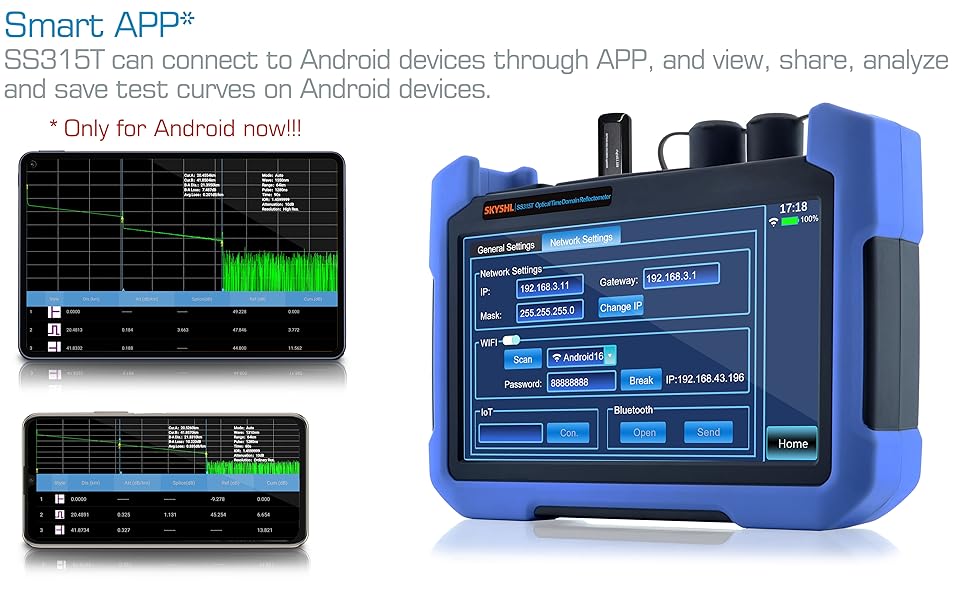
Image: Illustration of Smart APP and Windows Software connectivity for OTDR data analysis.
Maintenance
Cleaning Optical Connectors
Regular cleaning of optical connectors is crucial for accurate measurements and to prevent damage to the device. Use the provided 2.5mm and 1.25mm cleaning rods to clean the fiber optic ports and connectors before each use. Always ensure the fiber ends are clean and free of dust or debris.
Battery Care
The device is powered by a 12.6V/3250mAh lithium battery, providing 8-10 hours of continuous operation. To prolong battery life, avoid fully discharging the battery frequently and store the device in a cool, dry place when not in use. Use only the provided charger.
General Care
Keep the device away from extreme temperatures, moisture, and direct sunlight. Store it in the Oxford backpack when transporting to protect it from physical damage.
Troubleshooting
Generating PDF Reports
If you are having trouble generating PDF reports, ensure you are following the steps outlined in the 'Operating Instructions' section: navigate to 'File' -> 'Print', input a file name, and then tap 'PDF'. Ensure there is sufficient memory on the device or connected U-disk.
Inaccurate Readings
If readings appear inaccurate, first check all fiber connections for cleanliness and proper seating. Ensure the correct adapters are being used for the fiber type. Verify that the OTDR test parameters (wavelength, pulse width, range) are appropriate for the fiber link being tested. Dirty connectors are a common cause of measurement errors.
Specifications
| Feature | Specification |
|---|---|
| Brand Name | SKYSHL |
| Model Number | SS315T-2A1 |
| Fiber Type | Single Mode |
| Wavelength | 1310nm + 1550nm |
| Dynamic Range | 32dB + 30dB |
| Max Test Distance | 120km / 75mi |
| EDZ/ADZ | 1.2m / 4.5m |
| Data Storage | 80000 groups of curve |
| Display | 7 inch capacitive touching screen |
| Battery | 12.6V/3250mAh lithium battery (8-10 hours continuous) |
| Dimension | 190*145*50mm / 7.5*5.7*1.97inch |
| Weight | 0.85kg (Include Battery) |
| Optical Power Meter | 850nm~1650nm; -60~+3dB |
| Light Source | 1310nm+1550nm (≥-5dBm/CW, 270Hz, 1kHz and 2kHz) |
| VFL | 2km (650nm±20nm/CW, 1Hz and 2Hz) |
| APP Module Compatibility | Android and IOS (currently Android only) |
| Connector Type | FC/UPC, SC/UPC, ST/UPC, LC/UPC & FC/APC, SC/APC, ST/APC, LC/APC |
| Origin | Mainland China |
User Tips
- Leverage the Smart APP: For enhanced data analysis, sharing, and remote control capabilities, connect your OTDR to an Android device using the dedicated APP. This allows for convenient management of test curves and reports.
- Generate PDF Reports: Easily create professional PDF test reports directly from the device. This feature is useful for documentation and sharing results with clients or colleagues.
- Utilize Event Map: The 'Graphics Analysis/Event Map' feature simplifies fault identification by presenting fiber optic elements in an easy-to-understand icon-based view, making complex analysis accessible to all skill levels.
- Regular Cleaning: Always clean fiber connectors and ports before each use to ensure accurate measurements and prevent damage.
Warranty and Support
For any technical assistance, warranty claims, or support inquiries, please contact your seller or the manufacturer directly. Refer to your purchase documentation for specific warranty terms and contact information.
