
Introduction
The WONDOM AA-AB32231 is a versatile Class D digital audio amplifier board designed around the Texas Instruments TPA3110 chip. It offers flexible output configurations, supporting either 2 x 8W in stereo mode or 1 x 16W in mono mode. This module is characterized by its high efficiency (up to 90%), low total harmonic distortion plus noise (THD+N), and compact size, making it suitable for a wide range of audio applications including DIY projects, home audio systems, and industrial uses such as vending machines, kiosks, and gaming machines. A DC 8V – 19V power supply is required for operation.

Figure: Top-down view of the WONDOM AA-AB32231 amplifier board.
Key Features
- Output Power: 2 x 8W @ 8 Ohm (THD+N=10%) or 1 x 16W @ 4 Ohm (THD+N=10%)
- Power Supply Range: DC 8V to 19V
- PBTL (Parallel Bridge-Tied Load) and BTL (Bridge-Tied Load) Configurable
- Power Indicator LED
- Efficient heat dissipation through PCB copper
- Integrated protection features: Overcurrent Protection, Overtemperature Protection
- 4-screw easy installation
- Supports both single-ended and differential input
- Compact size: 3 x 2 x 0.65 inches
- Weight: 90g / 0.20 lbs (±10%)
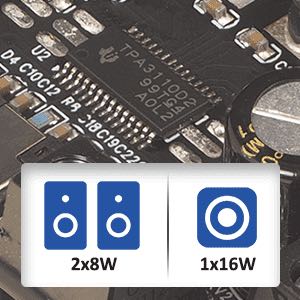
Figure: The amplifier board supports both 2x8W stereo and 1x16W mono configurations.
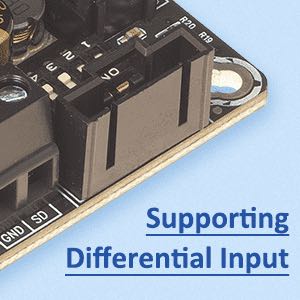
Figure: Close-up view of the input section, highlighting support for differential input.
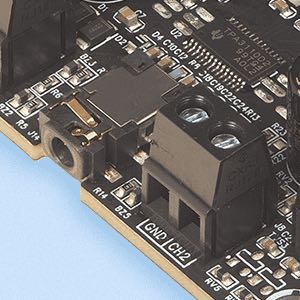
Figure: Pre-mounted industrial terminal interfaces for quick and solder-free connection.
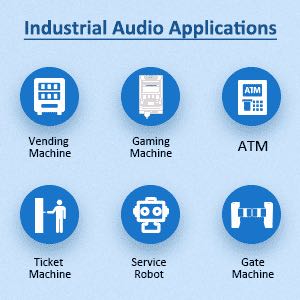
Figure: Examples of industrial audio applications for the amplifier board, including vending machines, gaming machines, ATMs, ticket machines, service robots, and gate machines.
Specifications
Electrical Characteristics in Stereo Mode (RL=8ohm)
Specifications typical @ +25°C, powered by 12V DC, unless otherwise noted. Specifications subject to change without notice.

Table: Electrical characteristics for the amplifier board operating in stereo mode with an 8 Ohm load.
Audio Characteristics in Stereo Mode (RL=8ohm)
Specifications typical @ +25°C, powered by 12V DC, unless otherwise noted. Specifications subject to change without notice.

Table: Audio performance characteristics for the amplifier board in stereo mode with an 8 Ohm load.
Electrical Characteristics in Mono Mode (RL=4ohm)
Specifications typical @ +25°C, powered by 12V DC, unless otherwise noted. Specifications subject to change without notice.

Table: Electrical characteristics for the amplifier board operating in mono mode with a 4 Ohm load.
Audio Characteristics in Mono Mode (RL=4ohm)
Specifications typical @ +25°C, powered by 12V DC, unless otherwise noted. Specifications subject to change without notice.

Table: Audio performance characteristics for the amplifier board in mono mode with a 4 Ohm load.
Mechanical Dimensions
| Dimension | inch/mm |
|---|---|
| A | 3.0 / 76.2 |
| A1 | 2.7 / 68.6 |
| B | 2.0 / 50.8 |
| B1 | 1.7 / 43.2 |
| D | 0.12 / 3.1 |
Note: All dimensions are typical. Tolerance x.xx = ±0.02 (±0.50).
Performance Graphs
The following graphs illustrate the typical performance characteristics of the amplifier board.

Figure: Total Harmonic Distortion + Noise (Mono Mode) vs Frequency.

Figure: Frequency Response (Mono Mode) vs Frequency.

Figure: Total Harmonic Distortion + Noise (Stereo Mode) vs Frequency.

Figure: Frequency Response (Stereo Mode) vs Frequency.
Setup and Connection
This section details the physical connections and configuration of the amplifier board.
General Connection Notes
- Always choose only one method to power the amplifier board at a time.
- Feed only one group (dual channel) of audio signal to the amplifier board at a time.
- Never connect more than one group of speakers to the audio output.
- Never connect CH1_OUT- and CH2_OUT- together as they belong to different NETs.
Mode Configuration (Stereo / Mono)
The amplifier board supports switching between stereo and mono modes using the onboard switches SW1 and SW2. The default setting is stereo mode.
| Mode \ SW Position | SW1 | SW2 |
|---|---|---|
| Stereo | B | OFF (3,4) |
| Mono | A | ON (1,2) |
Table: Switch settings for Stereo and Mono modes.
Input Method Configuration (Single-ended / Differential)
The board also supports both single-ended and differential input methods. The default setting is single-ended input.
| Input Method \ SW Position | SW2 |
|---|---|
| Single-ended | ON (1,2) |
| Differential | OFF (3,4) |
Table: Switch settings for Single-ended and Differential input.
Wiring Diagrams
Refer to the following diagrams for detailed connection instructions.

Figure: Detailed wiring diagram for connecting the amplifier board in Stereo Mode. This includes power supply (J3, J1), audio input (J14, J4, J8), speaker output (J5, J7), and mute setting (J2).

Figure: Detailed wiring diagram for connecting the amplifier board in Mono Mode. This includes power supply (J3, J1), audio input (J8 for single-ended, J6 for differential), speaker output (J5, J7), and mute setting (J2). Note the shorting of OUT2+ and OUT2- for positive mono output, and OUT1- and OUT1+ for negative mono output.
Operating Instructions
Once the board is correctly wired and configured:
- Connect a DC power supply within the 8V to 19V range to the power input (J3 or J1).
- The "POWER" LED indicator will illuminate green when the board is powered up correctly.
- Connect your audio source to the selected audio input (J14, J4, J8, or J6).
- Connect your speakers to the speaker output terminals (J5, J7).
- Adjust the volume from your audio source.
LED Indicators
- POWER LED: Illuminates green when the board is powered up.
- FAULT LED: Illuminates red if there is an issue with the amplifier board (e.g., overcurrent, overtemperature).
Maintenance
- Keep the amplifier board clean and free from dust.
- Ensure adequate ventilation around the board to prevent overheating.
- Avoid exposing the board to moisture, high humidity, or extreme temperatures.
- Regularly inspect connections for any signs of wear or damage.
Troubleshooting
- No Power / No Sound:
- Check power supply connections and ensure the voltage is within the 8V-19V range.
- Verify that the power supply is functional.
- Ensure the POWER LED is green.
- FAULT LED is Red:
- Immediately disconnect power.
- Check for short circuits at the speaker outputs.
- Ensure speaker impedance matches the amplifier's rated impedance (typically 4Ω-8Ω).
- Allow the board to cool down if it has been operating at high volume for extended periods (overtemperature protection).
- Distorted Sound:
- Check audio input signal level; avoid overdriving the input.
- Ensure speaker connections are secure and correct.
- Verify that the correct mode (Stereo/Mono) and input method (Single-ended/Differential) are selected via SW1/SW2.
- No Output from One Channel (Stereo Mode):
- Check the speaker wiring for that channel.
- Verify the audio input signal for that channel.
User Tips
- For optimal performance and to prevent damage, always ensure proper heat dissipation. While the board uses PCB copper for heat dissipation, consider ambient temperature and enclosure ventilation, especially when operating at higher power levels.
- When switching between stereo and mono modes or input types, always power off the board first to prevent potential damage or unexpected behavior.
- Utilize the differential input feature in environments prone to electrical noise to minimize interference and achieve cleaner audio.
Safety and Warnings
Important Safety Information:
Read all instructions before use. Failure to follow these instructions may result in damage to the product or personal injury.
- Keep the device and its cord out of reach of children under 3 years old.
- Keep away from children unless supervised by an adult.
- Do not use this product for purposes other than its intended use.
- Inspect the product before each use; do not use if damaged.
- Follow installation and operation guidelines to avoid injury.
- Do not expose to water or moisture.
Electrical Safety
- Use only the specified power supply (DC 8V-19V). Do not exceed rated input.
- Never reverse polarity of power input; this will cause permanent damage.
- Do not operate the amplifier with exposed wiring or damaged cables.
- Disconnect power before connecting/disconnecting speakers, signal cables, or modules.
Speaker & Output Safety
- Match speaker impedance to the amplifier's rated impedance (typically 4Ω-8Ω).
- Do not short-circuit speaker output terminals.
- Do not drive the amplifier at maximum volume for extended periods; risk of overheating.
Thermal & Environmental
- The amplifier board requires adequate heat dissipation. Do not block ventilation.
- Operate only in dry, dust-free environments. Avoid moisture, high humidity, and extreme temperatures.
- In case of abnormal heat, smoke, or odor, immediately disconnect power and stop use.
Installation & Modification
- Do not modify the PCB, components, or firmware unless authorized. Unauthorized changes void compliance and warranty.
- Use only shielded cables for power and signal inputs to maintain EMC compliance.
Compliance Information
EU CE Declaration of Conformity
This product is in conformity with the essential requirements and other relevant provisions of the following EU Directives:
- Electromagnetic Compatibility (EMC) Directive 2014/30/EU
- Low Voltage Directive (LVD) 2014/35/EU
- RoHS Directive 2011/65/EU (Restriction of Hazardous Substances)
The following harmonized standards were applied:
- EN 60065 (Safety for Audio, Video and Similar Electronic Apparatus)
- EN 55013 (Limits and Methods of Measurement of Radio Disturbance Characteristics)
- EN 55020 (Immunity Characteristics for Audio, Video and Similar Electronic Apparatus)
- EN 61000-3-2 / 61000-3-3 (Harmonic Current Emissions / Voltage Fluctuations)
Authorized Representative in EU:
Company Name: MJCM SARL
Full Address: 78 avenue des Champs-Élysées Bureau 326
Telephone: 33-0767213611
Email: mjcm190928@gmail.com
FCC Compliance Statement
This device complies with Part 15 of the FCC Rules. Operation is subject to the following two conditions:
- This device may not cause harmful interference.
- This device must accept any interference received, including interference that may cause undesired operation.
This equipment has been tested and found to comply with the limits for a Class B digital device, pursuant to Part 15 of the FCC Rules. These limits are designed to provide reasonable protection against harmful interference in a residential installation. This equipment generates, uses, and can radiate radio frequency energy and, if not installed and used in accordance with the instructions, may cause harmful interference to radio communications. However, there is no guarantee that interference will not occur in a particular installation.
Warranty and Support
Warranty Disclaimer
This product is warranted against defects in materials and workmanship under normal use. The warranty does not cover damage caused by:
- Incorrect power supply or reverse polarity
- Short circuits, overload, or improper speaker matching
- Unauthorized modification, disassembly, or repair
- Environmental damage (water, dust, extreme heat)
Disposal (WEEE Directive)
This product is marked with the crossed-out wheeled bin symbol, indicating it should not be disposed of with unsorted municipal waste. It must be collected separately for treatment and recycling. Contact your local waste management authority for disposal instructions.
Contact Information
Manufacturer: Sure Electronics Co., Ltd.
Address: 3F, Building F6, No. 9 Weidi Road, Xianlin, Qixia District, Nanjing, Jiangsu Province, P.R.C
Telephone: 86-13601408832
Email: info@sure-electronics.com (General inquiries), store@sure-electronics.com (Retail inquiries), mjcm190928@gmail.com (EU Representative)
Website: www.sure-electronics.com, www.wondom.com
User Manual (PDF): A detailed user manual in PDF format is available for download. Please refer to the official product page or contact support for the link: Download PDF Manual


